
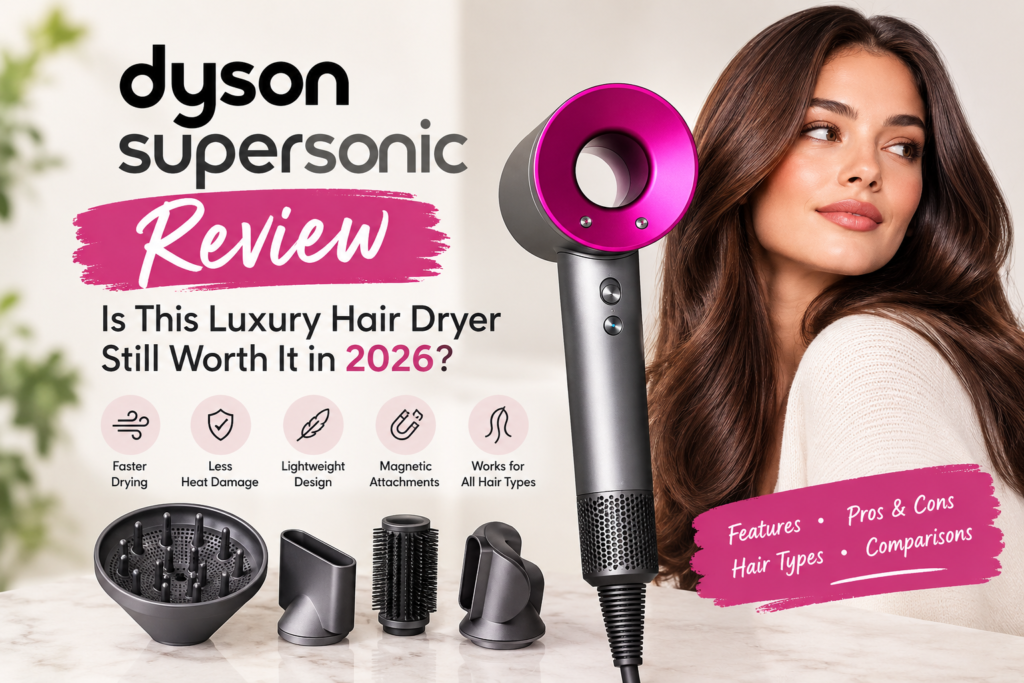
Spending several hundred dollars on a hair dryer sounds unreasonable until you’ve actually held a Dyson Supersonic. That’s usually the moment people either roll their eyes at the price tag or start rearranging their bathroom budget. Either reaction is fair.
Affiliate disclosure: This post contains affiliate links. If you buy through one of them, Natural Skin Studio may earn a small commission at no extra cost to you. This doesn’t affect which products we recommend or how we describe them.
This Dyson Supersonic review is built around one question: does the original Supersonic still make sense in 2026, now that Dyson sells two newer machines — the Supersonic Nural and the Supersonic r? The short answer is that it depends heavily on your hair type, your patience for extra features, and how much you’re willing to pay for marginal gains. The long answer takes a bit more unpacking, so let’s get into it.
Dyson Supersonic Review: Quick Verdict
The original Dyson Supersonic is still a genuinely good hair dryer. It’s fast, well-balanced, comfortable to hold for long styling sessions, and it comes with attachments that actually solve real problems, particularly the flyaway attachment.

- Fast drying. The small, powerful Dyson digital motor V9 combined with Air Multiplier technology produces a high-pressure…
- Intelligent heat control. The Dyson Supersonic hair dryer measures air temperature over 40 times a second and regulates …
- Magnetic attachments adjust quickly and easily. Heat Shield technology keeps the surfaces of attachments cool, even duri…
It is not, however, the newest or most feature-rich machine Dyson makes anymore. The Supersonic Nural adds scalp-sensing technology and attachment memory. The Supersonic r is lighter, more maneuverable, and aimed at people who style hair for a living. The original Supersonic is increasingly the “value” option in Dyson’s own lineup — which is a strange sentence to write about a dryer that still costs more than most people’s entire hair-care routine.
If you want Dyson’s core drying performance and iconic design without paying for sensors and smart attachments, the original Supersonic still earns its place. If you have damaged hair, a sensitive scalp, or you simply want the newest tech Dyson offers, you’ll want to look at the Nural or the r before you buy.
Dyson Supersonic vs Supersonic Nural vs Supersonic r: At a Glance
| Dyson Supersonic (original) | Dyson Supersonic Nural | Dyson Supersonic r | |
|---|---|---|---|
| Positioning | Dyson’s original luxury hair dryer, now the entry point into the range | Dyson’s “intelligent” flagship, built on the original | Dyson’s lightest, most precision-focused model, originally built for stylists |
| Key technology | Digital V9 motor, magnetic attachments, heat-regulating microprocessor | Adds Nural sensors, a time-of-flight scalp sensor, and attachment learning | Hyperdymium motor with RFID-enabled attachments and a redesigned, slimmer body |
| Attachments | Styling concentrator, diffuser, flyaway attachment, gentle air attachment, wide-tooth comb (bundle varies by set) | Five re-engineered magnetic attachments including a Wave+Curl diffuser, with “memory” for each one | RFID-chipped attachments that auto-adjust airflow and heat per attachment |
| Hair types | Works across most hair types; diffuser suits curls, concentrator suits straight/fine styling | Marketed for “all hair types” with an emphasis on scalp comfort and damaged or color-treated hair | Marketed heavily toward curl definition, frizz control, and precision styling |
| Main advantage | Proven design, strong drying speed, typically the lowest price of the three | Scalp Protect mode and attachment memory reduce guesswork for heat-sensitive hair | Noticeably lighter and easier to maneuver during long styling sessions |
| Main drawback | Lacks the sensor-based features of newer models; getting harder to find new | Premium pricing, added complexity, and a learning curve for some of the smart modes | Unusual shape takes adjustment; positioned more toward stylists and styling-heavy routines |
| Who it suits | Buyers who want the classic Dyson experience without paying for extra sensors | Buyers with damaged, color-treated, or heat-sensitive hair who want hands-off heat management | Buyers who style frequently and want the lightest, most controllable Dyson dryer |
Pricing for all three varies by retailer, color, region, and whatever bundle or promotion is running that month, so treat any number you see online as a snapshot rather than a fixed price.
What Is the Dyson Supersonic?
The Dyson Supersonic launched in 2016 as the company’s first product outside of vacuums, fans, and air purifiers. It was a genuine departure in hair-dryer design: instead of a bulky motor sitting in the dryer’s head, Dyson moved the motor into the handle, which changed both the weight distribution and the entire silhouette of the tool.
That decision mattered more than it sounds. Traditional hair dryers put most of their weight up top, which is uncomfortable to hold overhead for long periods. By relocating the motor, Dyson created something lighter to maneuver, even though the underlying tech was more complex, not less.
- Fast drying. The small, powerful Dyson digital motor V9 combined with Air Multiplier technology produces a high-pressure…
- Intelligent heat control. The Dyson Supersonic hair dryer measures air temperature over 40 times a second and regulates …
- Magnetic attachments adjust quickly and easily. Heat Shield technology keeps the surfaces of attachments cool, even duri…
The Supersonic quickly became the reference point for what a “luxury hair dryer” could be, and it’s part of why competitors from GHD, Shark, and others eventually built their own high-end dryers. Nearly a decade later, it’s still recognizable, even as Dyson has moved on to newer models.
Dyson Supersonic Design and Build Quality
The defining feature of the Supersonic’s design is where Dyson put the motor. Instead of sitting in the head of the dryer, the small Digital V9 motor sits in the handle, which shifts the dryer’s center of gravity and makes it noticeably easier to hold up for extended styling sessions.
The dryer itself is compact and ring-shaped rather than barrel-shaped, and it’s genuinely lightweight for what it does — reviewers have measured it at roughly 1.5 pounds. Controls are straightforward: a power button, a cold-shot button, and two separate dials for airflow speed and heat, all located on the handle rather than crowded onto the head of the dryer.
Build quality has held up well across reviews; the housing feels solid rather than plasticky, and the cord is long enough for most bathroom setups without constant repositioning. The attachments snap on magnetically, which is a small detail that makes a real difference day to day — no twisting, no forcing pieces into place, and the attachment edges stay cool enough to swap mid-style. According to Dyson’s official Supersonic specifications, the magnetic attachment system is designed to make it obvious when an attachment is correctly seated.
Dyson Supersonic Features and Specifications
The Supersonic’s core specs haven’t changed since launch, and it’s worth being precise here, since it’s easy to confuse the original’s specs with the newer Nural or Supersonic r.
- Motor: Dyson’s Digital V9 motor, which the company says spins at up to 110,000 rpm
- Airflow settings: Three speed settings, covering fast drying, regular drying, and diffusing
- Heat settings: Three heat levels plus a constant cold shot
- Heat regulation: A glass-bead thermometer that Dyson says measures airflow temperature multiple times per second, keeping heat below roughly 302°F (150°C)
- Ions: Negative ions intended to reduce static and frizz
- Attachments: Magnetic attachments that can include a styling concentrator, diffuser, flyaway attachment, gentle air attachment, and wide-tooth comb, depending on the specific set or region
It’s worth stressing that none of this includes the scalp-sensing technology or attachment-memory features found on the Supersonic Nural, or the RFID-based attachment communication on the Supersonic r. Those are meaningfully different systems, not just marketing refreshes of the same tech.
Dyson Supersonic Drying Performance
This is where it’s important to separate what Dyson says from what independent testers have actually measured.
Dyson’s own marketing emphasizes fast, controlled airflow and consistent temperature. That’s a manufacturer claim, and while it lines up with the engineering behind the dryer, it isn’t independently verified drying-time data on its own.
Independent testing tells a more specific story. In TechRadar’s Dyson Supersonic review, reviewers timed the dryer at just over four minutes to take below-shoulder-length fine hair from damp to fully dry on the lowest heat and highest speed setting, and just under three and a half minutes on the highest heat setting — among the fastest dryers TechRadar had tested at the time. That same review noted the flyaway attachment slowed things down when used for the entire dry, and that sectioning hair got the best balance of speed and a smooth finish.
Good Housekeeping’s independent Supersonic testing has similarly evaluated the dryer’s airflow, weight, and drying consistency using its in-house testing process rather than relying on Dyson’s own figures, which is exactly the kind of third-party check worth looking for before spending this much on a dryer.
The honest takeaway: drying speed is a genuine strength of the Supersonic, backed by more than one outlet’s testing, but “fastest dryer we’ve tested” is a comparative statement from specific reviewers and specific hair types — not a universal guarantee for every head of hair.
How Does the Dyson Supersonic Perform on Different Hair Types?
No hair dryer is universally “best” for every hair type, and the Supersonic is no exception. Here’s a more realistic breakdown.
Fine Hair
Fine hair generally does well with the Supersonic’s lower heat settings and higher airflow speeds, since fine strands are more prone to heat damage but don’t need much heat to dry quickly. The styling concentrator helps direct airflow precisely without blasting the whole head at once.
Thick Hair
Thick hair benefits from the Supersonic’s higher airflow pressure, which cuts down overall drying time compared with lower-powered dryers. That said, very thick or long hair will still take real time to dry fully, regardless of the dryer — no amount of airflow eliminates the physics of drying a large volume of hair.
Curly Hair
The diffuser attachment is the key tool here. It spreads airflow more gently and evenly to reduce frizz and help preserve curl pattern, rather than blasting curls straight and flat. Reviewers at Vogue’s Dyson Supersonic review have discussed how the diffuser and attachment lineup perform across different curl types, which is worth reading if curl definition is your priority.
Wavy Hair
Wavy hair tends to sit in a middle ground — the diffuser helps preserve texture, while the concentrator is more useful if you’re smoothing waves into a straighter style. Which attachment makes more sense really depends on the finished look you want, not the dryer itself.
Coily/Textured Hair
The wide-tooth comb attachment, where included in your specific set, can help detangle and stretch coily hair while drying, though many people with coily or textured hair still prefer air-drying or lower-heat routines to limit stress on the hair shaft. A hair dryer is one tool in that process, not a replacement for a broader routine.
Damaged or Color-Treated Hair
Heat-regulation matters most here. The Supersonic’s temperature control may help reduce excessive heat exposure when used correctly, particularly on lower heat settings, but it does not undo existing damage or guarantee that color won’t fade with repeated heat styling. If heat sensitivity is a major concern, it’s worth reading how the Supersonic Nural’s Scalp Protect mode compares, later in this article.
Straight Hair
Straight hair is arguably the easiest case for any dryer, and the Supersonic performs well here — fast drying, smooth results with the flyaway attachment, and less need for diffusing or heavy styling attachments.
Dyson Supersonic Attachments Explained
Attachment bundles vary by model, region, retailer, and specific package, so don’t assume every Supersonic box contains every attachment listed below. Here’s what each one is actually for.
- Styling concentrator: Narrows and directs airflow for precision styling, smoothing, or blow-drying with a round brush.
- Diffuser: Spreads airflow more gently across a wider area, which helps preserve curl or wave pattern instead of blowing it straight.
- Flyaway/smoothing attachment: Uses angled airflow to smooth strands and control flyaways for a sleeker finish; this is one of the Supersonic’s most distinctive tools.
- Gentle air attachment: Reduces airflow intensity for more sensitive scalps or lower-impact drying.
- Wide-tooth comb attachment (where included/compatible): Helps detangle and stretch hair, most useful on thicker or coilier textures — but check compatibility, since not every Supersonic set includes this piece.
If you’re building out a broader styling routine around your dryer, our guide to hair straightening tools and products covers some complementary options worth considering alongside a Supersonic.
Is the Dyson Supersonic Really Better for Hair?
This is the claim worth scrutinizing most carefully. Dyson’s heat-regulation system is real engineering, not vaporware — the microprocessor and thermometer setup is designed to keep airflow temperature from climbing into the range where heat damage becomes irreversible.
But “regulated heat” is not the same as “no heat damage.” Hair can still be stressed by prolonged heat exposure, mechanical friction from brushing while drying, or simply from styling too frequently, regardless of which dryer is doing the work. The most accurate way to describe the benefit is that consistent, well-regulated heat may help reduce excessive heat exposure when the dryer is used correctly — on appropriate settings, at a reasonable distance from the scalp, and not held in one spot for too long.
- Fast drying. The small, powerful Dyson digital motor V9 combined with Air Multiplier technology produces a high-pressure…
- Intelligent heat control. The Dyson Supersonic hair dryer measures air temperature over 40 times a second and regulates …
- Magnetic attachments adjust quickly and easily. Heat Shield technology keeps the surfaces of attachments cool, even duri…
If minimizing heat exposure is your top priority, it’s worth knowing that the Supersonic Nural takes this further with a dedicated Scalp Protect mode, covered in the comparison section below.
Is the Dyson Supersonic Quiet?
“Quiet” is relative here — the Supersonic is quieter than a lot of older, cheaper hair dryers, but it is not silent, and it’s not whisper-quiet either. TechRadar’s Dyson Supersonic review measured it at around 74 decibels on a sound meter, which the reviewers noted was about 8 decibels quieter than one of the noisiest dryers they’d tested — but still loud enough that using it early in the morning next to a sleeping partner wasn’t exactly welcome.
Dyson’s own marketing describes the pitch of the Supersonic’s sound as engineered to be less irritating, which is a different claim from raw decibel level. Both things can be true: it may sound less harsh while still registering as loud on a meter.
Dyson Supersonic vs Supersonic Nural vs Supersonic r
This is the section that actually answers most people’s 2026 buying question, so let’s slow down here.
What changed with the Nural: The Supersonic Nural, which Dyson introduced in 2024, keeps the same core drying approach as the original but adds a network of sensors. The standout feature is Scalp Protect mode, which uses a time-of-flight sensor to measure distance between the dryer and your head, automatically reducing heat as it gets closer to your scalp. The Nural also “remembers” your preferred heat and airflow setting for each individual attachment, and it automatically drops into a lower-power state when you set the dryer down. These are genuinely new capabilities, not just a heat-settings tweak.
What changed with the Supersonic r: The Supersonic r takes a different approach entirely. Instead of adding scalp sensors, Dyson focused on size, weight, and precision, building a new Hyperdymium motor and a noticeably smaller, lighter body — Dyson says it’s around 30% smaller and 20% lighter than the original Supersonic. Its attachments use RFID chips that communicate with the dryer to automatically set airflow and heat per attachment. It was initially sold to professional stylists before becoming available to general consumers.
What the original Supersonic still does well: Reliable, fast drying, comfortable balance, and Dyson’s original set of well-designed attachments — all without paying for scalp sensors or RFID attachment communication you may not need. If your hair isn’t particularly heat-sensitive and you don’t need attachment memory, the original still gets the job done.
Does this make the original obsolete? Not really, but it does reposition it. The original Supersonic is no longer Dyson’s most advanced hair dryer, and it’s becoming harder to find as new stock, according to some retailer listings and reviewer updates. It’s now closer to the “classic, proven option” in Dyson’s lineup rather than the cutting edge — which for a lot of buyers is exactly what they want, especially if it comes at a comparatively lower price than the Nural or the r.
If you want the short version: choose the original Supersonic for proven performance at the lowest price point in Dyson’s range, choose the Nural if heat-sensitive or damaged hair is your main concern, and choose the Supersonic r if lightweight handling and precision styling matter most to you.
Pros and Cons
Pros
- Fast, consistent drying performance backed by more than one independent test
- Comfortable, well-balanced design thanks to the handle-mounted motor
- Genuinely useful attachments, especially the flyaway attachment
- Magnetic attachment system that’s quick and comfortable to use
- Heat regulation that may help reduce excessive heat exposure with correct use
Cons
- Premium price point, even compared to other high-end dryers
- Controls and attachment options take a little getting used to at first
- Doesn’t include the scalp-sensing or attachment-memory features of the Nural
- Occasional buyers may not get enough use out of it to justify the cost
- Attachment bundles and even model names can be confusing across retailers and regions
- Increasingly limited availability as Dyson shifts focus to the Nural and Supersonic r
- Fast drying. The small, powerful Dyson digital motor V9 combined with Air Multiplier technology produces a high-pressure…
- Intelligent heat control. The Dyson Supersonic hair dryer measures air temperature over 40 times a second and regulates …
- Magnetic attachments adjust quickly and easily. Heat Shield technology keeps the surfaces of attachments cool, even duri…
Dyson Supersonic vs Cheaper Hair Dryers
Does the premium price buy something real, or is it mostly branding? Based on the specs and testing discussed above, it’s a mix of both.
- Faster drying: Independent testing has shown genuinely fast dry times compared with many cheaper dryers, particularly on high settings.
- Better balance: The handle-mounted motor is a real design advantage most budget dryers don’t replicate.
- Better attachments: The magnetic system and flyaway attachment aren’t gimmicks — they solve real styling problems.
- Better temperature management: The heat-regulation system is more sophisticated than what you’ll find in most budget dryers, though it isn’t a guarantee against all heat-related hair stress.
- Better styling convenience: Quick attachment swaps and consistent airflow make styling sessions feel less fiddly.
- Long-term ownership: Build quality has generally held up well in longer-term use, per Forbes Vetted’s long-term review, which looked specifically at ownership experience and customer support over time rather than just first impressions.
A cheaper dryer may make more sense if you dry your hair infrequently, have straightforward hair that doesn’t need much styling assistance, or simply aren’t in a position to spend hundreds of dollars on an appliance you’ll replace within a few years regardless of brand.
Who Should Buy the Dyson Supersonic?
- Someone who dries and styles their hair most days and wants a dryer built to hold up to frequent use
- Someone who wants Dyson’s core design and drying performance without paying extra for the Nural’s sensors or the r’s RFID attachments
- Someone whose local retailer still has the original Supersonic in stock at a lower price than the newer models
- Someone who values the flyaway attachment specifically, since it remains one of the most distinctive tools in the Dyson hair-care lineup
- Fast drying. The small, powerful Dyson digital motor V9 combined with Air Multiplier technology produces a high-pressure…
- Intelligent heat control. The Dyson Supersonic hair dryer measures air temperature over 40 times a second and regulates …
- Magnetic attachments adjust quickly and easily. Heat Shield technology keeps the surfaces of attachments cool, even duri…
Who Should Skip the Dyson Supersonic?
- Someone with significant heat sensitivity or damaged hair who would benefit more from the Nural’s Scalp Protect mode
- Someone who styles hair professionally or very frequently and would get more value from the Supersonic r’s lighter, more maneuverable body
- Someone who dries their hair only occasionally and would be better served by a mid-range dryer at a fraction of the price
- Someone on a strict budget who values cost savings over incremental performance gains
Dyson Supersonic Buying Tips for 2026
- Check the exact model name. “Supersonic,” “Supersonic Nural,” and “Supersonic r” are genuinely different machines with different technology — don’t assume they’re interchangeable based on similar names or box art.
- Check included attachments before buying. Bundles vary significantly by retailer and region, so confirm the specific attachments in your set rather than assuming based on a review you read online.
- Check voltage compatibility, especially if you’re buying for travel or bringing a dryer purchased in one country to another — voltage requirements differ across Dyson’s models and configurations.
- Compare pricing across multiple retailers, since Dyson’s own site, department stores, and third-party retailers can all list different prices for the same configuration.
- Check the warranty terms for your specific region before purchasing, since coverage details and lengths can vary.
- Consider certified refurbished units where available through reputable retailers, which can meaningfully lower the price for the same performance.
- Watch for legitimate seasonal sales rather than assuming a “deal” badge means genuine savings — cross-check the price history if the retailer allows it.
If you’re building out a broader hair-health routine rather than just buying a dryer, it may also be worth browsing hair growth oils as a complementary step, particularly if heat styling is a regular part of your routine.
Final Verdict
So, is the Dyson Supersonic still worth it in 2026? It depends on a few honest factors.
If your priority is hair type and heat sensitivity, the original Supersonic performs well across most hair types, but the Nural’s Scalp Protect mode is a meaningful upgrade if damaged or color-treated hair is a real concern for you.
If your priority is how often you dry and style your hair, frequent stylers get more long-term value from any of the three Dyson models than occasional users will, simply because the cost per use drops the more you actually use it.
If your priority is styling needs, curl-focused stylers may lean toward the diffuser-equipped original or Nural, while precision-focused, frequent stylers may prefer the Supersonic r’s lighter body.
If your priority is budget, the original Supersonic is generally the least expensive of the three Dyson models, which matters if you want the brand’s drying performance without paying for sensors or RFID attachments you may not use.
And if your priority is wanting the newest tech Dyson offers, the honest answer is that the original Supersonic isn’t it anymore — that’s the Nural and the Supersonic r’s job now.
There’s no single right answer here, and that’s really the point of this Dyson Supersonic review: the original Supersonic remains a well-built, fast, comfortable hair dryer with real advantages over cheaper alternatives, but “worth it” now depends on comparing it honestly against its own newer siblings, not just against budget dryers from other brands.
FAQ
Is the Dyson Supersonic worth it in 2026?
For most people who dry and style their hair regularly, yes — it remains fast, well-balanced, and reasonably priced compared to Dyson’s newer models. If you need scalp-sensing heat control or the lightest possible body, the Nural or Supersonic r may be a better fit.
Is the Dyson Supersonic good for thick hair?
Yes. Its airflow pressure helps cut down drying time on thick hair, though very long or dense hair will still take real time to dry with any dryer.
Is Dyson Supersonic good for curly hair?
It can be, especially when used with the diffuser attachment, which spreads airflow more evenly to help preserve curl pattern rather than blowing curls straight.
Does Dyson Supersonic damage hair?
No hair dryer is damage-proof. The Supersonic’s heat-regulation system may help reduce excessive heat exposure when used correctly, but it doesn’t eliminate the risk of heat-related hair stress from frequent or prolonged use.
How long does Dyson Supersonic take to dry hair?
Independent testing has shown dry times of roughly three and a half to four and a half minutes for fine, below-shoulder-length hair, depending on the heat and speed settings used. Your own results will vary based on hair length, thickness, and texture.
Is Dyson Supersonic quieter than regular hair dryers?
It’s generally quieter than many budget dryers, with independent measurements around 74 decibels, but it’s not silent and can still feel loud in a quiet room.
What is the difference between Dyson Supersonic and Nural?
The Nural adds sensor-based features, including a Scalp Protect mode that reduces heat as the dryer nears your head, plus attachment memory and an auto low-power mode when the dryer is set down. The original Supersonic doesn’t have these sensors.
What is the difference between Dyson Supersonic and Supersonic r?
The Supersonic r uses a different motor and a smaller, lighter body, with RFID-enabled attachments that auto-adjust settings. It was originally developed for professional stylists before becoming available to general consumers.
Can I use Dyson Supersonic every day?
Most people can use it daily, though frequent heat styling of any kind carries some risk to hair health over time. Using lower heat settings and giving hair occasional breaks from heat styling is generally a reasonable approach.
Are Dyson Supersonic attachments interchangeable?
Attachments from the original Supersonic and the Nural are generally compatible with each other’s barrels, but the Nural’s attachments include magnetic IDs that enable attachment-memory features only when paired with a Nural unit. Supersonic r attachments use a different RFID-based system and aren’t interchangeable with the other two models.