
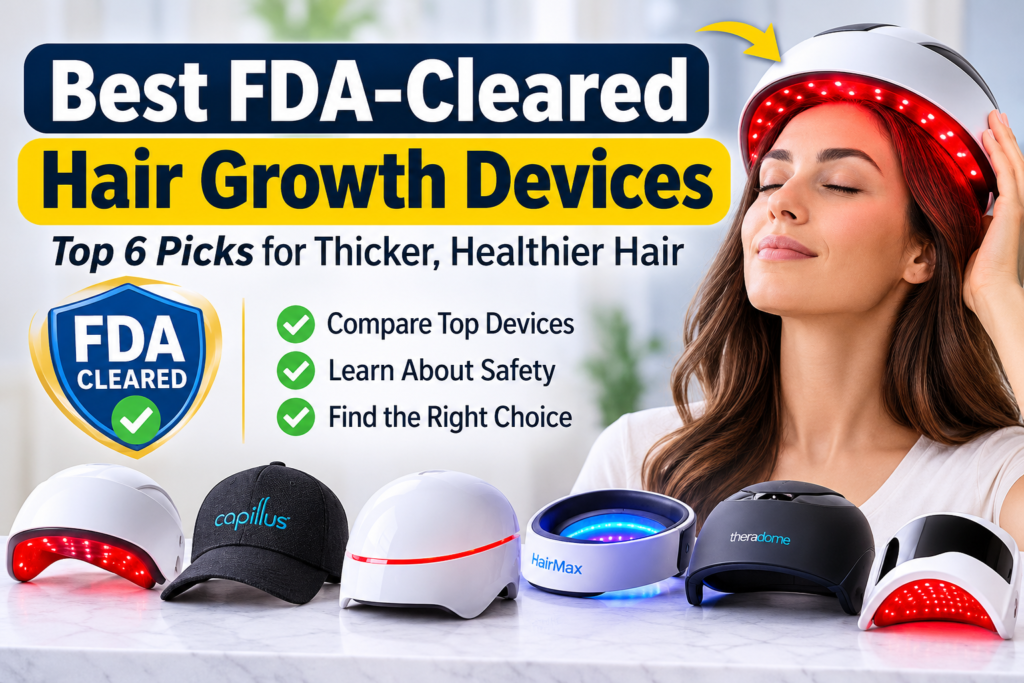
Thinning hair is hard to ignore. A wider part, a receding hairline or more hair in the shower drain sends a lot of people looking for something they can do at home. Laser caps, helmets and bands are the most visible option, and the best FDA-cleared hair growth devices promise a drug-free routine you can run while you watch TV.
Affiliate disclosure: Natural Skin Studio is a participant in the Amazon Services LLC Associates Program. If you buy through links on this page, we may earn a commission at no extra cost to you. This never changes how we research or rank products. This article is educational and is not medical advice.
The category is also full of confusing claims. Plenty of red-light hats say “FDA-approved” without any clearance behind them, and even real clearances can be narrower than the marketing suggests. We checked the FDA records for each device below and flag anything we couldn’t verify. Prices and policies were checked on November 22, 2026, and they change often.
What Are FDA-Cleared Hair Growth Devices?
These are at-home devices that shine low-level red light on the scalp. The approach goes by three names that overlap:
- Low-level laser therapy (LLLT): laser diodes deliver red light at low power.
- Red light therapy: the everyday term for red LEDs or lasers aimed at tissue.
- Photobiomodulation: the scientific term. Light is thought to stimulate the mitochondria in hair follicle cells, which may help keep follicles in their growth phase.
The mechanism is plausible but not proven in people the way a drug’s effect is. The devices sit in two groups:
- Laser-only: caps and bands that use dozens or hundreds of laser diodes.
- Hybrid or LED-only: helmets that mix lasers with LEDs, or use LEDs alone.
If you’re comparing options beyond this list, our guides to the best red light therapy devices for hair growth and the best laser hair growth devices cover more models.
FDA-Cleared vs FDA-Approved: What’s the Difference?
The two words are not interchangeable. FDA-cleared is the right term for these devices.
- 510(k) clearance. The manufacturer shows the FDA that a device is “substantially equivalent” to a legally marketed predicate device. It is not a finding that the device works better than anything else. The FDA’s 510(k) premarket notification overview explains the pathway.
- FDA approval. This usually means premarket approval (PMA), a stricter process for higher-risk devices. Hair-growth lasers don’t go through it.
- “FDA registered.” This only means a company registered its facility. The FDA says it does not issue registration certificates and that registration does not mean a device was approved or cleared.
Clearance has real limits:
- It applies to a specific model and a specific indication. Most hair-growth clearances cover men with Norwood-Hamilton stages IIa–V and women with Ludwig-Savin stages I–II (some include frontal patterns), and only Fitzpatrick skin phototypes I–IV.
- It does not guarantee regrowth, and it does not show one device beats another. Several of the 510(k) summaries we read rely on bench testing against predicate devices rather than new clinical trials.
- A similarly named model may not be covered. Always match the exact model name to a K-number in the FDA’s database.
Best FDA-Cleared Hair Growth Devices at a Glance
| Device | Type | Light technology | Wavelength | FDA clearance verification | Treatment time | Price* | Best for |
|---|---|---|---|---|---|---|---|
| iRestore Elite | Helmet | 300 laser diodes + 200 LED-type diodes | 625, 655, 680 nm | Verified: K222081 (ID-510 iRestore Elite) | 12 min daily | $1,799 | Broad coverage, short daily session |
| Capillus PRO | Cap | 272 laser diodes | 650 nm | Verified: K163170 lists Capillus 272 Pro | 6 min daily (per maker) | $1,499 | Shortest daily routine |
| Kiierr 272 Premier | Cap | 272 laser diodes | 650 ± 5 nm | Verified: K181878 | 30 min every other day | $1,199 sale (list $1,799) | Laser cap at sale pricing |
| HairMax LaserBand 82 | Band | 82 laser diodes | 655 nm | Partly verified: K142573 (HairMax LaserComb 82/41) | 90 sec, 3x/week | $849 | Fastest sessions, portability |
| Theradome PRO LH80 | Helmet | 80 laser diodes | ~680 nm | Partly verified: K122950 (LH80 PRO) | 20 min, 2x/week | $895–$995 | Fewest weekly sessions |
| CurrentBody LED Hair Growth Helmet | Helmet | 120 red LEDs | 660 nm (FDA summary) | Verified: K230336 (model MZ-07) | 10 min daily | £649.99 UK; US price varies | LED-only, built-in headphones |
Prices are list or sale prices seen on November 22, 2026, and promotions change often.
Best FDA-Cleared Hair Growth Devices – Detailed Reviews
We did not hands-on test these devices. Specifications come from FDA records and manufacturer pages, and we label manufacturer claims as such.
iRestore Elite
Overview: The iRestore Elite is a hard-shell helmet that covers the whole scalp. It is the most powerful hybrid helmet on this list.
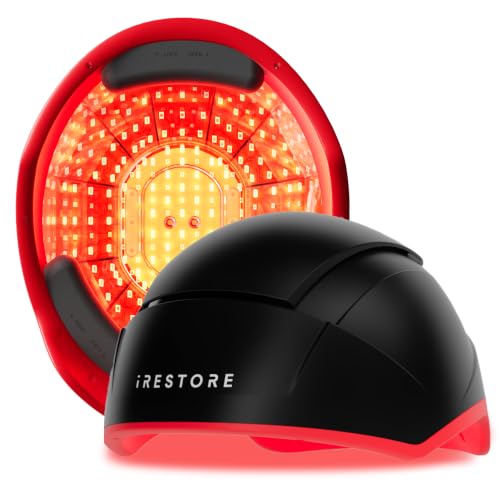
- Unmatched Hair Growth Technology: The iRESTORE Elite Laser Hair Growth Device offers advanced home treatment with 500 la…
- Proven Results: Experience the safest and most effective low-level red light therapy for hair growth with the iRESTORE E…
- Maximum Scalp Coverage: The iRESTORE Elite provides the best at home treatment with unmatched scalp coverage, reaching h…
Technology and features: The FDA summary describes 300 five-milliwatt laser diodes and 200 five-milliwatt super luminescent diodes, at 625, 655 and 680 nm. Output is fixed at about 2,500 mW per 12-minute session.
Schedule: 12 minutes, daily.
FDA clearance verification: FDA 510(k) summary K222081 covers the “ID-510 iRestore Elite” (letter dated October 13, 2022). Clearance is based on equivalence to the iRestore ID-500, and the testing listed is non-clinical. The indication is men with Norwood-Hamilton IIa–V and women with Ludwig-Savin I–II, both with Fitzpatrick I–IV. The summary text contains an inconsistent “III” for women, but the signed indications form says I–II.
Warranty and returns: 3-year warranty and a 12-month money-back guarantee (limited to one return per household, per Wareable’s review).
Advantages: Full coverage, a short daily session and a clear FDA record.
Disadvantages: It costs more than most options, it is bulky, and “500 diodes” includes 200 LED-type emitters.
Who should buy it: People who want a hands-free helmet and a quick daily routine.
Who should seek advice first: Anyone with skin phototype V–VI, advanced hair loss or a scalp condition.
Capillus PRO
Overview: This is a laser dome that sits inside a baseball-style cap. Capillus says the PRO was formerly sold as the Capillus272.

Technology and features: 272 laser diodes at 650 nm, up to 5 mW each, with no LEDs. It runs on a rechargeable battery.
Schedule: Capillus says 6 minutes daily. The published trial used a different schedule (see below).
FDA clearance verification: K163170 lists the Capillus 272 Pro. Earlier records are K143199 (women, 2015) and K160285 (adds men). I could not verify which record supports the 6-minute daily protocol.
Warranty and returns: 3-year limited warranty. The 6-month satisfaction guarantee applies only to purchases on Capillus.com, and the buyer pays return shipping plus a 25% service fee. Some customers report the battery is covered for just one year, so confirm in the terms.
Advantages: The shortest session here, a laser-only design and a long clearance history.
Disadvantages: It is expensive, a poor fit is a common complaint (use the sizing guide), and some reviewers report battery and support problems.
Who should buy it: Buyers who value a 6-minute routine.
Who should seek advice first: People taking photosensitizing medications, with scalp cancer, or sensitive to 650 nm light, per Capillus’s own precautions.
Kiierr 272 Premier
Overview: A laser-only cap built around a high diode count and longer, less frequent sessions.
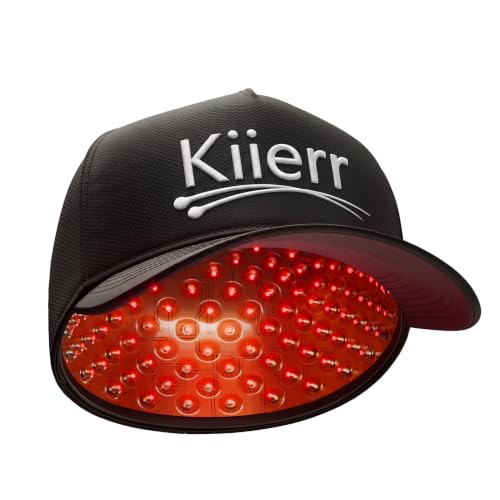
- 272 LASER DIODES: Designed to provide coverage across the upper scalp area.
- WEARABLE CAP DESIGN: Hands-free format for convenient use at home.
- 30-MINUTE SESSIONS: Review the included instructions before use.
Technology and features: 272 laser diodes at 650 ± 5 nm, up to 5 mW each.
Schedule: 30 minutes every other day.
FDA clearance verification: K181878 (“Kiierr 272 Laser, Kiierr 148 Laser,” Kiierr International) covers the 272 and 148 models. Its indications are limited to specific hair-loss stages and Fitzpatrick I–IV.
Warranty and returns: 2-year limited warranty (battery replacements carry a fee). Kiierr advertises a 7-month Growth Guarantee, and company replies to customers describe a 25% service fee that can be waived with progress photos. They also describe device registration within 45 days and a 30-day request window after the treatment period. Read the current policy carefully, because some customers say it was hard to use.
Advantages: Laser-only and often discounted.
Disadvantages: 30-minute sessions are a real time commitment, and the 2020 systematic review we cite below lists no published trial for the Kiierr 272.
Who should buy it: People who don’t mind longer sessions and want laser density at a lower sale price.
Who should seek advice first: Anyone with sudden or patchy hair loss.
HairMax LaserBand 82
Overview: A flexible, hands-free band with hair-parting teeth. You glide it across the scalp in sections rather than wearing a full dome.

- VALIDATED BY CLINICAL TRIALS: Technology validated by 7 clinical studies, international medical device licenses, and 6 p…
- REGROW FULLER DENSER HAIR: Hairmax pioneered the use of nourishing and therapeutic laser light energy directly targeted …
- FAST TREATMENT & LIGHTWEIGHT: Regrow fuller, denser healthier hair. The treatment takes as little as 90 seconds, 3 times…
Technology and features: 82 laser diodes at 655 nm, no LEDs, with a rechargeable battery.
Schedule: About 90 seconds, three times a week.
FDA clearance verification: Partly verified. FDA record K142573 is titled “HairMax LaserComb 82 and 41,” and the summary describes 655 nm lasers and a hands-free shape. A third-party registration database links “LaserBand 82 ComfortFlex” to K142573, but I did not find the LaserBand name on the FDA record itself. Confirm with HairMax. The clearance relied on bench testing against predicate devices.
Warranty and returns: 1-year warranty and a 6-month money-back guarantee, per HairMax’s product page.
Advantages: The shortest sessions on this list, a portable design and a long brand history.
Disadvantages: It requires careful technique, the warranty is only one year, and its evidence comes from HairMax LaserComb trials rather than the band itself.
Who should buy it: Busy or traveling users who want minimal time per session.
Who should seek advice first: Anyone outside the cleared stages (Norwood IIa–V; Ludwig-Savin I-4, II-1, II-2 or frontal) or with Fitzpatrick V–VI skin.
Theradome PRO LH80
Overview: A cordless helmet that trades diode count for fewer weekly sessions.

- Advanced Laser Technology for Hair Wellness: The Theradome Laser Hair Therapy Helmet uses medical-grade laser technology…
- Powerful & Targeted Light Therapy: Unlike other devices that mix lasers with LEDs, Theradome utilizes 40-80 premium lase…
- Full Scalp Coverage for Convenient Treatment: Theradome’s ergonomic helmet design ensures hands-free, full-scalp coverag…
Technology and features: 80 laser diodes. Theradome’s manual lists 680 nm and 5 mW per diode, and press coverage gives 678 nm.
Schedule: 20 minutes, twice a week on non-consecutive days.
FDA clearance verification: Partly verified. K122950 (“Laser Helmet,” Theradome, June 2013) describes the LH80 PRO, 80 diodes and the twice-weekly schedule, and was written for adult women. Press reports say a later clearance extended it to men, but I could not verify that number.
Warranty and returns: 1-year limited warranty per the manual, with extended coverage sold separately. Refund terms were not verified, so check Theradome’s site.
Advantages: Only two sessions a week and a lower price than most helmets.
Disadvantages: The fewest diodes here, and the systematic review’s table lists no published trial for this model. Some customers report support and warranty frustrations.
Who should buy it: People who want the lowest weekly time commitment.
Who should seek advice first: Men should confirm the exact clearance covering their use.
CurrentBody LED Hair Growth Helmet
Overview: An LED-only helmet with built-in Bluetooth headphones, from a UK beauty-tech retailer.

- CurrentBody LED Hair Growth Helmet: An effective at-home hair growth solution
- Natural, cellular LED light therapy treatment for hair thickening and new hair growth
- 120 LED bulbs deliver 18 J/cm² of the precise red (660nm) wavelength
Technology and features: 120 red LEDs. The FDA summary lists 660 nm, while CurrentBody’s site says 620–660 nm.
Schedule: 10 minutes, daily. CurrentBody suggests 16 weeks before judging results.
FDA clearance verification: K230336 covers the “CurrentBody Skin LED Hair Regrowth (Model: MZ-07).” FDA cleared it by comparison to the Revian Red, and the summary states clinical testing was not needed. CurrentBody’s own trial (31 people, 84 days, measured against baseline) is manufacturer-commissioned. A separate “Dual Light” helmet (K251017, model MZ-07A) is a different product.
Warranty and returns: I could not verify a warranty. CurrentBody’s page offers a 14-day refund only if a skin sensitivity test shows a reaction. The UK store was out of stock and not shipping to the US when checked, and the US price I found was press-reported (about $859).
Advantages: Comparatively lower price, easy 10-minute sessions and a handy audio feature.
Disadvantages: Evidence is thinner, availability varies by region, and the LED-versus-laser question is unsettled (see below).
Who should buy it: Budget-conscious buyers who prefer LEDs and a gentle routine.
Who should seek advice first: Anyone using light-sensitizing drugs or with photosensitive or eye conditions, per CurrentBody’s own contraindications.
Laser Caps vs LED Helmets: Which Is Better?
Nobody has proven that one is better. The 2021 systematic review of home-use LLLT devices found a statistically larger benefit for laser-only devices than for laser-plus-LED combinations, but the authors note those are indirect comparisons across different trials and call for head-to-head studies.
- Coverage: Caps and helmets both treat the full scalp. Bands like the LaserBand require sectional passes.
- Convenience: Caps fit under a hat. Helmets are bulkier but often have shorter sessions.
- Evidence limits: Most trials used mild-to-moderate hair loss and lasted 16–26 weeks, and most used older or comb-style devices.
If you’re deciding between laser caps, our roundup of premium laser hair growth caps compares more models.
Are FDA-Cleared Hair Growth Devices Effective?
The evidence is encouraging but limited. The systematic review pooled seven double-blind randomized trials with 607 participants and found a significant increase in hair density versus sham devices. The effect was similar in men and women. These are the caveats:
- Short trials. None ran longer than 26 weeks, so long-term effects are unknown.
- No head-to-head studies. Nothing shows one device beats another.
- Not every device has its own trial. Many clearances (including several above) rest on equivalence rather than new clinical data.
- Manufacturer ties. Some studies were sponsored or co-authored by device makers. For example, a co-author of the Capillus trial is also listed as Capillus’s sponsor contact in an FDA filing.
The American Academy of Dermatology (AAD) says that for at-home lasers, only a few studies have looked at these devices and the results are promising, but not everyone sees regrowth and long-term side effects are not fully known. The AAD also lists minoxidil and prescription medicines such as finasteride as established options, and says earlier treatment is more likely to work.
How Long Does It Take to See Hair Growth Results?
Plan on months, not weeks.
- First 1–3 months: You may notice less shedding. Some people see temporary shedding as they start.
- 4–6 months: Most trials measure results at 16–26 weeks, so this is the earliest realistic window.
- 6–12 months: A fairer test. Take photos in the same lighting every month.
Results vary, and some people see little change. If nothing improves after about six months of consistent use, talk to a dermatologist rather than adding more sessions. Using a device more than directed hasn’t been shown to help.
Are FDA-Cleared Hair Growth Devices Safe?
Studies and the AAD describe laser therapy as generally safe and painless, but there are precautions:
- Side effects: Reported effects are mild, such as dry skin, itching, warmth or headache.
- Eye safety: The cleared lasers are Class 3R. Follow the manual, keep your eyes closed or use the provided protection, and don’t look into the light.
- Contraindications: Manufacturers advise checking with a doctor if you take photosensitizing medications, have scalp cancer or suspicious lesions, have light-sensitive conditions or eye disorders, or are pregnant or nursing.
- Skin tone: Clearances cover Fitzpatrick I–IV, so ask a dermatologist if your skin is darker.
- Diagnosis first: Sudden, patchy or painful hair loss can have medical causes a laser won’t fix.
How to Choose the Best FDA-Cleared Hair Growth Device
- FDA verification: Match the exact model to a K-number in the FDA 510(k) database, and read the indications.
- Hair loss type: Check that your pattern and skin type fall inside the cleared indications.
- Scalp coverage: Full-scalp caps and helmets differ from band-style devices.
- Treatment time: The best device is the one you’ll use. Compare 90 seconds, 6 minutes, 12 minutes and 30 minutes.
- Comfort and fit: Caps and helmets come in limited sizes. Measure your head first.
- Budget: Prices here run from about $849 to $1,799, plus battery and replacement costs.
- Warranty: Compare length and what’s excluded, such as batteries.
- Return policy: Look for service fees, registration deadlines and “purchased directly from the maker” rules.
- Published clinical evidence: Prefer devices tied to peer-reviewed trials, and treat brand-reported percentages as marketing.
Frequently Asked Questions
What is the best FDA-cleared hair growth device?
There isn’t one proven winner. Pick by routine and budget: Capillus PRO for the shortest daily session, HairMax LaserBand 82 for 90-second sessions, Theradome PRO LH80 for twice-weekly use, and iRestore Elite for a hybrid helmet.
Are FDA-cleared laser caps effective?
Pooled trial data suggest laser devices increase hair density compared with sham devices, mostly in mild-to-moderate hair loss over 16–26 weeks. Individual caps vary in how much published evidence supports them, and not everyone responds.
Is FDA-cleared the same as FDA-approved?
No. Clearance (510(k)) means a device is substantially equivalent to a legally marketed predicate. Approval usually means a stricter PMA review. Hair-growth lasers are cleared.
How long does it take for laser hair growth devices to work?
Most studies measure outcomes at 16–26 weeks. Expect at least four to six months of consistent use before judging, and don’t expect guaranteed results.
Are LED hair growth helmets better than laser caps?
Not proven. Some analyses favor laser-only devices, but these are indirect comparisons, and the authors call for head-to-head studies.
Can women use FDA-cleared hair growth devices?
Yes, within the cleared indications. For the devices here, that generally means female pattern hair loss at Ludwig-Savin stages I–II (some include frontal patterns) and Fitzpatrick I–IV skin. See a doctor first if your hair loss is sudden or you’re pregnant.
Can men use laser hair growth helmets?
Yes. The devices reviewed are cleared for men with Norwood-Hamilton IIa–V patterns. The Theradome’s original clearance was for women, so confirm its men’s clearance before buying.
Can you use a hair growth laser device every day?
Only if that’s the cleared protocol. Capillus, iRestore Elite and CurrentBody are used daily, HairMax three times a week, Kiierr every other day and Theradome twice weekly. Capillus warns that exceeding the recommended use won’t increase the effect and may have a negative effect.
Final Verdict – Which FDA-Cleared Hair Growth Device Is Worth Buying?
Because no head-to-head trial has crowned a winner, the best FDA-cleared hair growth devices are the ones whose clearance matches your hair loss and whose routine you’ll stick with. This is our editorial take, not established science:
- Shortest daily routine: Capillus PRO.
- Fastest sessions and travel: HairMax LaserBand 82.
- Fewest weekly sessions: Theradome PRO LH80.
- Hybrid helmet with a clear FDA record: iRestore Elite.
- Best sale-priced laser cap: Kiierr 272 Premier, if you accept 30-minute sessions.
- LED-only on a tighter budget: CurrentBody LED Hair Growth Helmet.
Whichever you choose, confirm the exact model’s K-number, read the refund fine print, and see a board-certified dermatologist if your hair loss is sudden, patchy or unexplained. Check the latest price on Amazon using the links above.
This article is for informational purposes only and does not replace medical advice. Prices, specifications and policies change, so verify them before you buy.