
As an Amazon Associate, Natural Skin Studio earns from qualifying purchases. This does not affect our editorial assessments.
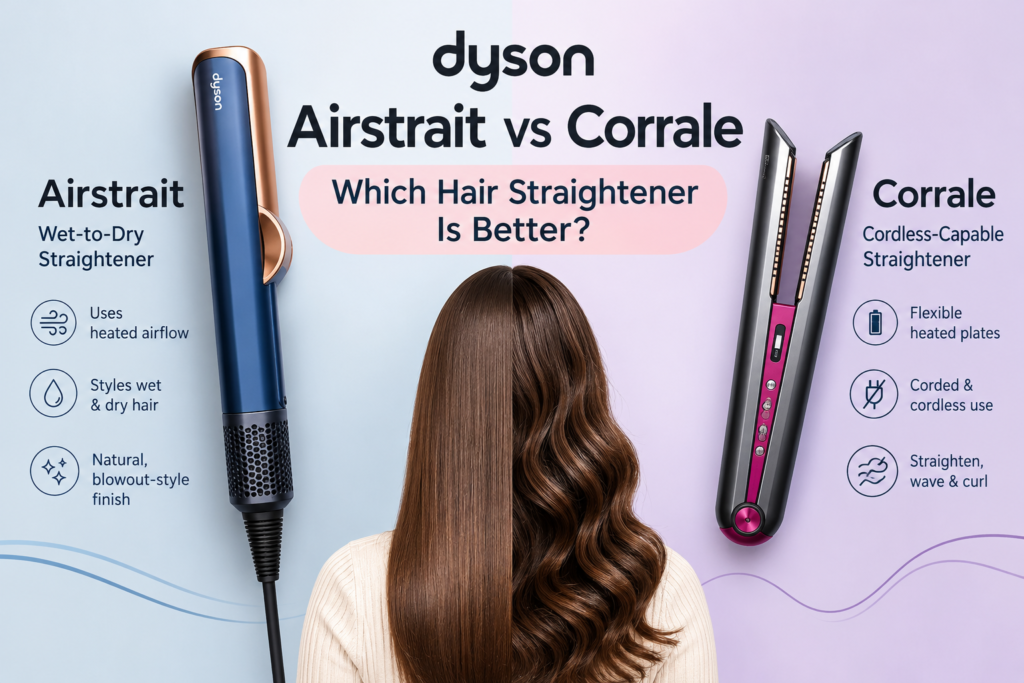
You’re looking at two Dyson straighteners that cost roughly the same and work in completely different ways. One dries and straightens wet hair with directed air. The other is a cordless flat iron with flexible plates. So the Dyson Airstrait vs Corrale decision isn’t about which is “better.” It’s about whether you want to cut a step out of your wash-day routine or get a more versatile, classic-feeling iron.
This is a research-based comparison built from Dyson’s own specifications and published editorial reviews. We haven’t run our own lab tests, and we’ve labeled manufacturer claims as such.
In this guide
- Quick verdict
- At a glance
- Airstrait review and Corrale review
- Key differences
- Hair type guide
- Finish, heat damage, travel, price
- FAQ and final verdict
Quick Verdict: Which Dyson Straightener Should You Buy?
Choose the Airstrait if you currently blow-dry and then flat-iron, you want a natural, bouncy-straight finish, and you’re happy to style at home near an outlet. It replaces two steps with one.
Choose the Corrale if you style dry hair, want a sleek plate-straightened finish, like to add waves or loose curls, or need a cordless tool that travels.
Skip both if you straighten rarely or want pin-straight results at the lowest price. A good conventional flat iron costs far less (see our guide to the best premium hair straighteners in 2026 for the range between budget and Dyson pricing).
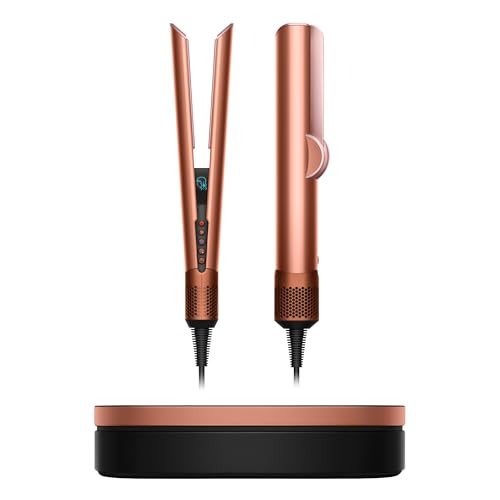
- Wet to dry straightening with air. No hot plates. No heat damage.¹
- Reduces time spent drying and styling by an average of 25%.⁴
- Airflow is projected downwards at a 45° angle to create the tension needed to align hair for a smooth end style – with l…

- Use corded or cord-free for extra versatility. Up to 30 minutes cord-free styling: Delivers the same thermal performance…
- Less heat, half the damage: Flexing plates gather your hair for more control, so you can achieve the same style with les…
- Auto shut-off and Safety lock: Switches off after 10 minutes of inactivity for added peace of mind. Safety lock allows f…
Dyson Airstrait vs Corrale: At a Glance
Prices checked October 21, 2026, in US dollars. Prices change often, so confirm before buying.
| Airstrait | Corrale (original) | |
|---|---|---|
| Best for | Wet-to-dry, natural straight finish | Dry styling, sleek finish, waves/curls |
| Technology | Directed heated airflow, no hot plates | Flexing manganese copper-alloy heated plates |
| Hair condition | Damp/wet (primary), dry mode available | Dry |
| Finish | Softer, natural, with movement | Classic sleek, flat-iron smooth |
| Heat settings | Wet and dry modes with several temperature levels (TechRadar reports roughly 175–285°F) | 3: 330°F, 365°F, 410°F |
| Corded/cordless | Corded only | Corded or cordless |
| Battery runtime | N/A | Up to 30 min cordless (Dyson) |
| Versatility | Mainly straightening | Straighten, wave, curl |
| Weight | About 1.3 lb in hand; heavier with cord and plug (TechRadar) | 1.23 lb (Dyson US) |
| US price | $499.99 list (TechRadar, Aug 2026)* | $539.99 (Dyson US, Professional edition) |
| Main advantage | Cuts a routine step | Cordless flexibility |
| Main drawback | Not pin-straight; bulky plug | Heavy; only for dry hair |
*We couldn’t load Dyson’s US Airstrait page, so this is a published list price. Check Dyson.com or retailers for the live price.
1. Dyson Airstrait Review: Strengths and Weaknesses
The technology. The Airstrait has no heated plates. Its arms push hot air down the hair at an angle, creating tension while the hair dries. Dyson says the approach works best from wet hair, because moisture makes hair easier to reshape without extreme heat. You can read the manufacturer’s description on Dyson’s Airstrait specifications page (the Indian market page, so voltage and pricing differ in the US).
The routine. Instead of blow-drying and then flat-ironing, you towel-dry and go section by section with the Airstrait. TechRadar’s reviewer got thick, wavy, porous hair from wet to straight in about ten minutes, which she described as less than half her usual time. That’s one tester’s experience, but it matches the tool’s purpose. It also has a dry mode and a cool-air setting for setting the style.
Strengths
- Combines drying and straightening in one pass
- Soft, natural-looking results with movement
- Clever auto-airflow and auto-pause features
- No plates to snag or scorch
Weaknesses
- TechRadar found results smooth and shiny but not pin-straight, and dry-hair use less effective than wet
- The bulky arms can’t reach the roots closely
- Corded only, with a large safety plug (PRCD) that can be awkward near furniture
- Not a curling or waving tool
- Premium price
Ideal user: Someone who wants a faster routine and a natural finish, especially with straight-to-wavy hair, and who stays mostly at home.
2. Dyson Corrale Review: Strengths and Weaknesses
The technology. The original Corrale is a flat iron with manganese copper-alloy plates that flex to gather hair into the grip, rather than letting strands splay. Dyson says this gives more control, so you need less heat for the same result. It has three settings (330°F, 365°F, 410°F), an OLED screen, and a rechargeable battery for up to 30 minutes cordless (Dyson’s figure; actual time varies with your hair and technique). Specs are on Dyson’s Corrale page.
Strengths
- Classic sleek, plate-smooth finish
- Cordless or corded, with docking to extend runtime
- Can straighten, wave or curl hair
- Simple upkeep, with no air filter to clean
- Universal-voltage charging, which suits travel
Weaknesses
- Heavy for a flat iron (1.23 lb), and TechRadar called it bulky
- For dry hair only, so you still blow-dry first
- Premium price
- Still uses hot plates, so technique and temperature matter
Ideal user: Someone who prefers the look and feel of a traditional flat iron, wants one tool for straight and wavy styles, and values cordless freedom. For a deeper dive, see our detailed Dyson Corrale review.
Note: Dyson now sells a newer Corrale model (CoolShine). This article covers the original Corrale, so check the exact model before buying.
3. Airstrait vs Corrale: Key Differences
- Technology: Heated air versus heated flexible plates. This is the root of every other difference.
- Finish: The Airstrait leans natural and voluminous. The Corrale leans sleek and defined.
- Styling time: The Airstrait can replace a dry-then-iron routine. The Corrale only replaces your flat iron, so you still dry your hair first. Dyson’s own comparison page frames this the same way.
- Heat exposure: The Airstrait uses no plate contact. The Corrale uses direct contact but at controlled temperatures.
- Versatility: The Corrale can wave and curl. TechRadar notes the Airstrait isn’t suited to curling.
- Comfort and handling: Both are heavy. The Airstrait’s plug and bulk affect placement; the Corrale’s weight is felt in the wrist.
- Portability: The Corrale wins clearly (see travel below).
- Value: Similar list prices, but you’re paying for different things.
4. Which Is Better for Your Hair Type?
No tool is guaranteed for a given texture. Technique, humidity, and hair condition matter as much as the device.
Fine or fragile hair. The Airstrait avoids plate contact and lets you skip a separate dry-then-iron step, which appeals if your hair breaks easily. The Corrale’s lowest setting may also suffice (TechRadar’s tester with fine hair reported one pass at the lowest setting). Either can work, so choose by finish and routine.
Thick or coarse hair. The Airstrait handles sizeable sections, per TechRadar, but may not give the tension some thick hair needs for a very smooth result. The Corrale’s higher setting and plate tension suit hair that resists straightening. Expect to work in smaller sections with either.
Wavy hair. The Airstrait is arguably the sweet spot. TechRadar’s reviewer has thick, wavy hair and liked the natural finish. The Corrale is great if you alternate between straight and waves.
Curly or coily hair. Be cautious with the Airstrait. TechRadar noted it couldn’t reach the roots closely, struggled to get curlier hair fully straight, and that results relaxed with humidity. Dyson suggests cool mode helps set styles on curlier textures, but it can’t replace plate tension for everyone. Plate straighteners generally hold the style longer, and the Corrale can add curls and waves to the repertoire. Our guide to premium hair tools for curly hair covers other options.
Color-treated or damaged hair. Lower heat and fewer passes are the goal either way. The Airstrait eliminates plate contact. The Corrale offers a lower setting and, per Dyson, less reliance on heat. If your hair is already compromised, consider reducing how often you heat-style at all.
- Wet to dry straightening with air. No hot plates. No heat damage.¹
- Reduces time spent drying and styling by an average of 25%.⁴
- Airflow is projected downwards at a 45° angle to create the tension needed to align hair for a smooth end style – with l…
- Use corded or cord-free for extra versatility. Up to 30 minutes cord-free styling: Delivers the same thermal performance…
- Less heat, half the damage: Flexing plates gather your hair for more control, so you can achieve the same style with les…
- Auto shut-off and Safety lock: Switches off after 10 minutes of inactivity for added peace of mind. Safety lock allows f…
5. Which Gives Straighter, Smoother Results?
Plates press and smooth hair as they glide; airflow aligns hair while it dries. That’s why the Airstrait tends toward a softer, natural-straight look, and plates tend toward a flatter, sleeker one. TechRadar’s reviewer called the Airstrait’s finish natural rather than pin-straight and said she preferred that.
If your priority is a glass-smooth, poker-straight look, a plate straightener like the Corrale is the safer bet. If you want volume and movement, the Airstrait fits better. Humidity, your starting texture, how well you prepare the hair, and how methodically you section it will change results with either tool.
6. Which Is Better for Heat Damage?
The Airstrait avoids hot plates. Dyson says it causes no heat damage in wet-to-dry mode, but that’s a manufacturer claim, and we’d read it cautiously. The airflow is still heated (TechRadar lists temperatures up to about 285°F), so “less direct heat” is the safer way to describe it.
The Corrale uses hot plates, but Dyson says its flexing plates cause half the thermal damage of solid plates, measured by hair strength. Note the baseline: that comparison is against a Corrale with solid plates, not against air styling. TechRadar also credits the design with helping protect hair.
How to reduce damage with either tool:
- Use the lowest setting that works, and avoid repeated passes
- Apply a heat protectant suited to the tool (damp-hair products for wet-to-dry, dry-hair formulas for plates), following the label
- Work in small sections and don’t linger
- Limit how often you heat-style
Neither tool is damage-proof. Results depend on hair condition, temperature, frequency, and technique.
7. Which Is Better for Travel?
Corrale: Cordless for up to 30 minutes (Dyson), recharges in about 70 minutes to full or 40 minutes to 90%, and charges at universal voltage, per Dyson. Dyson notes it can’t be flown in or out of Japan. Weight is 1.23 lb.
Airstrait: Corded, with a large PRCD plug, and built for the voltage of the country where you bought it. TechRadar’s reviewer said hers wouldn’t power up in Europe with a UK plug and adapter.
Before any trip, check current airline battery rules and the destination’s electrical requirements. The Corrale is the clear travel pick.
8. Price and Value for Money
At the time of writing, the Corrale’s Dyson US price is $539.99 and the Airstrait’s published list price is $499.99. Both are premium prices, and both get discounted from time to time, so compare before buying.
What you’re paying for:
- Airstrait: time savings and a gentler-feeling routine. It’s worth most to people who style several times a week.
- Corrale: cordless freedom and versatility. It’s worth most to people who style dry hair, curl or wave, or travel.
When to spend less: If you straighten occasionally, a conventional flat iron with adjustable temperature will do the job at a fraction of the cost. Even TechRadar says that if you’re willing to risk a bit more heat, plenty of excellent cheaper straighteners exist. Its best hair straighteners guide shows the range. For salon-grade corded options, see our picks of professional hair straighteners for salon-quality results.
9. Who Should Buy the Airstrait vs Corrale?
Buy the Airstrait if you:
- Blow-dry then straighten most days
- Want a natural, voluminous straight finish
- Have straight, wavy, or loosely curly hair
- Mostly style at home
Buy the Corrale if you:
- Straighten dry hair and prefer a sleek finish
- Want waves or curls from the same tool
- Need cordless use or travel often
- Have hair that resists straightening or loses the style quickly
- Wet to dry straightening with air. No hot plates. No heat damage.¹
- Reduces time spent drying and styling by an average of 25%.⁴
- Airflow is projected downwards at a 45° angle to create the tension needed to align hair for a smooth end style – with l…
- Use corded or cord-free for extra versatility. Up to 30 minutes cord-free styling: Delivers the same thermal performance…
- Less heat, half the damage: Flexing plates gather your hair for more control, so you can achieve the same style with les…
- Auto shut-off and Safety lock: Switches off after 10 minutes of inactivity for added peace of mind. Safety lock allows f…
10. Frequently Asked Questions
1. Is the Dyson Airstrait better than the Corrale?
Not universally. The Airstrait is better for saving time and getting a natural finish; the Corrale is better for sleekness, versatility, and portability.
2. Which is better for thick hair?
Often the Corrale, because plate tension and higher heat settings help smooth resistant hair. The Airstrait works on thick hair too (TechRadar’s tester has thick hair), but expect a softer finish.
3. Which is better for fine hair?
Either can work. The Airstrait avoids plate contact, and the Corrale has a lower setting. Choose by finish and routine, and keep heat as low as possible.
4. Can the Dyson Corrale straighten wet hair?
No. It’s designed for dry hair, so blow-dry first.
5. Can the Dyson Airstrait curl hair like the Corrale?
No. It’s essentially a straightening tool, and TechRadar says it’s not suited to curling.
6. Which produces a sleeker finish?
The Corrale. Plate straightening tends to give a flatter, smoother look than airflow.
7. Which is better for curly hair?
Usually the Corrale, if you want maximum straightness and staying power. The Airstrait struggled with curlier hair in TechRadar’s testing, though cool mode may help set styles.
8. Does the Airstrait cause less heat damage?
It avoids hot plates, and Dyson says it causes no heat damage in wet-to-dry mode. That’s a manufacturer claim, and heated air is still heat, so some risk remains.
9. Is the Corrale worth the extra money?
Only if you’ll use the cordless operation, the curling and waving ability, or the plates’ sleek finish. Otherwise a cheaper iron may serve you equally well.
10. Which Dyson straightener is better for travel?
The Corrale, thanks to cordless use and universal-voltage charging. The Airstrait is corded and voltage-specific.
Final Verdict
In the Dyson Airstrait vs Corrale matchup, the right answer depends on how you style. If you blow-dry and then flat-iron, want a natural finish, and mostly stay home, the Airstrait earns its price by saving time. If you straighten dry hair, want a sleeker finish, like to add waves, or travel, the Corrale is the more flexible tool.
If neither fits your routine and budget, a well-chosen conventional straightener is a perfectly sensible alternative. For more help choosing, explore our haircare guides.