
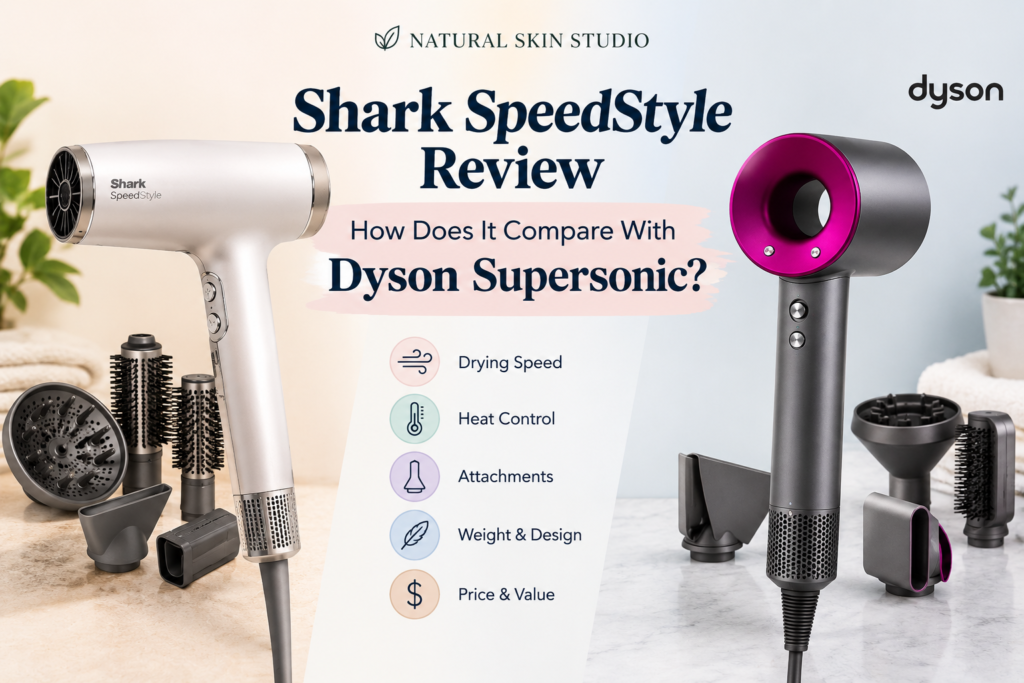
If you’ve spent any time comparing hair dryers, you’ve probably landed on the same question everyone else does: the Dyson Supersonic costs roughly double the price of a Shark SpeedStyle, so is that gap actually justified by performance? Or is the Shark good enough that the extra money buys little more than a logo?
Affiliate disclosure: Natural Skin Studio is reader-supported. If you purchase through links on this page, we may earn a commission at no additional cost to you.
The honest answer sits somewhere in the middle, and it depends heavily on your hair type, how often you style, and what specifically frustrates you about your current dryer. Both brands use high-velocity airflow and some form of automatic heat management, but they get there in different ways, and the differences matter more for some hair types than others. This review breaks down what’s actually different, what’s just marketing language, and which dryer makes sense for which kind of reader.

- PROFESSIONAL PERFORMANCE: Style with high-velocity airflow for wet-to-dry, ultra-fast styling with no heat damage, in a …
- HIGH-VELOCITY. COMPACT DESIGN: Airflow reaches 0-100 mph in less than a second. Style with higher airflow velocity in a …
- SCALP SHIELD MODE: Activate to instantly reduce air temperatures to the optimum safe level for scalp comfort and root dr…
Shark SpeedStyle Review: Quick Verdict
Consider Shark SpeedStyle if: you want fast drying, a solid attachment set, and IQ-style automatic heat adjustment without spending Dyson money. It’s a strong pick for thick or long hair that takes forever to dry, and for anyone who wants several styling options (smoothing, diffusing, finishing) in one box.
Consider Dyson Supersonic if: you style your hair frequently, want the most consistent heat and airflow control published testing has found, and don’t mind paying more for magnetic attachments and a design that testers have generally found easier to hold for long sessions.
Shark’s strengths: speed, attachment variety, lower entry price, IQ Styling automation.
Shark’s weaknesses: in at least one independent lab test, its jump from Medium to High airflow was described as abrupt, and its L-shaped handle isn’t universally comfortable to hold.
Dyson’s strengths: widely reported ergonomics, more granular airflow increments in testing, five included attachments.
Dyson’s weaknesses: significantly higher price, fewer heat/airflow combinations than some competitors offer.
Neither dryer is “no damage” or “best for everyone” — that’s not how heat styling works. What follows is the detail behind this quick take.
Shark SpeedStyle vs Dyson Supersonic at a Glance
This table compares the original Shark SpeedStyle (RapidGloss Finisher & High-Velocity Dryer) against the Dyson Supersonic. Where the SpeedStyle Pro or Pro Flex differ, it’s called out separately in later sections — don’t assume these numbers apply to those versions.
| Shark SpeedStyle (original) | Dyson Supersonic | |
|---|---|---|
| Price | Starts around $179.99, with the full five-attachment bundle around $259 | From roughly $429 at consumer retail |
| Weight | About 750g / 1.7 lb before attachments | 1.8 lbs |
| Wattage | 1,700W as tested by TechRadar; Shark’s current published spec states the SpeedStyle series uses 1,750W | 1,600W |
| Heat settings | Four, including a cool-shot button (roughly 149°F, 176°F, and 212°F plus cool shot) | Four precise heat settings: 212°F, 176°F, 140°F, and an 82°F cold shot |
| Speed/airflow settings | Three airflow settings | Three precise speed settings — high, medium, and low for diffusing |
| Heat-control tech | IQ Styling auto-adjusts per attachment (original + Pro/Pro Flex); Scalp Shield temperature regulation is available on the SpeedStyle Pro and Pro Flex ranges, not the original | Intelligent heat control measures airflow temperature more than 40 times per second |
| Attachments | Five in the top bundle: RapidGloss Finisher, Quicksmooth brush, Turbo Concentrator, Express Touchup brush, Defrizzfast Diffuser | Five magnetic attachments: flyaway attachment, styling concentrator, diffuser, gentle air attachment, wide-tooth comb |
| Cord length | 2.44m / 8ft | 9ft |
| Noise | Up to 85dB on the highest setting in TechRadar’s own testing, 76–80dB on lower settings | 77 dBA published spec |
| Warranty | Varies by bundle and retailer — check current terms before buying | 2-year limited warranty |
| Main strength | Fast, IQ-assisted drying at a lower price | Independent testers have generally preferred its ergonomics and airflow consistency |
| Main weakness | One tester found a noticeable jump between Medium and High airflow with no in-between option | High price relative to attachment count |
A quick note on that noise comparison: TechRadar measured the Shark with a phone decibel app during its own review, while Dyson’s 77 dBA figure is the company’s published spec. Different measurement setups aren’t perfectly comparable, so treat this as a directional guide rather than a lab-verified head-to-head.
What Is the Shark SpeedStyle?
The Shark SpeedStyle is Shark Beauty’s entry-level high-velocity hair dryer line, first released in the US in August 2023. It’s built around three ideas: fast drying through high-velocity airflow, automatic heat and speed adjustment through what Shark calls IQ Styling, and a set of clip-in attachments aimed at different finishes. techradar
IQ Styling automatically adjusts heat and airflow settings depending on which attachment is connected, so you’re not manually guessing the right heat for a diffuser versus a smoothing brush. The line has since expanded into two upgraded versions — SpeedStyle Pro and SpeedStyle Pro Flex — which add features the original doesn’t have, covered in detail below. You can see the full current range on Shark’s official hair dryer page. sharkninja
Shark SpeedStyle vs Dyson Supersonic: What’s Actually Different?
Drying Speed
TechRadar’s testers dried thick, shoulder-length hair with the original SpeedStyle in about three and a half minutes without any attachment on the highest settings. Styling with a round brush attachment took roughly 15 minutes for a full blowout. By comparison, the same publication’s reviewers found the Dyson Supersonic could dry hair in a little over two minutes without attachments. techradartechradar
Here’s the important caveat the brief specifically wants clarified: wattage is not the same thing as drying speed. Wattage measures electrical power draw; airflow (measured in liters per second) measures how much air actually moves; and real-world drying time depends on airflow, nozzle design, heat, hair density, and technique together. Dyson’s 1,600W Supersonic moves air through its V9 motor at 13 liters per second, while Shark’s SpeedStyle series runs at 1,750W — a higher wattage number that doesn’t automatically translate into faster drying, since Shark hasn’t published a directly comparable liters-per-second figure for public comparison. dysonsharkninja
Heat Control
This is where the two brands’ philosophies genuinely diverge, and it’s worth not treating them as interchangeable. Dyson’s intelligent heat control measures airflow temperature more than 40 times per second to help prevent extreme heat damage. Shark’s newer temperature-regulation system, used in the SpeedStyle Pro and Pro Flex ranges, measures and regulates temperature 1,000 times per second and states it won’t exceed 230°F. dysonsharkninja
A higher measurement frequency doesn’t automatically mean better real-world heat protection — it’s one input into a larger heat-management system, and Shark and Dyson use different sensor placements, algorithms, and attachment designs around those measurements. Treat “1,000 times per second” and “40+ times per second” as descriptions of different engineering approaches, not a simple bigger-number-wins comparison. Also worth noting: this Scalp Shield-linked regulation is a Pro/Pro Flex feature on the Shark side, not something the original SpeedStyle includes.
Airflow
Dyson states the Supersonic’s V9 motor spins up to 110,000rpm and propels air through its Air Multiplier technology for a controlled, high-velocity jet. Shark markets its SpeedStyle Pro Flex with a claimed top airflow speed reaching up to 160km/h in under a second, according to Shark — but that comparison, drawn from a single reviewer’s hands-on piece, was made against Dyson’s newer intelligent Supersonic Nural model rather than the standard Supersonic covered in this article’s spec table, so it isn’t a fair like-for-like stand-in for the numbers above. Neither brand has published directly comparable third-party wind-speed testing for the original SpeedStyle versus the standard Supersonic, so we’re not going to declare a winner here. dysontomsguide
Weight and Balance
The original SpeedStyle weighs about 750g / 1.7 lb before attachments, while the Dyson Supersonic weighs 1.8 lbs. On paper, that’s close. But shape matters as much as weight: BestReviews testers described the SpeedStyle as L-shaped, more like a traditional hair dryer, while the Supersonic uses a long-handle, short-barrel design, which their testers found easier to hold and maneuver over an extended drying session. If you have smaller hands or get fatigued holding a dryer overhead, this ergonomic difference may matter more to you than the numbers suggest. Shark SpeedStyle RapidGloss Finisher & High-Velocity Dryer review: hair drying made easy +3
Noise
As noted in the table above, TechRadar measured the SpeedStyle at up to 85dB on its highest setting and 76–80dB lower, versus Dyson’s published 77 dBA spec for the Supersonic. Because one figure comes from an independent tester’s app and the other from the manufacturer’s own spec sheet, these numbers describe different testing methods and shouldn’t be read as a precise side-by-side. techradardyson
Attachments
The original SpeedStyle’s full bundle includes a RapidGloss Finisher, Quicksmooth brush, Turbo Concentrator, Express Touchup brush, and Defrizzfast Diffuser, though US buyers can also choose a smaller two-attachment bundle at a lower price, or one of several pre-selected three-attachment bundles for specific hair types. Dyson’s Supersonic ships with five magnetic attachments: a flyaway attachment, a styling concentrator, a diffuser, a gentle air attachment for fine hair, and a wide-tooth comb for curly and textured hair, and all of them attach magnetically with 360° rotation, versus Shark’s twist-and-lock mechanism. Shark SpeedStyle RapidGloss Finisher & High-Velocity Dryer review: hair drying made easy +3
Styling
For smooth, straight blowouts, both dryers rely on a concentrator-style attachment paired with a round brush — a fairly standard technique regardless of brand, and one where our guide to hair straightening tools and products covers additional brush and product options worth pairing with either dryer. For waves and curls, both include diffuser attachments, though Dyson’s diffuser has longer prongs designed to reach deeper into hair, while Shark’s diffuser attachment is generally aimed at similar curl-defining, frizz-reducing results. For flyaway control specifically, Dyson’s flyaway attachment is designed to tuck stray hairs under longer layers for a smooth finish, while Shark’s RapidGloss Finisher (and the Pro Flex’s Rapid Gloss Finishing tool) uses a metal roller or Coanda airflow to smooth strands as you pull the dryer through your hair — a different mechanism aimed at a similar result. dysondyson
Shark SpeedStyle for Different Hair Types
Fine Hair
Lower heat settings and the lightest attachment (a touch-up or gentle-air style brush) reduce the risk of over-drying already-delicate strands. Avoid the highest heat/airflow combination for extended periods.
Thick Hair
This is where high-velocity airflow earns its keep — TechRadar’s tester dried thick, shoulder-length hair in around three and a half minutes without an attachment. The concentrator attachment helps section-by-section drying go faster. techradar
Curly Hair
The diffuser attachment is the one to reach for. Use lower heat and airflow to avoid disrupting curl pattern, and consider bunching hair upward into the diffuser rather than pulling it through.
Coily Hair
Diffusing on low-to-medium heat, working in smaller sections, tends to preserve pattern definition better than high-velocity direct airflow. Watch attachment size — a larger diffuser bowl may suit longer or denser coils better.
Straight Hair
The concentrator and a round brush attachment are the standard combination here; the automatic IQ Styling adjustment can save time versus manually cycling through heat settings.
Wavy Hair
Medium heat and airflow with a diffuser tend to preserve wave pattern while still cutting drying time meaningfully compared with air-drying alone.
Frizzy Hair
The RapidGloss-style finishing attachment is specifically aimed at this concern, though TechRadar’s review noted it took a few attempts to get comfortable with the technique.
Damaged or Color-Treated Hair
Favor lower heat settings and shorter direct-heat exposure. This is also where a broader hair-care routine matters more than any single tool — if you’re rebuilding hair health after color damage, our roundup of hair growth oils is a reasonable next stop for pre-styling protection.
Sensitive Scalp
Shark’s Scalp Shield mode (Pro and Pro Flex only) is specifically built around this concern, dropping root-area temperature to a lower, steadier level. On the original SpeedStyle or Dyson Supersonic, using a lower heat setting near the scalp achieves a similar practical effect, just without the dedicated one-touch mode.
- PROFESSIONAL PERFORMANCE: Style with high-velocity airflow for wet-to-dry, ultra-fast styling with no heat damage, in a …
- HIGH-VELOCITY. COMPACT DESIGN: Airflow reaches 0-100 mph in less than a second. Style with higher airflow velocity in a …
- SCALP SHIELD MODE: Activate to instantly reduce air temperatures to the optimum safe level for scalp comfort and root dr…
Shark SpeedStyle Attachments Explained
The table below covers the original SpeedStyle’s full attachment bundle, as tested by TechRadar. Pro and Pro Flex bundles vary — see the next section.
| Attachment | What It Does | Best For | Learning Curve |
|---|---|---|---|
| RapidGloss Finisher | Pulls hair along a metal roller to smooth flyaways and add a glossy finish | Frizz control, sleek finishes | Moderate — TechRadar’s reviewer needed a few attempts before getting consistent results |
| Quicksmooth brush | Round-brush-style attachment for smoothing while drying | Straight and wavy blowouts | Low |
| Turbo Concentrator | Narrows airflow to focus on one section at a time | Precision styling, straightening | Low |
| Express Touchup brush | A swiveling brush that adjusts to different head angles | Quick daily styling | Low |
| Defrizzfast Diffuser | Disperses airflow for gentler curl and wave drying | Curly and wavy hair | Low |
Shark SpeedStyle Pro vs SpeedStyle Pro Flex vs Original SpeedStyle
This is where a lot of shoppers get confused, so let’s separate the three clearly. Full details on the Pro model live on Shark’s SpeedStyle Pro product page.
Original SpeedStyle: No folding handle. No Scalp Shield. Uses IQ Styling for automatic attachment-based adjustment. This is the version most current reviews reference by default, and the one this article’s main comparison table uses.
SpeedStyle Pro: Delivers high-velocity airflow reaching up to 100 mph, according to Shark, and adds Scalp Shield Mode to protect new hair growth from extreme heat, alongside an IQ Speed Styling & Drying Suite that automatically adjusts settings per accessory. No folding handle. Tom’s GuideTom’s Guide
SpeedStyle Pro Flex: Adds a foldable/bendable barrel for storage and travel, on top of the Pro’s Scalp Shield feature. It regulates and measures temperature up to 1,000 times per second, and Scalp Shield mode is activated by holding the temperature button for two seconds. It has four heat settings (cool shot, low, medium, high) and three airflow settings. Its signature attachment, the Rapid Gloss Finishing tool, uses Coanda airflow technology — the same aerodynamic principle used in the Shark FlexStyle and Dyson’s Airwrap Coanda 2x — to smooth flyaways using two air streams. I tried Shark’s latest hairdryer for two months — and it’s the ultimate speed-drying companion +2
Which one for whom: if you just want a reliable, budget-friendly high-velocity dryer, the original is fine. If scalp comfort during root-drying is a priority, step up to the Pro. If you also want a compact, foldable design for travel or small bathroom storage, the Pro Flex is the one to compare against Dyson, since it’s the closest feature match on heat regulation.
Pricing varies significantly by bundle: Shark’s own site currently lists Build Your Own Pro Flex configurations from around $169.99, Build Your Own Pro from around $159.99, and a four-attachment Pro Flex bundle at $249.99 — so always check the current configuration and bundle contents before assuming a price applies to the exact attachments you want. sharkninja
- PROFESSIONAL PERFORMANCE: Style with high-velocity airflow for wet-to-dry, ultra-fast styling with no heat damage, in a …
- HIGH-VELOCITY. COMPACT DESIGN: Airflow reaches 0-100 mph in less than a second. Style with higher airflow velocity in a …
- SCALP SHIELD MODE: Activate to instantly reduce air temperatures to the optimum safe level for scalp comfort and root dr…
Dyson Supersonic: What You Get for the Extra Money
The Supersonic is built around Dyson’s V9 digital motor, which spins up to 110,000rpm and propels 13 liters of air per second through the dryer’s Air Multiplier technology — the ring at the front rather than a traditional grille. Intelligent heat control measures airflow temperature more than 40 times per second, and all five styling attachments connect magnetically with 360° rotation instead of Shark’s twist-lock system. Negative ions are also built in to help reduce static. Dyson Supersonic™ hair dryer for business | Dyson +3
What that extra money is buying, in plain terms: a motor located in the handle rather than the head (which affects balance and noise distribution), attachments that testers have generally found faster and easier to swap, and a heat-monitoring system Dyson has iterated on since 2016. It is not buying a guarantee of zero heat damage, and Dyson doesn’t claim that — it claims reduced risk of extreme heat damage through temperature monitoring.
Is Shark SpeedStyle a Real Dyson Supersonic Alternative?
Reasonably close, but not identical, and the honest answer depends on what “alternative” means to you. On raw drying speed, published testing gives the edge to the Supersonic — TechRadar’s own tests clocked it at a little over two minutes versus roughly three and a half minutes for the SpeedStyle, both without attachments. On attachment count and price flexibility, Shark wins by offering more customizable bundles at a meaningfully lower entry cost. On ergonomics, BestReviews’ lab testers were partial to the Supersonic’s handle design, though that’s stated as a preference, not a universal fact. techradarfox59
If what you mainly want is faster, more controlled drying with attachments you’ll actually use daily, and price isn’t the deciding factor, the Supersonic is likely to satisfy that want more precisely. If you want most of the high-velocity, IQ-adjusted drying experience without the price tag, and you’re comfortable with a slightly different handle shape, the SpeedStyle is a legitimate lower-cost path to a similar daily result — just not a spec-for-spec clone.
Shark SpeedStyle vs Dyson Supersonic: Which One Is Right for You?
Choose Shark SpeedStyle if:
- Value and total cost matter more than having the premium-brand name
- You want high-speed drying without spending Dyson money
- You want several styling attachments to swap between looks
- You prefer a lightweight, compact dryer for travel
- A lower entry price matters more than the last 10% of performance
Consider Dyson Supersonic if:
- Advanced, well-documented heat monitoring is a top priority
- You specifically like a motor-in-handle, magnetic-attachment design
- You style your hair most days and want the most consistent airflow control testers have reported
- Premium build and ergonomics outweigh upfront price for you
- You want the widest third-party review coverage backing performance claims
Neither product is universally “the best” — the right choice tracks your priorities more than either brand’s marketing copy.
Pros and Cons
Shark SpeedStyle
- Pros: Lower price, IQ Styling automation, multiple attachment bundle options, compact for travel
- Cons: Noticeable jump between Medium and High airflow in independent testing, slower unattached drying time than Supersonic in published tests, twist-lock attachments rather than magnetic
Dyson Supersonic
- Pros: Consistent airflow increments per BestReviews’ testing, magnetic 360° attachments, widely documented heat-monitoring system, generally preferred ergonomics in lab tests
- Cons: Significantly higher price, fewer included attachments relative to Shark’s largest bundles, no folding design for travel
- PROFESSIONAL PERFORMANCE: Style with high-velocity airflow for wet-to-dry, ultra-fast styling with no heat damage, in a …
- HIGH-VELOCITY. COMPACT DESIGN: Airflow reaches 0-100 mph in less than a second. Style with higher airflow velocity in a …
- SCALP SHIELD MODE: Activate to instantly reduce air temperatures to the optimum safe level for scalp comfort and root dr…
What We Like About the Shark SpeedStyle
- Fast unattached drying on thick hair in independent testing
- IQ Styling removes the guesswork of matching heat to attachment
- Multiple bundle configurations let you pay only for attachments you’ll use
- Compact, travel-friendly size with a genuinely long 8-foot cord
- Scalp Shield mode (Pro and Pro Flex) targets a specific, real discomfort point — hot roots
- Noticeably lower entry price than Dyson without giving up a decent attachment set
What Could Be Better
- The jump from Medium to High airflow can feel abrupt rather than gradual, per BestReviews’ testing
- The RapidGloss Finisher attachment has a real learning curve before results look consistent
- The original SpeedStyle lacks Scalp Shield and the folding design found on Pro/Pro Flex — don’t assume you’re getting those features unless you check the exact model
- Handle comfort isn’t universal; some testers found extended grip use uncomfortable
- Bundle and pricing structures change often, so a price you see in one review may not match current stock
FAQs
Is Shark SpeedStyle as good as Dyson Supersonic?
It’s close on daily usability but not identical in tested drying speed or ergonomics. Independent testing has generally favored the Supersonic on raw speed and handle comfort, while the SpeedStyle offers more attachments per dollar.
Is Shark SpeedStyle worth the money?
For most people prioritizing value, yes — you get high-velocity drying, IQ Styling, and multiple attachments well below Dyson’s price point.
Is Shark SpeedStyle better for thick hair?
It performs well on thick hair in published testing, drying shoulder-length thick hair in a few minutes without an attachment. Whether it’s “better” than the Supersonic for your specific hair depends on how much you value that extra speed versus the price difference.
Is Shark SpeedStyle good for fine hair?
Yes, if you stick to lower heat settings and gentler attachments — the same caution applies to any high-velocity dryer on fine hair.
Does Shark SpeedStyle damage hair?
No hair dryer can guarantee zero heat damage. Shark’s temperature-regulation technology on the Pro and Pro Flex models is designed to reduce extreme heat exposure, not eliminate risk entirely.
How often does Shark SpeedStyle regulate temperature?
On the Pro and Pro Flex models, Shark states it measures and regulates temperature 1,000 times per second. The original SpeedStyle doesn’t use this same system.
What is the difference between Shark SpeedStyle and SpeedStyle Pro?
The Pro adds Scalp Shield heat protection and Shark’s claimed 100 mph high-velocity airflow; the original doesn’t include Scalp Shield.
What is the difference between SpeedStyle and SpeedStyle Pro Flex?
The Pro Flex adds everything the Pro has, plus a foldable barrel for travel/storage and the Rapid Gloss Finishing tool with Coanda airflow technology.
Does Shark SpeedStyle come with a diffuser?
The original SpeedStyle’s full bundle includes a Defrizzfast Diffuser; Pro Flex bundles commonly include a diffuser attachment as well, though exact contents vary by configuration.
Is Shark SpeedStyle good for curly hair?
Yes, when paired with its diffuser attachment on lower heat and airflow settings.
Is Dyson Supersonic quieter than Shark SpeedStyle?
Published figures suggest it may be, but the numbers come from different testing methods (an independent reviewer’s decibel app for Shark versus Dyson’s own spec sheet), so this isn’t a strictly controlled comparison.
Can Shark SpeedStyle replace a Dyson Supersonic?
For most everyday styling needs, yes. If you specifically need the fastest tested drying time or magnetic attachment swapping, the Supersonic remains the more capable tool in published testing.
Does Shark SpeedStyle have ionic technology?
Shark markets its hair dryer line under an “ionic” positioning on its own site, though it hasn’t published the same kind of detailed ion-output specifications Dyson has for negative ion generation.
Final Verdict
The Shark SpeedStyle Review question really comes down to what you’re solving for. If your priority is getting most of the high-velocity, auto-adjusting drying experience at a fraction of the Dyson Supersonic’s price, the SpeedStyle line — especially the Pro or Pro Flex if scalp comfort or travel-folding matters to you — is a sensible choice worth checking the current configuration and attachment options for before you buy.
If your priority is the most consistent airflow control and ergonomics that independent testers have documented, and the price difference isn’t a barrier, the Dyson Supersonic remains the more thoroughly tested option, and it’s worth comparing the current bundle pricing against your specific hair-type needs.
Either way, treat both as tools that reduce some heat exposure risk through smarter airflow and temperature management — not as products that eliminate heat damage altogether.