
Affiliate disclosure: Natural Skin Studio is an Amazon affiliate website. If you buy through links on this page, we may earn a commission at no extra cost to you. This does not influence our recommendations. We have not physically tested either device for this article; it is based on manufacturer information, published independent reviews and established haircare guidance.
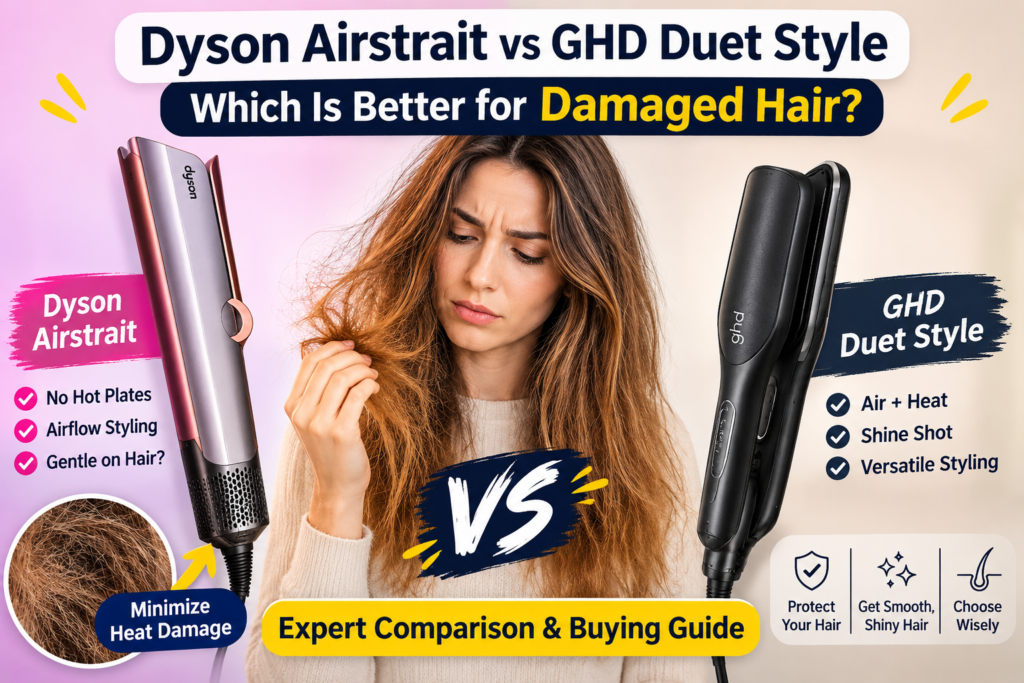
If your hair is already dry, brittle or snapping at the ends, buying another expensive styling tool feels risky. Every brand promises smoother, shinier hair, yet very few explain what happens when the hair you’re styling is already fragile. The Dyson Airstrait vs GHD Duet Style debate is a good example: both are wet-to-dry stylers that dry and straighten in one step, but they get there in very different ways.
This guide skips the generic spec-sheet comparison. Instead, it asks one question: which wet-to-dry styler is the more sensible choice for hair that is already damaged, bleached, colour-treated or chemically processed? We separate manufacturer claims from independent observations and general haircare guidance, and we are upfront about where the evidence runs out.

- DRY & STYLE WITH JUST ONE TOOL ― Revolutionary air-fusion technology dries and straightens hair at the same time, quickl…
- LUXURIOUS RESULTS EVERYDAY ― Unprecedented softness for up to 48 hours while protecting your hair's natural moisture. Un…
- UNCOMPROMISING STYLE ― Advanced floating plates with ultra-glass coating ensure incredibly smooth and snag-free gliding …

Dyson Airstrait vs GHD Duet Style: Quick Comparison
| Feature | Dyson Airstrait | GHD Duet Style |
|---|---|---|
| Technology | High-velocity heated airflow | Air-fusion: heated airflow plus low-temperature plates |
| Heating method | Air only (no traditional hot plates) | Air and four heated plates |
| Wet-to-dry performance | Dries and straightens from wet in one step | Dries and styles from wet in one step |
| Dry styling | Dry mode available | Dedicated dry styling, including Shine Shot |
| Temperature settings | Wet mode: 80°C (176°F), 110°C (230°F), 140°C (284°F) | Wet-to-style uses a different temperature system; Shine Shot is 365°F (185°C), dry hair only |
| Heated plates | No | Yes, four |
| Shine Shot mode | No | Yes |
| Frizz control | Smoothing through directional airflow; results vary by hair type | Smoothing through air plus plate contact; results vary by hair type |
| Styling versatility | Focused on straightening and smoothing | Wider dry-styling options, including a high-heat finishing mode |
| Suitability for damaged hair | Appealing if you want to avoid direct plate contact | Workable if used carefully; Shine Shot needs caution |
| Main disadvantages | Premium price; less dry-hair finishing flexibility | Plate contact; high-heat Shine Shot is unsuitable for some fragile hair |
| Price category | Premium (check official page) | Premium (check official page) |
Neither device is “damage-free.” Any tool that applies heat can contribute to dryness and breakage, especially on hair that is already compromised. The real question is how much heat stress each one asks your hair to handle, and how it handles it.
How the Dyson Airstrait Works
According to Dyson’s official Airstrait page, the Airstrait uses high-velocity heated airflow instead of conventional hot straightening plates. Hair is guided between two airflow surfaces, and the directional air aligns the strands as they dry. In simple terms, it behaves like a hair dryer and a straightener combined, with no metal or ceramic plate clamping the hair.
Temperature regulation
The Airstrait has intelligent temperature regulation, designed to keep the heat controlled while you style. Its wet-mode settings are 80°C (176°F), 110°C (230°F) and 140°C (284°F). Dyson positions the lower settings for finer or more delicate hair, though you should treat this as the manufacturer’s guidance rather than a guarantee.
Advantages
- No traditional hot plates, so there is no pressing or sliding of a heated surface along the hair.
- Wet-to-dry in one step, which can reduce the number of separate heated tools in your routine.
- Selectable wet-mode temperatures that let you start low.
Limitations
- It is a premium purchase.
- It is not a way to avoid heat entirely: heated air still dries and styles the hair.
- Straightening results depend on technique and hair type, and some users with very thick or coarse hair may need more time or sectioning.
If you are comparing it with traditional irons as well, our guide to the best premium hair straighteners covers the wider field.
How the GHD Duet Style Works
The GHD Duet Style product page describes Air-fusion technology: heated airflow combined with four low-temperature styling plates. The idea is that airflow helps dry the hair while the plates smooth it, so you can go from wet to styled without blow-drying first.
The four plates and the airflow
Unlike the Dyson, the GHD still involves plate contact. GHD says the wet-to-style technology uses a lower-temperature system designed for damp hair, and that system is different from its dry styling mode. Check GHD’s official page for the current temperature details rather than relying on third-party figures.
Shine Shot
The Duet Style includes a Shine Shot mode, intended for completely dry hair only. It operates at 365°F (185°C). This is where the GHD offers extra styling versatility, but also where it asks the most of already fragile hair (more on this below).
Limitations
- Plate contact remains part of the process.
- Shine Shot is a high-temperature setting.
- It is also a premium purchase.
Dyson Airstrait vs GHD Duet Style: Which Causes Less Additional Heat Stress?
This is the most important question for damaged hair, and the honest answer has layers.
What the manufacturers say. Dyson’s selling point is airflow styling without hot plates and regulated temperatures. GHD’s selling point is a low-temperature wet-to-style system combined with airflow. Both are manufacturer claims. Any laboratory data a brand publishes about its own product should be read as the company’s evidence, not independent research.
What independent reviewers say. Publications have examined Dyson’s heat-damage claims in editorial testing; Allure’s Dyson Airstrait review is a useful read on how an independent outlet approached those claims. Independent editorial testing is helpful, but it generally reflects limited samples and short timeframes, not long-term studies of fragile hair.
What established haircare guidance says. The American Academy of Dermatology advises limiting heat styling and reducing exposure to hot tools to help protect hair. The principle is simple: less heat, less often, makes a difference.
Does avoiding hot plates make a meaningful difference?
It may, but it isn’t proven to eliminate damage. Direct plate contact concentrates heat on a small area and often involves repeated passes. Airflow spreads heat more broadly, with no contact friction. For someone who is specifically worried about hot-plate contact, the Dyson’s design is the more natural fit. But airflow still heats the hair, and a poor technique with any device can still harm it.
What matters beyond the tool
- Number of passes. Repeating a section several times adds heat exposure on either device.
- Moisture level. Styling very wet hair for a long time and styling bone-dry hair at high heat both carry trade-offs; follow each manufacturer’s wet and dry instructions.
- Temperature. Lower settings reduce stress, while higher ones may be quicker but harder on fragile strands.
- Hair condition. Bleached, porous or chemically processed hair has less capacity to tolerate heat.
- Technique. Small sections, steady movement and avoiding hot spots all matter.
Can the GHD Duet Style cause additional damage? Like any heated tool, yes, it can if used with excessive heat, too many passes or on hair that cannot tolerate it. The same cautious principle applies to the Dyson.
Which Is Better for Different Types of Damaged Hair?
Damaged hair is not one category. Here is how we would think about each type.
Best for bleached and blonde hair
Bleached hair is typically more porous and fragile, so the Dyson Airstrait’s no-plate design and lower wet-mode settings (starting at 80°C/176°F) look more reassuring. With a GHD, we’d keep to its wet-to-style mode and skip Shine Shot. Either way, a conservative approach beats a powerful one.
Best for fine and brittle hair
Fine strands have less mass to absorb heat. The Dyson’s lower temperature options and absence of plates make it the more cautious pick. If you use the GHD, stay with the gentlest recommended approach and avoid repeated passes.
Best for colour-treated hair
Heat can contribute to colour fading. A device that lets you use lower heat and fewer passes is a sensible choice. The Dyson’s lower settings are an advantage here, though you can also protect colour with the GHD by avoiding high-heat dry finishing. Looking for the best straightener for colour-treated hair really comes down to technique.
Best for dry and porous hair
Porous hair absorbs and loses moisture rapidly. A moisture-focused routine matters more than the device. Whichever you choose, pair it with a heat protectant and conditioning. Our guide to the best hair dryers for damaged hair also helps if you’d rather skip straightening altogether.
Best for chemically processed hair
Relaxed, keratin-treated or permed hair can be less predictable under heat. Start low, test on a small hidden section, and follow the manufacturer’s guidance and your stylist’s advice.
Best for thick and coarse damaged hair
Thick hair often needs more time and tension to straighten, and the GHD’s plates plus its drying and styling versatility may suit it better. The Dyson can work on thick hair, but you may need smaller sections and more patience, which can increase total heat exposure. This is the hair type where the “gentler” device may not be the most efficient one.
Best for curly and frizz-prone hair
Both devices can smooth frizz, and results vary with curl pattern and humidity. If frizz is your main concern, see our roundup of premium hair tools for frizzy hair. We’d still start at the lowest effective temperature and avoid repeated passes on curls that are already dry.
| Hair type | Better starting point | Why |
|---|---|---|
| Bleached/blonde | Dyson Airstrait | No plates; low wet-mode settings |
| Fine and brittle | Dyson Airstrait | Less direct contact; lower temperatures |
| Colour-treated | Dyson Airstrait (slight edge) | Lower-heat approach |
| Dry and porous | Either, with care | Routine matters most |
| Chemically processed | Either, tested cautiously | Reactions vary |
| Thick and coarse | GHD Duet Style | Plates can help with stubborn hair |
| Curly and frizz-prone | Depends on goal | Test on a small section |
Is GHD Shine Shot Too Hot for Damaged Hair?
Shine Shot operates at 365°F (185°C), and it is intended for completely dry hair only. GHD designs it as a finishing step for a glossier look.
For healthy hair, a single, careful pass may be fine. For brittle, bleached or heavily processed hair, 365°F is a high temperature, and repeated use adds up. Hair that is already damaged typically has less tolerance, so our cautious view is that Shine Shot should be optional, occasional and skipped entirely if your hair is in poor condition. If your hair is fragile, using only the wet-to-style mode is the more conservative approach.
Which Device Gives Better Results?
Independent reviewers compare the two devices on real-world drying time, styling performance and usability. Woman & Home’s comparison is a good starting point if you want those details. Results vary by hair type, so we’ve framed this as general tendencies, not guarantees.
| Result | Dyson Airstrait | GHD Duet Style |
|---|---|---|
| Straightness | Good, technique-dependent | Good, with plate assistance |
| Smoothness | Smooth with airflow alignment | Smooth, with extra Shine Shot option |
| Shine | Natural-looking finish | Shine Shot may boost gloss on dry hair |
| Frizz reduction | Effective for many users | Effective for many users |
| Volume | Often retains more natural body, based on the no-plate design | Plates can flatten more |
| Styling time | Varies; thick hair may take longer | Varies; plates can help on thick hair |
| Thick hair | Needs smaller sections | Often more forgiving |
| Fine hair | Gentler feel | Fine if used cautiously |
Can Dyson Airstrait or GHD Duet Style Repair Existing Hair Damage?
No. Neither device repairs broken hair fibers or permanently reverses split ends. Hair is not living tissue once it grows out of the scalp, so a styling tool can’t heal it.
What these tools can do is create cosmetic smoothness: lying the cuticle flatter, reducing frizz and making hair look more polished. That is different from true repair. The only lasting fix for split ends is trimming, and the best long-term strategy is to reduce further damage.
How to Use Wet-to-Dry Stylers More Carefully on Damaged Hair
- Remove excess water gently. Squeeze or blot with a soft towel instead of rubbing.
- Follow the manufacturer’s instructions. Each device specifies how damp hair should be.
- Use a suitable heat protectant. It is not a force field, but it is a sensible part of any routine.
- Avoid unnecessary repeated passes. If a section isn’t smooth after a couple of passes, lower the speed or re-section rather than going again and again.
- Work in manageable sections. Smaller sections reduce the need for extra passes.
- Skip Shine Shot if high heat doesn’t suit your hair. This applies to the GHD.
- Reduce styling frequency. Fewer heat sessions a week matter more than any single setting.
- Maintain your conditioning routine. Regular conditioning and deep-conditioning treatments improve how hair looks and feels.
If you also dry hair separately, check our guide to professional hair dryers for home use.
Dyson Airstrait vs GHD Duet Style: Which Offers Better Value?
Both are premium purchases, and prices vary by region and retailer. We don’t list prices here, because they change. Check the official Dyson and GHD product pages for current regional pricing.
Is the Dyson worth the extra money? If you want the no-hot-plate design and care mostly about lower-contact straightening, it may be. If you want a flexible styler that also handles dry hair finishing, the GHD may deliver more versatility per dollar. Consider how often you’ll use it, how it fits your routine and whether you’d replace more than one tool.
If budget is a concern, explore professional hair styling tools under $300.
- DRY & STYLE WITH JUST ONE TOOL ― Revolutionary air-fusion technology dries and straightens hair at the same time, quickl…
- LUXURIOUS RESULTS EVERYDAY ― Unprecedented softness for up to 48 hours while protecting your hair's natural moisture. Un…
- UNCOMPROMISING STYLE ― Advanced floating plates with ultra-glass coating ensure incredibly smooth and snag-free gliding …
Frequently Asked Questions
Is Dyson Airstrait better than GHD Duet Style for damaged hair?
It depends on your priority. If avoiding hot-plate contact matters most, the Dyson is the more natural fit. If you want versatility, the GHD may suit you. Neither is damage-free.
Which hair straightener causes less heat damage?
No straightener is universally damage-free. Fewer passes, lower temperatures and good technique often matter as much as the tool. The Dyson avoids plates, which some people prefer for fragile hair.
Is Dyson Airstrait safe for bleached hair?
It may be a reasonable option when used carefully at a low setting, but bleached hair is fragile and no device is risk-free. Test on a small section first.
Can GHD Duet Style damage fine hair?
Any heated tool can contribute to damage if used with too much heat or too many passes. Use the gentlest approach and avoid Shine Shot.
Is GHD Shine Shot safe for damaged hair?
It runs at 365°F (185°C) and is for completely dry hair only. On fragile hair, we’d treat it as optional and use it sparingly, if at all.
Can Dyson Airstrait repair heat-damaged hair?
No. It can create a smoother look, but it can’t repair broken fibers or reverse split ends.
Should you use heat protectant with Dyson Airstrait?
A suitable heat protectant is sensible with any heated styling tool. Follow Dyson’s guidance for your model.
Can you use GHD Duet Style on completely dry hair?
Yes, GHD describes dry styling and Shine Shot for dry hair. Check the official page for instructions.
Which is better for frizzy and brittle hair?
For brittle hair, the Dyson’s lower-contact approach is appealing. For frizz, both can help; results vary with hair type.
Is Dyson Airstrait worth the extra money?
If you prioritize air-only styling for delicate hair and will use it regularly, it may be. Compare current pricing on official pages before deciding.
Final Verdict: Which Should You Buy for Damaged Hair?
There is no universal winner here, and anyone who tells you otherwise is overselling.
Choose the Dyson Airstrait if your main priority is avoiding direct hot-plate contact, especially for bleached, fine, brittle or colour-treated hair. Its air-only design and lower wet-mode settings (80°C/176°F up to 140°C/284°F) make it the more cautious fit for fragile hair. [Dyson Airstrait Amazon Link]
Choose the GHD Duet Style if you want a wet-to-dry styler with extra dry-hair styling versatility, or you have thick, coarse hair that may benefit from plate assistance. Just be careful with Shine Shot on fragile hair. [GHD Duet Style Amazon Link]
Whichever you choose, remember that no tool repairs damage already done. Lower heat, fewer passes, a protectant and a regular conditioning routine will do more for your hair than any single purchase.