
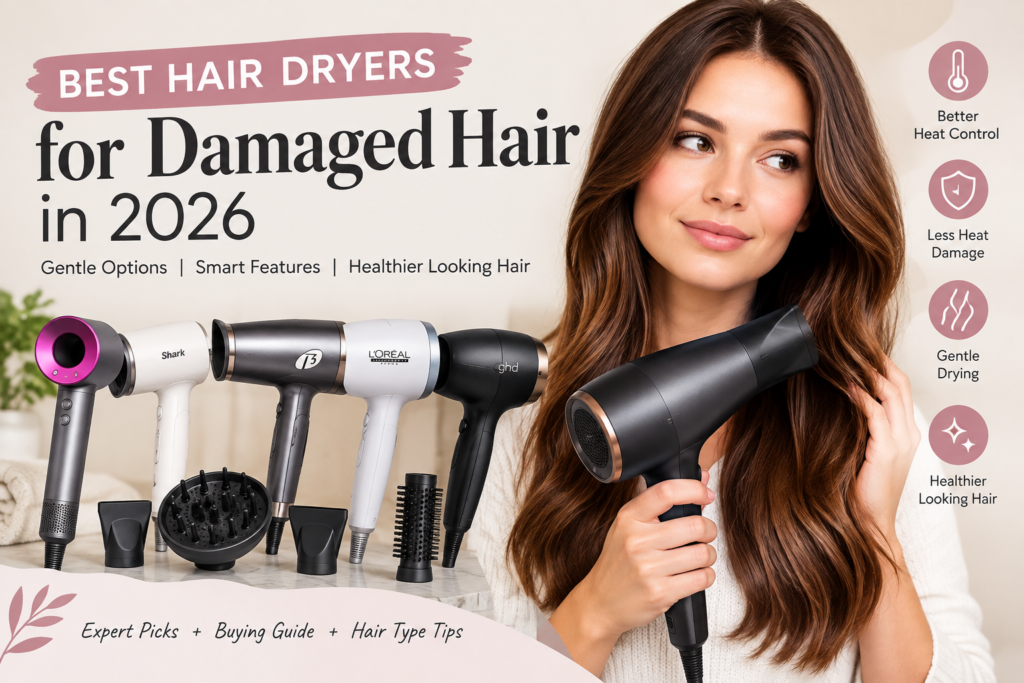
A damaged head of hair can turn a normal blow-dry into a difficult tradeoff. You need enough airflow to get hair dry, but too much heat or rough handling can make already-fragile strands feel worse. The best hair dryers for damaged hair try to resolve that tension with better heat control, faster drying, and attachments that spread airflow gently.
This guide skips the generic “best overall / best budget” format. It asks a more useful question: what actually makes a dryer a better choice for damaged hair?
This article contains affiliate links. If you purchase through one of these links, Natural Skin Studio may earn a commission at no additional cost to you. This does not affect how we evaluate or describe products.
A note on how this guide was built: It draws on manufacturer pages, dermatology guidance, and published reviews. It is not based on our own lab testing. We label manufacturer claims as manufacturer claims, and prices are approximate and change often, so check the retailer before buying.
One rule up front: no dryer repairs damaged hair. An appropriate dryer may help you avoid adding heat stress, but existing damage doesn’t reverse because you changed tools. Nothing here is “damage-proof.”
Quick Comparison: Hair Dryers for Damaged Hair
| Hair Dryer | Best For | Heat Control | Key Technology | Attachments | Main Advantage | Main Limitation | Price Tier |
|---|---|---|---|---|---|---|---|
| Dyson Supersonic Nural | Scalp-conscious, daily users | Scalp Protect mode adjusts heat by distance (Dyson) | Sensors, intelligent heat control | 5, incl. Gentle air, diffuser | Distance-aware heat | Price; learning curve | Premium (~$450 at last check) |
| Dyson Supersonic | Color-treated, fine to thick hair | Intelligent heat control (Dyson) | Digital motor | 5, incl. Gentle air | Well-rounded attachments | Price | Premium |
| Shark SpeedStyle | Value-minded shoppers | 4 heat levels incl. no heat; stated 230°F cap (Shark) | Temperature regulation | 2–3 stylers, by kit | Lower cost, lighter | Cap is a manufacturer claim | Mid-range (~$160–$200) |
| T3 AireLuxe | Fast drying at lower heat settings | 5 heat × 3 speed settings | Ion generator, digital control | 2 concentrators; diffuser sold separately | Light, wide airflow | Mixed owner reviews on power | Upper mid ($224.99 list) |
| L’Oréal Professionnel AirLight Pro | Infrared curiosity, custom modes | 3 temps × 3 airflows, plus pro modes | Infrared + airflow | Comb sold separately | App-customizable modes | Claims are L’Oréal’s own | Premium (verify) |
What Actually Makes a Hair Dryer Better for Damaged Hair?
Most of what matters comes down to a few factors:
- Heat control and usable low settings. A dryer that only runs hot gives you no room to be gentle.
- Temperature regulation. Consistent output matters more than peak output.
- Airflow and drying speed. Strong airflow can shorten drying time, which can mean less total heat exposure.
- Distance and movement. How you use the dryer matters as much as which one you own.
- Attachments, weight, and hair-type fit. A diffuser, a concentrator, and a dryer you can hold comfortably all affect how well you can use low heat.
- Evidence quality. Is a claim from independent testing, or from the brand?
- Price versus benefit. More money buys features, not guaranteed gentleness.
The American Academy of Dermatology (AAD) is blunt about the baseline. Dermatologists advise limiting blow-drying, using low or medium heat, and applying a heat-protective product. No dryer replaces those habits.
The Best Hair Dryers for Damaged Hair: In-Depth Picks
Dyson Supersonic and Supersonic Nural
What it is

- Fast drying. The small, powerful Dyson digital motor V9 combined with Air Multiplier technology produces a high-pressure…
- Intelligent heat control. The Dyson Supersonic hair dryer measures air temperature over 40 times a second and regulates …
- Magnetic attachments adjust quickly and easily. Heat Shield technology keeps the surfaces of attachments cool, even duri…

- A new network of Nural sensors within the machine activate intelligent features automatically to optimize your styling r…
- Scalp protect mode automatically adjusts air temperature to maintain an optimal target temperature of 130°F at the scalp…
- Attachment learning recognizes each attachment and remembers your styling preferences. New, intelligent attachments auto…
Dyson’s flagship dryer comes in two generations. Dyson says both include five attachments, and the Nural adds sensor-driven features. Dyson lists a two-year limited warranty. One price tracker put the Nural near $450 in June 2026. Verify current pricing and stock directly.
Why it may suit damaged hair
Dyson says its intelligent heat control is engineered to prevent extreme heat damage. Those figures come from Dyson’s own testing, so treat them as manufacturer claims. They are not independent proof.
Heat-control features
Dyson says the Gentle air attachment diffuses airflow and lowers temperature by up to 20 degrees, and positions it for sensitive scalps and color-treated hair. On the Nural, Scalp Protect mode adjusts temperature based on how close the dryer is to your head. Reviewers add useful caveats. One found it can occasionally lower the temperature more than necessary. Another noted the dryer still gets quite hot if held too close to the scalp. Dyson Supersonic Nural review: tech-packed and time-saving +2
Technology
Dyson describes a digital motor with heat regulation. The Nural adds sensors for Scalp Protect, Attachment Learning, and Pause Detect, according to Dyson.
Best hair types
Dyson’s attachment range spans straight to coily. It shows a diffuser for curls and a wide-tooth comb attachment for textured styles. The Flyaway attachment is for dry, straight hair only, per Dyson.
What we like
The Gentle air attachment is a rare dedicated lower-temperature tool. The Nural’s distance-aware heat is a genuinely different approach. For a deeper look at the original, see our Dyson Supersonic review.
Potential drawbacks
Cost is the obvious one. One UK comparison argues that for straight to wavy hair with a healthy scalp, the original Supersonic does everything the Nural does for drying performance. You pay extra mainly for scalp sensing. mamabella
Who should buy it
Daily blow-dryers with scalp sensitivity or color-treated hair, and anyone who wants a full attachment set.
Who should skip it
Budget shoppers, and people who already keep the dryer moving and a few inches from the scalp.
Shark SpeedStyle
What it is

- High-Speed Styling, No Compromise: This powerful hair dryer delivers ultra-fast wet-to-dry results with three smart styl…
- Shiny, Frizz-Free Finish: The RapidGloss Finisher uses dual high-speed airflow to smooth flyaways and boost shine, givin…
- No Heat Damage: Advanced technology regulates temperature 1,000x per second, staying below 230°F to protect hair from he…
A lighter, lower-cost alternative with styler attachments. Retail has run roughly $180 to $200 depending on the kit, with sales near $160. It has been sold in different configurations for straight/wavy versus curly/coily hair, so confirm which kit you’re buying. Check whether a newer SpeedStyle version has replaced it. wwd
Why it may suit damaged hair
Shark relies on strong airflow rather than high heat. Per Shark’s listing, it has a 1700W motor, four heat levels including no heat, three airflow settings, and a cool shot.
Heat-control features
Shark states it measures and regulates temperature 1,000 times per second and never exceeds 230°F. That is a manufacturer claim. A ceiling is not the same as “gentle,” and 230°F is still hot.
Technology
Temperature regulation, plus attachments that automatically set heat and airflow for each styler, per Shark.
Best hair types
Straight and wavy hair with the standard kit. Curly and coily users should look at the curl-specific configuration.
What we like
The price-to-feature ratio, and weight of about 0.75 kg for the dryer alone, per Shark. It’s our pick for best value option among the dryers researched here.
Potential drawbacks
Reviews are mostly older, and its temperature claim has not been independently verified in anything we reviewed. For a direct matchup, read our Shark SpeedStyle vs. Dyson Supersonic comparison.
Who should buy it
Shoppers who want a temperature-capped dryer without a premium price.
Who should skip it
Anyone who wants distance-aware scalp protection or a long attachment lineup.
T3 AireLuxe
What it is

- PROFESSIONAL BLOW DRYER FOR FAST DRYING: T3 AireLuxe’s digitally controlled heat and ion-rich airflow deliver fast dryin…
- ION GENERATOR FOR SMOOTHER, FRIZZ-FREE STYLING: AireLuxe produces 10 million negative ions per second to neutralize stat…
- 5 HEAT & 3 SPEED SETTINGS PLUS COOL SHOT: Choose from 5 heat and 3 speed settings for any hair type, gentle for fine or …
A salon-style dryer listed at $224.99 on T3’s official page. It’s often discussed alongside other premium options in our broader comparison of professional dryers for home use.
Why it may suit damaged hair
T3 says its wide airflow cuts dry time in half and helps hair retain up to 60% more natural moisture. Those figures come from T3’s own testing and should be treated as marketing claims.
Heat-control features
T3 lists five heat and three speed settings, giving 15 combinations, plus a cool shot. That makes lower heat with higher airflow easy to dial in.
Technology
T3 says a smart microchip digitally controls heat and that an ion generator emits 10 million negative ions per second to reduce frizz. Treat the ion claim as a manufacturer claim (more in the tech section below).
Best hair types
T3 positions it for all hair types. The diffuser and a smoothing comb are sold separately. T3 specifies 1875W, 17.1 oz (without cord), and a 9-foot cord.
What we like
The weight is notably low on paper, and the included concentrators are practical. On T3’s own site, one reviewer with fine hair praised the speed at lower heat.
Potential drawbacks
Owner reviews on T3’s site are positive overall but not unanimous. One buyer called it slow compared with their previous dryer, and another disliked the diffuser.
Who should buy it
Straight-to-wavy hair that needs fast drying with adjustable heat, and anyone prioritizing low weight.
Who should skip it
Curly and coily users who want a strong diffuser out of the box.
L’Oréal Professionnel AirLight Pro
What it is

- Fast-Drying Blow Dryer: The AirLight Pro hair dryer is augmented Infrared light technology for fast drying and hydration…
- Benefits: Co-developed with stylists this cutting-edge dryer combines the power of heat, wind and infrared light for pow…
- Features: Lightweight 1.7lb with a powerful 17-blade high-speed motor. Customizable heat settings reach up to 285OF and …
An infrared-assisted dryer detailed on L’Oréal Professionnel’s official page. The page we reviewed is L’Oréal’s international site. US availability, pricing, and sales channels (including salon-focused ones) may differ, so check before you plan around it.
Why it may suit damaged hair
L’Oréal says it combines infrared light with airflow to target water molecules directly and shorten heat exposure. It cites up to 21% faster drying than the most-sold premium European dryer, and 55% more hydration locked in versus naturally dried hair, from its own instrumental tests. We did not find independent testing in our research.
Heat-control features
L’Oréal lists a standard mode with three temperatures and three airflows. A pro mode adds Sleek, Curly, Coily, and Custom presets, all adjustable in an app.
Technology
Infrared light plus conventional airflow.
Best hair types
L’Oréal publishes styling videos for straight, wavy, coily, and color-treated hair. A professional comb for curly and coily hair is sold separately.
What we like
Customizable modes make it the best infrared option we could responsibly name, mainly because it’s the only infrared dryer we verified.
Potential drawbacks
Unverified US pricing and availability, and a reliance on brand-reported data.
Who should buy it
Tech-curious shoppers who want programmable heat and airflow profiles.
Who should skip it
Anyone who wants independent test data before spending premium money.
Best Hair Dryer for Fine Damaged Hair
Fine strands tend to have less margin for error, so lower heat, controlled airflow, and a lighter tool that’s easy to keep moving all help. Shortlist the T3 AireLuxe for its low listed weight and 15 heat/speed combinations, or the Shark SpeedStyle for its no-heat and low-heat options. The Nural’s Scalp Protect is worth considering if you tend to dry close to the roots.
Best Hair Dryer for Bleached or Color-Treated Hair
Bleached and color-treated hair is often more porous and fragile, so excess heat is a real concern. The AAD notes that excessive heat can damage hair of any type. Temperature management matters most here. Dyson’s Gentle air attachment is designed for a lower-temperature airflow and Dyson ties it to color retention, though that’s Dyson’s claim. The AirLight Pro’s custom modes could also help you build a low-heat profile.
Best Hair Dryer for Thick Damaged Hair
Thick hair takes longer to dry, which tempts people to crank the heat. The better strategy is strong airflow with moderate heat. Shark leans on airflow over heat, while T3 pairs a wide airflow pattern with adjustable settings. Dyson’s full attachment set also helps you work section by section. Be aware that one reviewer felt Scalp Protect can feel slower on thick or coarse hair. toptrustedproducts
Best Hair Dryer for Curly or Coily Damaged Hair
Curls benefit from a diffuser, gentler airflow, and less manipulation while drying. Dyson’s Nural features a re-engineered diffuser, designed with curly hair types in mind. L’Oréal’s AirLight Pro has Curly and Coily modes plus an optional comb. T3’s diffuser is a separate purchase and one T3-site reviewer rated it unimpressive. Notably, the AAD says people with tightly curled or textured hair should brush when wet to reduce breakage, which differs from advice for other hair types. tomsguide
Best Lightweight Hair Dryer for Damaged Hair
A dryer you can hold comfortably is a dryer you’ll move properly. Per manufacturer specs, the T3 AireLuxe is 17.1 oz without the cord, and Shark lists 0.75 kg for the Speedstyle dryer alone. A Nural reviewer praised the weight distribution for comfortable drying, though we found no official weight to compare. thedisconnekt
Technology Explained: What to Expect
Ionic technology
Manufacturers say ion generators reduce static and smooth the cuticle. Independent evidence in the consumer dryers we reviewed was limited, so expect modest frizz benefits at most. It does not reduce heat or repair damage.
Ceramic technology
Ceramic elements are generally marketed for more even heat distribution. Even heat is useful, but it doesn’t make a dryer safe on its own.
Tourmaline technology
Tourmaline is a mineral often used in coatings and marketed alongside ionic features. Claims are usually manufacturer-driven, so treat it as a minor bonus.
Infrared technology
Infrared dryers, like the AirLight Pro, are designed to dry with less reliance on hot air. L’Oréal’s performance numbers come from its own tests. We’d want independent testing before calling it better than a good conventional dryer.
Intelligent temperature control
Regulated temperature can matter more than raw wattage. Systems like Dyson’s and Shark’s aim to prevent spikes. Their effectiveness rests mostly on brand testing, but the underlying logic is sound.
What to Look for in a Hair Dryer for Damaged Hair
- Multiple heat settings, including low/medium. The AAD recommends low or medium heat.
- Adjustable airflow. Lets you trade heat for speed.
- Cool shot. Useful for finishing.
- Temperature regulation. Look for specifics, then read who verified them.
- Attachments that fit your hair. Concentrator for straight, diffuser for curls.
- Light construction and solid drying speed.
- Heat protectant. Use one, as the AAD advises.
Why more watts doesn’t mean better: wattage describes motor power, not temperature or gentleness. A powerful dryer can dry faster, but only controlled heat and good technique keep exposure down. Two dryers with similar wattage can behave very differently at the nozzle.
A Damage-Minimizing Blow-Drying Routine
General information, not medical advice.
- Gently remove excess water. The AAD suggests wrapping hair in a towel or letting it air-dry.
- Skip aggressive towel rubbing. Rough drying can cause damage, per the AAD.
- Apply a heat protectant. The AAD advises a product to protect hair from heat.
- Let hair partially air-dry when practical. The AAD lists this as a way to limit damage.
- Start with low or medium heat. Also AAD guidance.
- Keep the dryer moving. (Common stylist practice, not AAD-specific.)
- Avoid holding heat on one section.
- Use a concentrator for straight styling.
- Use a diffuser for curls and coils.
- Finish with cool air when useful.
The AAD also notes that reducing how often you blow-dry each week helps limit damage. If you notice persistent breakage or hair loss, see a board-certified dermatologist.
Common Mistakes
- Using maximum heat every time. Lower settings with more airflow are usually kinder.
- Holding the dryer too close or too long in one spot.
- Blow-drying soaking-wet hair aggressively, or brushing roughly while wet.
- Assuming expensive means damage-free. Price buys features, not immunity.
- Choosing by wattage alone, or ignoring attachments.
- Skipping heat protection.
- Confusing frizz reduction with repair. Smoother-looking hair isn’t healed hair. For polish after drying, see our guide to premium tools for frizzy hair.
Is a Dedicated Dryer Always the Answer?
Not necessarily. If you dry and style in one step, a multi-styler may replace a dryer for some people. Dyson’s version is covered in our Dyson Airwrap review. For damaged hair, though, a good dedicated dryer with real heat control is usually the simpler place to start.
FAQ
1. What is the best hair dryer for damaged hair in 2026?
There isn’t one winner. The Dyson Supersonic Nural suits scalp-conscious daily users, the Shark SpeedStyle is the value pick, and the T3 AireLuxe is a lightweight option. The best choice depends on your hair texture, budget, and how often you dry.
2. Is Dyson Supersonic good for damaged hair?
Dyson says its intelligent heat control is designed to prevent extreme heat damage, and it offers a Gentle air attachment. Those are manufacturer claims. It’s a well-reviewed premium dryer, but no dryer repairs damage, and technique still matters.
3. Is Dyson Supersonic Nural better for damaged hair?
It adds Scalp Protect, which adjusts heat based on distance from your head. That’s useful if you dry close to the scalp. For many people, reviewers say the original performs similarly for drying, so you’re paying mainly for sensors.
4. Are ionic hair dryers good for damaged hair?
Manufacturers say ions help reduce frizz and static. That may improve how hair looks and feels, but it doesn’t repair damage or reduce heat. Prioritize temperature control and settings first, and treat ionic as a bonus.
5. Is infrared better than ionic for damaged hair?
We can’t say. L’Oréal says its infrared system shortens heat exposure, but the data we found is from the brand. Ionic claims are also mostly manufacturer-sourced. Compare features like adjustable heat rather than assuming either technology wins.
6. What heat setting should I use on damaged hair?
The AAD recommends low or medium heat settings. Combine that with a heat protectant and keep the dryer moving. If your dryer has adjustable airflow, higher airflow with lower heat is often a sensible approach.
7. Can a hair dryer repair damaged hair?
No. A better dryer may help you avoid adding stress, but existing damage doesn’t reverse. Trimming, gentler handling, and less frequent heat use do more. A dermatologist can help if breakage is severe.
8. Is a high-wattage hair dryer bad for damaged hair?
Not automatically. Wattage reflects motor power, not temperature. A strong motor can dry faster at lower heat, which may reduce exposure. What matters is how hot the air gets and how you use it.
9. How often can I blow-dry damaged hair?
There’s no universal number. The AAD says reducing blow-drying frequency helps limit damage, so air-dry or partially air-dry when practical. Use low or medium heat on the days you do blow-dry.
10. Should I use a heat protectant with a hair dryer?
Yes. The AAD advises using a product to protect hair from heat, along with low or medium settings. A protectant doesn’t make heat harmless, so combine it with good technique and temperature control.
The Bottom Line
The right dryer depends on your degree of damage, hair texture, how often you dry, how heat-sensitive your scalp is, your budget, and which attachments you actually need. Choose the Nural if scalp protection is your priority, the Shark if value matters, the T3 for light weight, and the AirLight Pro if you want to experiment with infrared. Whatever you choose, the dryer is only one part of a damage-conscious routine. Gentle towel drying, heat protectant, low heat, and less frequent blow-drying do much of the work.