
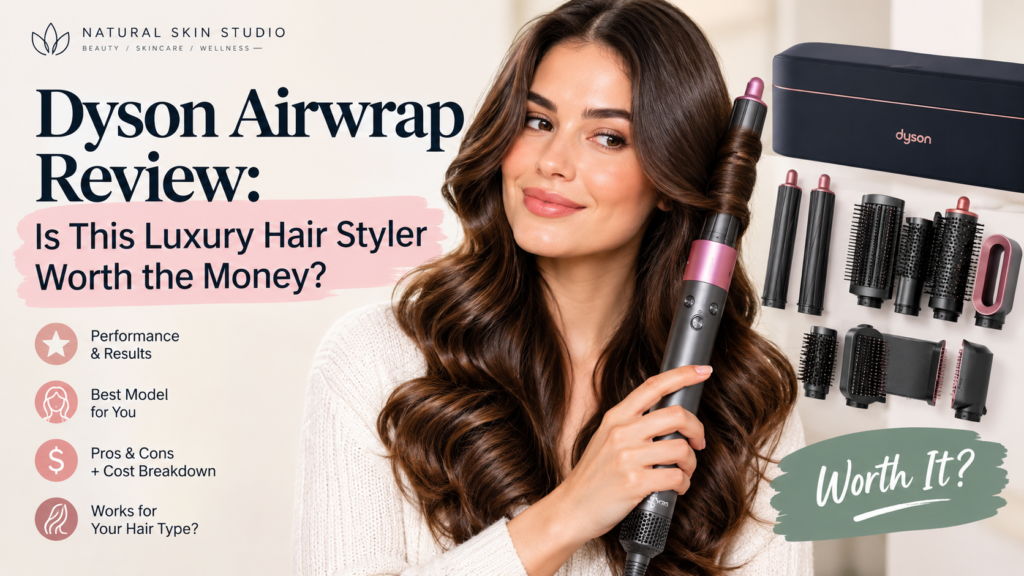
Spending several hundred dollars on a hair tool sounds absurd until you’re standing in the aisle, credit card in hand, wondering if this is the thing that finally ends your daily battle with a flat iron and three different brushes. That’s the appeal — and the risk — of the Dyson Airwrap.
The real question isn’t whether the Airwrap is impressive engineering. It clearly is. The question is whether it’s genuinely different enough to justify a luxury price tag, or whether shoppers are mostly paying for the Dyson name.
The short answer: for the right person, it earns its price by replacing multiple tools and cutting down on extreme-heat styling. For the wrong person — someone who dries their hair twice a week and calls it a day — it’s an expensive way to own a very well-engineered hair dryer.
Let’s break down exactly why.
Quick Answer: Is the Dyson Airwrap Worth It?
If you style your hair several times a week, use more than one heat tool in your routine, and want to reduce reliance on extreme-heat styling, the Airwrap tends to deliver real long-term value. If you mostly just blow-dry and go, or you already get great results with a $40 curling iron, the premium price is harder to justify.

- Coanda styling pioneered by Dyson: The Dyson Airwrap multi-styler harnesses an aerodynamic phenomenon called the Coanda …
- Powered by the Dyson digital motor V9: The 13-blade impeller spins at up to 110,000rpm, generating 3.2kPa. Powerful enou…
- Intelligent heat control: Measures airflow temperature over 40 times a second, intelligently controlling the heating ele…
Hair type matters too. Fine and straight-to-wavy hair tends to see the most dramatic before-and-after with the Airwrap’s barrels. Very thick, coarse, or coily hair can still get good results, but often needs more time, more product, and — depending on the attachment — a bit more trial and error.
Styling frequency is the biggest variable in whether the cost per use ever starts to look reasonable. We’ll walk through the actual math further down.
What Is the Dyson Airwrap?
The Dyson Airwrap is a multi-styling tool that dries, curls, waves, smooths, and volumizes hair using fast-moving air instead of relying purely on very hot metal barrels or plates. Instead of clamping hair between hot surfaces the way a traditional curling iron or flat iron does, it uses air pressure to wrap sections of hair around a barrel automatically.
It comes as a single handle-and-motor unit with interchangeable attachments, so one device covers jobs that would otherwise require a hair dryer, a curling iron, a round brush, and a flat iron.
How Does the Dyson Airwrap Work?
The core technology behind the Airwrap is something called the Coanda effect — a physics principle where a fast-moving stream of air follows the curve of a nearby surface instead of shooting straight past it.
In practical terms: when you hold a section of hair near the styling barrel, the airflow “hugs” the curved surface of the barrel and pulls the hair along with it, wrapping it automatically. That’s why you don’t have to manually twist your hair around the barrel the way you would with a curling iron — the air does that part.
This is also central to Dyson’s pitch on hair health. According to Dyson, the Co-anda2x model uses its Hyperdymium 2 motor to deliver 2x the air pressure of the previous generation, drying hair as fast as a full-performance hair dryer, while still styling primarily through airflow rather than sustained, high-intensity heat contact.
Dyson Airwrap Models in 2026
This is where a lot of shoppers get confused, because Dyson currently sells more than one Airwrap, and older generations are still floating around too.
As of early 2026, Dyson’s Airwrap lineup includes three tiers: the Airwrap Origin, the Airwrap i.d., and the Airwrap Co-anda2x, so you can choose based on budget and how much smart functionality you want.
| Model | What it is | Best for |
|---|---|---|
| Older Airwrap generations | Original Coanda airflow styling, no app connectivity | Budget-conscious buyers who still want the core Airwrap concept |
| Airwrap i.d. | App-connected multi-styler with a personalized curl sequence | Buyers who want smart guidance without paying for the newest motor |
| Airwrap Co-anda2x | Dyson’s newest, most powerful version | Buyers who want the fastest drying, latest attachments, and straightening capability |
Airwrap i.d. connects to the MyDyson app via Bluetooth. You build a hair profile, and the device’s “i.d. curl” sequence senses movement and adjusts heat, airflow, and timing to your hair type as you style.
Airwrap Co-anda2x is the newer, more powerful option. Dyson describes it as its most powerful Airwrap multi-styler, built around the Hyperdymium 2 motor, and says it’s also smaller and lighter than the previous generation for improved control. It adds wet-to-dry straightening through a new attachment, updated curling barrels, and “intelligent attachments” that remember your preferred settings.
One important compatibility note: Dyson confirms that Co-anda2x attachments will not fit older Airwrap devices, and attachments from previous devices won’t fit the Co-anda2x, because the newer unit was engineered to be smaller with a faster motor. If you already own attachments from an older Airwrap, upgrading to the Co-anda2x means starting your attachment collection over.
Older Airwrap generations still work and are still sold at a lower price point, but they lack app connectivity and the newer motor’s airflow output.
Dyson Airwrap Attachments Explained
Attachments are where the Airwrap earns its “multi-styler” label, but not every attachment matters to every user. Here’s what the core ones actually do.
Curling barrels are the signature feature. Different barrel sizes create different curl types — smaller barrels for tighter curls, larger ones for loose waves. On the Co-anda2x, the new Conical curling barrel is designed with a tapered shape for what Dyson describes as seamless, natural-looking curls from root to tip, while the 1.6-inch barrel is built to wrap more hair for loose waves and bouncy curls, aimed at mid-length to longer hair.
Smoothing attachments use directed airflow to lay hair flat and reduce frizz without clamping it between hot plates the way a flat iron does.
Round volumizing brush combines brush bristles with airflow through the base, intended to lift hair at the root while reducing tangling as you dry.
Pre-styling / dryer attachment is meant for the first pass on wet hair — getting hair to roughly 80% dry before you move to curling or smoothing attachments, which work best on hair that isn’t soaking wet.
Flyaway and finishing tools are smaller attachments meant for final touch-ups — taming baby hairs and static rather than doing the primary styling work.
On the newer Co-anda2x, Dyson has also added an Air Straightener 2x attachment, which is notable because previous Airwrap generations didn’t offer true wet-to-dry straightening. Dyson describes this attachment as creating a straighter, shinier finish using aerothermal plates that can straighten hair from wet to dry in as little as one pass. If straightening was the one job your old Airwrap couldn’t do, this is the attachment that changes that.
Dyson Airwrap Performance: What Can It Actually Do?
Drying: The Airwrap can function as a standalone dryer using its pre-styling attachment, and Dyson positions the Co-anda2x specifically as being able to match full hair-dryer performance. In practice, most users still find it more natural to use it for drying-while-styling rather than as a dedicated everyday dryer for days when they’re not doing a full style.
Curling: This is the Airwrap’s strongest feature. The auto-wrap function genuinely saves time and coordination compared to manually wrapping hair around a curling iron, especially for curls near the crown that are hard to see in a mirror.
Waves: Larger barrels produce looser, beachy waves reasonably well, though very loose waves can require larger sections and more practice with timing.
Blowouts: The round brush attachment can create a smooth, voluminous blowout, but it typically takes longer than a dedicated blow-dryer-and-brush routine, since you’re working in smaller sections for even airflow contact.
Smoothing: Good for reducing frizz and adding shine, but it’s not a full flat-iron replacement for very coarse, resistant, or heavily textured hair that needs high, sustained heat to lie flat — unless you’re using the newer Air Straightener 2x attachment specifically.
Volume: A genuine strength, particularly at the roots, thanks to the round brush attachment’s airflow-through-bristles design.
Flyaway control: Solid for finishing touches, less effective as a primary frizz-fighting tool on very frizz-prone hair in humid conditions.
How Well Does the Dyson Airwrap Work on Different Hair Types?
Results vary a lot by hair type and by what you’re actually trying to achieve, so treat this as a general guide, not a promise.
Fine hair: Often one of the best matches. The lower reliance on extreme heat can feel gentler, and the round brush adds volume without weighing hair down.
Straight hair: Works well for adding waves or curls to hair that doesn’t naturally hold a curl, though curl longevity depends heavily on technique (more on that below).
Wavy hair: Tends to respond very naturally to the barrels, often needing less heat and less time than straight hair to achieve texture.
Thick hair: Can absolutely be styled, but usually takes longer, since you’ll need to work in smaller sections for the airflow to dry and shape each section properly.
Curly hair: Some curly-haired users use the Airwrap to smooth or stretch curls, or to define them; others find their natural curl pattern is easier to enhance with curl-specific tools. Results here vary more than for straight or wavy hair.
Coily hair: This is where independent reviewers have been most split. The Airwrap’s barrels weren’t originally designed with tightly coiled textures as the primary use case, so expectations should be realistic and technique matters even more.
Long hair: Generally styles well, since there’s more length to work with when wrapping around barrels.
Short hair: Can be trickier for full-barrel curling since there may not be enough length to wrap comfortably around larger attachments, though smaller barrels and the round brush still work.
Why Do Dyson Airwrap Curls Fall Out?
This is one of the most common complaints, and it’s rarely a device malfunction — it’s usually one of these:
- Hair too wet or too dry. Hair that’s still very wet won’t hold a curl shape after cooling; hair that’s already fully dry won’t reshape as easily either. The 80%-dry range tends to work best.
- Sections too large. Bigger sections dry unevenly, so the outer hair sets while the inner hair stays damp and drops the curl shape.
- Skipping the cool shot. Letting hair cool in its curled shape before releasing it is what actually locks the style in — releasing too early undoes a lot of the work.
- No styling product. A lightweight prep spray or cream gives the curl something to hold onto; bare, freshly washed hair often loses curl faster.
- Hair texture. Very fine or very smooth hair naturally holds curl shape for less time than coarser or more textured hair.
- Humidity. Like any curl, Airwrap curls will relax faster in humid conditions without a humidity-resistant product.
- Wrong barrel or attachment for the goal. A larger barrel used for tight ringlets, or vice versa, won’t hold the way you expect.
- Technique inconsistency. Direction of wrap, timing, and tension all affect how long a curl lasts — this improves with practice.
Is the Dyson Airwrap Less Damaging Than Traditional Hot Tools?
Reduced reliance on extreme, sustained heat is a core part of the Airwrap’s design philosophy — using airflow to shape hair rather than clamping it between very hot plates for several seconds at a time. That’s a meaningful mechanical difference from a standard curling iron or flat iron.
- Coanda styling pioneered by Dyson: The Dyson Airwrap multi-styler harnesses an aerodynamic phenomenon called the Coanda …
- Powered by the Dyson digital motor V9: The 13-blade impeller spins at up to 110,000rpm, generating 3.2kPa. Powerful enou…
- Intelligent heat control: Measures airflow temperature over 40 times a second, intelligently controlling the heating ele…
That said, it would be inaccurate to call the Airwrap “damage-free.” It still applies heat, hair can still be affected by frequent heat styling of any kind, and outcomes depend on your hair’s condition, how often you style, and what temperature settings you use. Treat “gentler” as a reasonable characterization and skip any tool — including this one — that claims zero damage.
Dyson Airwrap Pros and Cons
Pros:
- Genuine versatility — one tool covers drying, curling, waving, and smoothing
- Airflow-based styling that reduces reliance on extreme, sustained heat
- Multiple styling functions in one attachment ecosystem
- Strong build quality and motor engineering
- Growing attachment lineup, including newer straightening capability
- Can dry and style in the same session rather than as separate steps
Cons:
- High upfront price relative to single-purpose tools
- Real learning curve for new users
- Curl longevity varies by hair type, humidity, and technique
- Not every attachment is useful to every hair type or goal
- Some users still keep a separate flat iron or curling iron for certain looks
- Upgrading between Airwrap generations often means buying new attachments, since older accessories aren’t compatible with newer motors
- Large initial investment compared to buying tools individually as needed
- Coanda styling pioneered by Dyson: The Dyson Airwrap multi-styler harnesses an aerodynamic phenomenon called the Coanda …
- Powered by the Dyson digital motor V9: The 13-blade impeller spins at up to 110,000rpm, generating 3.2kPa. Powerful enou…
- Intelligent heat control: Measures airflow temperature over 40 times a second, intelligently controlling the heating ele…
Dyson Airwrap vs. Traditional Hair Tools
Vs. a curling iron: The Airwrap’s auto-wrap function is faster and more consistent for hard-to-reach sections, but a traditional curling iron gives you more direct manual control over curl tightness and placement, and it’s far cheaper to replace.
Vs. a flat iron: A dedicated flat iron still tends to deliver flatter, more resistant-to-humidity results on very coarse or heavily textured hair, especially in a single fast pass. The Airwrap’s newer straightening attachment narrows this gap but doesn’t fully replace a high-heat flat iron for everyone.
Vs. a standard hair dryer: A basic hair dryer is lighter, cheaper, and faster for simple “get it dry and move on” days. The Airwrap adds styling capability a plain dryer doesn’t have, at the cost of more time and a learning curve.
Vs. a hot-air brush: Hot-air brushes are a simpler, single-attachment version of the same airflow-styling idea. The Airwrap offers more attachment variety and (on newer models) app-guided settings, but a hot-air brush is often faster for a simple smooth blowout with less setup.
If you’re mainly deciding between Dyson’s own dedicated dryers versus the Airwrap for pure drying performance, our best luxury hair dryers in 2026 guide breaks down how Dyson’s standalone dryers compare on drying speed and price.
Dyson Airwrap vs. Shark FlexStyle
This is one of the most searched comparisons in this category, and for good reason — the FlexStyle is built around a similar concept at a lower price.
| Factor | Dyson Airwrap | Shark FlexStyle |
|---|---|---|
| Price | Higher across all tiers | Standard set retails around $299.99 with 4 attachments |
| Versatility | Broad attachment ecosystem, including straightening on newer models | Also multi-attachment, with curlers, a finishing tool, and brush options |
| Drying | Strong, especially on Co-anda2x | Capable, positioned as a drying-and-styling combo tool |
| Curling | Auto-wrap barrels are a signature strength | Auto-Wrap curlers offer a similar concept at lower cost |
| Smoothing | Effective; newer straightening attachment adds more | Includes an Oval Brush attachment designed to smooth and add volume while drying |
| Learning curve | Noticeable for first-time users | Similarly features a learning curve, though often described as slightly more forgiving |
| Attachments | Premium build, but not cross-compatible between Dyson generations | Additional attachments can be purchased separately |
| Portability | Solid; newer Dyson models are lighter | Generally lightweight and travel-friendly |
| Best for | Buyers who want the newest tech and don’t mind the price | Budget-conscious buyers who want a similar styling concept for meaningfully less money |
Neither tool is a universal winner. If price is the deciding factor and you mainly want the “airflow styling” concept, the FlexStyle is a reasonable way to test whether this styling method fits your routine before committing to Dyson pricing. If you want the newest attachment technology, app connectivity, or the most powerful motor available, the Airwrap Co-anda2x is the more capable — and more expensive — option.
How Much Does the Dyson Airwrap Cost?
Pricing varies by model and changes periodically, so treat these as current approximate figures rather than fixed pricing. As of early 2026, one independent reviewer reported the three-tier Dyson Airwrap lineup priced at roughly $550 for the Airwrap Origin, $650 for the Airwrap i.d., and $749 for the Airwrap Co-anda2x. Always check Dyson’s official site for current pricing before buying, since promotional pricing and bundle offers shift throughout the year.
For comparison on the budget end, the standard Shark FlexStyle set with four attachments has a retail price around $299.99, with additional attachments sold separately.
Dyson Airwrap Cost Per Use
Here’s an illustrative — not guaranteed — way to think about value over time.
Say you buy the Co-anda2x at roughly $749 and use it three times a week. Over two years, that’s about 312 uses, working out to roughly $2.40 per use. Over three years at the same frequency, that drops to around $1.60 per use.
If you only use it once a week, that same $749 spread over two years (about 104 uses) works out closer to $7.20 per use — a much harder number to justify next to a $30 curling iron.
This is purely an example calculation to illustrate how frequency changes the math, not a projection of savings or a guarantee of the device’s lifespan.
Who Should Buy the Dyson Airwrap?
- People who currently do full blowouts multiple times a week and want to speed up or simplify that routine
- People who regularly both curl and smooth their hair and are tired of switching between multiple hot tools
- People looking to consolidate several separate tools into one device
- People who specifically want to reduce their reliance on extreme, sustained heat styling
- People who enjoy experimenting with different hairstyles and want a wider range of attachment options
If premium styling tools generally interest you, it’s worth browsing Natural Skin Studio’s Beauty Tools category for more comparisons before deciding where the Airwrap fits into your routine.
- Coanda styling pioneered by Dyson: The Dyson Airwrap multi-styler harnesses an aerodynamic phenomenon called the Coanda …
- Powered by the Dyson digital motor V9: The 13-blade impeller spins at up to 110,000rpm, generating 3.2kPa. Powerful enou…
- Intelligent heat control: Measures airflow temperature over 40 times a second, intelligently controlling the heating ele…
Who Should Skip the Dyson Airwrap?
- Occasional stylers who mostly wash-and-go or style once every week or two
- People who mainly need basic drying, not multi-function styling
- Shoppers on a genuinely limited beauty tool budget
- People who strongly prefer the direct control and speed of a traditional high-heat curling iron
- People who realistically won’t use most of the included attachments
Is Dyson Airwrap Worth the Money in 2026?
Value here depends on a handful of honest questions: How often do you actually style your hair? How many separate tools are you currently using, and would this genuinely replace them? Does your hair type respond well to airflow-based styling, or does it need more aggressive heat to hold a shape? And can your budget absorb the upfront cost without it becoming a source of buyer’s remorse?
For frequent stylers replacing multiple tools, the Airwrap tends to make long-term sense. For occasional users or those happy with a basic routine, cheaper tools — including the Shark FlexStyle — often deliver enough of the same concept for meaningfully less money.
Bottom Line
- Best for: Frequent stylers who want to replace multiple heat tools and reduce extreme-heat reliance
- Not ideal for: Occasional stylers or anyone on a tight beauty budget
- Biggest strength: Genuine multi-function versatility from one motor and attachment system
- Biggest drawback: High upfront price, plus a real learning curve before results feel consistent
- Before buying: Be honest about your styling frequency, hair type, and how many attachments you’ll realistically use
For more on building out a full haircare routine around premium tools, check out Natural Skin Studio’s haircare guides.
FAQ
Is the Dyson Airwrap worth it in 2026?
For frequent stylers replacing multiple tools, generally yes. For occasional users, the value is harder to justify given the price.
Which Dyson Airwrap is best in 2026?
It depends on budget and tech preference: older generations for lower cost, the Airwrap i.d. for app-guided styling, and the Airwrap Co-anda2x for the most powerful motor and newest attachments, including straightening.
What is the difference between Airwrap i.d. and Co-anda2x?
The i.d. offers app connectivity and a personalized curl sequence on an earlier motor platform. The Co-anda2x adds a more powerful motor, higher air pressure, new intelligent attachments, and wet-to-dry straightening capability.
Does the Dyson Airwrap work on fine hair?
Yes — fine hair is often one of the best-suited textures, since the tool relies less on extreme heat and the round brush adds root volume.
Does the Dyson Airwrap work on thick hair?
Yes, though thick hair typically requires smaller sections and more time to dry and style evenly.
Why do my Dyson Airwrap curls fall out?
Most often it’s due to hair being too wet or dry when styled, sections that are too large, skipping the cool-shot step, no styling product, humidity, or inconsistent technique.
Can the Dyson Airwrap replace a curling iron?
For many people, largely yes, thanks to the auto-wrap barrels — though some users still prefer a traditional curling iron for very specific, tight curl shapes.
Can the Dyson Airwrap replace a hair dryer?
It can function as a dryer, and newer models are built to match full dryer performance, but many users still find a dedicated dryer faster for simple no-styling days.
Is the Dyson Airwrap damaging to hair?
It’s designed to reduce reliance on extreme, sustained heat compared to traditional hot tools, but it still applies heat and isn’t damage-free. Results depend on your hair’s condition and how often you use it.
Is the Dyson Airwrap better than the Shark FlexStyle?
Neither is a universal winner. The Airwrap offers more attachment sophistication and the newest motor technology; the FlexStyle offers a similar styling concept at a significantly lower price.