
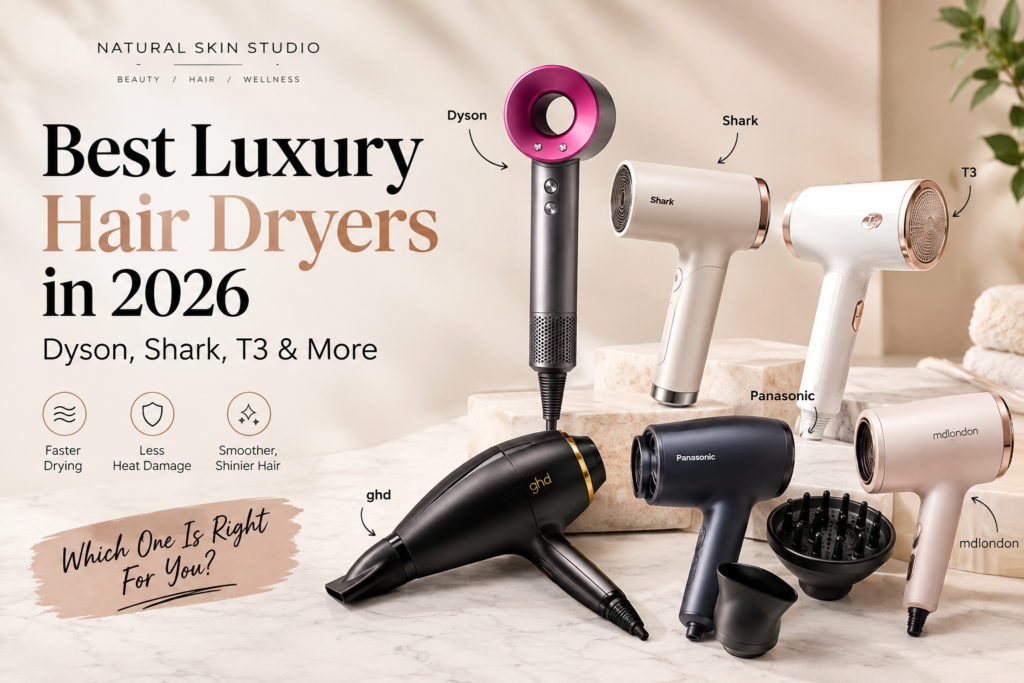
A $400 hair dryer sounds excessive until you start comparing what’s actually inside one. Airflow engineering that used to live only in professional salon equipment. Sensors that read your scalp temperature in real time. Motors light enough that a full blowout doesn’t leave your shoulder aching. Attachments that genuinely change the result, not just the box art.

- A network of Nural sensors within the machine activate intelligent features automatically to optimize your styling routi…
- Scalp protect mode automatically adjusts air temperature to maintain an optimal target temperature of 130°F at the scalp…
- Attachment learning recognizes each attachment and remembers your styling preferences. Intelligent attachments automatic…

- PROFESSIONAL PERFORMANCE: Style with high-velocity airflow for wet-to-dry, ultra-fast styling with no heat damage, in a …
- HIGH-VELOCITY. COMPACT DESIGN: Airflow reaches 0-100 mph in less than a second. Style with higher airflow velocity in a …
- SCALP SHIELD MODE: Activate to instantly reduce air temperatures to the optimum safe level for scalp comfort and root dr…

- PROFESSIONAL BLOW DRYER FOR FAST DRYING: T3 AireLuxe’s digitally controlled heat and ion-rich airflow deliver fast dryin…
- ION GENERATOR FOR SMOOTHER, FRIZZ-FREE STYLING: AireLuxe produces 10 million negative ions per second to neutralize stat…
- 5 HEAT & 3 SPEED SETTINGS PLUS COOL SHOT: Choose from 5 heat and 3 speed settings for any hair type, gentle for fine or …

- Advanced blow dry in less time: 75mph airflow and our patented Aeroprecis technology deliver salon-quality styling with …
- Smooth, shiny results: Ionic technology reduces frizz and flyaways for 30% more shine and smoother, healthier-looking ha…
- Lightweight and ergonomic: Balanced, comfortable design with low sound levels thanks to bespoke acoustic system
That doesn’t mean every expensive dryer earns its price tag, and it doesn’t mean a $90 drugstore model is doing something wrong. This guide isn’t about cheap everyday dryers — plenty of those do a perfectly good job for occasional use. It’s about the premium tier: the dryers people upgrade to when they’re drying and styling their hair most days of the week and want the experience, and the results, to feel different.
The real question worth asking in 2026 is whether Dyson still deserves the premium it commands, or whether Shark and T3 have closed the gap enough that spending less gets you nearly the same blowout. The honest answer, based on what each brand actually ships, is: it depends on your hair, your budget, and what you’re optimizing for. This guide walks through that decision so you don’t have to guess.
Quick Answer: Editor’s Picks
| Product | Best for | Approx. price* | Key strength | Main drawback |
|---|---|---|---|---|
| Dyson Supersonic Nural | Best Overall / Best Luxury Pick | $400–$450 | Sensor-based heat control, attachment memory | Highest price in the category |
| T3 AireLuxe | Best Value Luxury | $200–$230 | 15 heat/speed combinations, strong attachment set | Less “smart” than Dyson or Shark’s sensor tech |
| Shark SpeedStyle Pro FLEX | Best for Thick Hair / Best for Blowouts | $200–$230 | High-velocity airflow, folds for travel | Bulkier attachments than T3 |
| ghd Helios | Best for Fine Hair | $199 | Lightest ghd dryer, precise nozzle control | Only two heat settings |
*Prices fluctuate constantly across retailers and promotional periods. Treat these as ranges, not guarantees, and always check the current price before buying.
Nobody wins every category here, and that’s the point. If you have fine hair that scorches easily, the ghd Helios earns its spot for a different reason than the Dyson does for someone drying thick, long hair daily. We’ll get specific about who each dryer is actually for.
What Makes a Hair Dryer “Luxury”?
Price is the first thing people notice, but price alone doesn’t make a dryer luxury — plenty of $300 dryers are just $80 dryers with better marketing. What actually separates the premium tier:
Motor technology. Brushless digital motors (the kind found in the Dyson, ghd Helios, and Shark’s newer models) spin faster, run cooler, and last longer than the brushed AC motors in most drugstore dryers.
Airflow speed and volume. Luxury dryers move more air, faster, which means less time holding a hot tool near your scalp and a smoother cuticle finish.
Temperature regulation. This is arguably the biggest real difference. Cheap dryers blast one heat level regardless of distance from your head. Premium models increasingly use sensors to measure and adjust heat in real time.
Heat protection. Related to the above — features like Dyson’s Scalp Protect mode or Shark’s Scalp Shield exist specifically to reduce the risk of over-drying and heat stress at the root.
Ionic technology. Negative ion generators are now standard across this category and help smooth the hair cuticle, reducing frizz and static.
Weight and balance. A dryer you hold above your head for ten-plus minutes needs to be light and well-balanced, or your arm — and your styling precision — pays for it.
Attachments. Diffusers, concentrators, smoothing combs, and styling brushes that are engineered for the airflow of that specific dryer, not generic add-ons.
Noise, ergonomics, build quality, and warranty. These are the “you’ll notice this every single day” details that separate a dryer you enjoy using from one you tolerate.
None of this means the most expensive option automatically wins. A $220 dryer with the right attachments for your hair type can outperform a $450 one that isn’t suited to your texture.
Top Luxury Hair Dryers in 2026
Dyson Supersonic Nural
- A network of Nural sensors within the machine activate intelligent features automatically to optimize your styling routi…
- Scalp protect mode automatically adjusts air temperature to maintain an optimal target temperature of 130°F at the scalp…
- Attachment learning recognizes each attachment and remembers your styling preferences. Intelligent attachments automatic…
Best for: Anyone who wants the most technologically advanced heat control available, and is willing to pay for it Price: Roughly $450 at full retail, though it’s discounted often — sale prices in the $325–$400 range are common, particularly around Prime-style sales events Weight: About 1.8 lbs (816 g) Wattage: 1,600W Speed settings: 3 Heat settings: 4, plus automatic Scalp Protect adjustment Attachments: Gentle air attachment, styling concentrator, Wave+Curl diffuser, wide-tooth comb, flyaway attachment Warranty: 2 years (varies by region)
The Nural is Dyson’s update to the original Supersonic, and the update is almost entirely about intelligence rather than raw power. A time-of-flight sensor built into the barrel measures the distance from the nozzle to the scalp and automatically adjusts airflow temperature to maintain a target of around 130°F, regardless of how close you’re holding the dryer. Most dryers — including some other premium models — don’t do this; they apply the same heat whether you’re six inches away or pressed against your scalp.
Two other features carry real weight here. Pause Detect uses a motion sensor to reduce airflow and heat automatically when you set the dryer down, which matters more than it sounds — it’s a small thing that adds up over years of daily use. And the “attachment learning” feature means the dryer remembers your preferred heat and speed setting for each attachment you use, so you’re not re-adjusting every time you switch from concentrator to diffuser.
The motor sitting in the handle rather than the barrel is also why the Nural feels so different in hand from older-style dryers — the weight balance is closer to the wrist, which reduces fatigue during a full blowout.
Why it’s premium: Sensor-based, real-time heat regulation is a genuinely different category of engineering from a simple high/medium/low heat dial, and no competitor currently matches it feature-for-feature.
Pros:
- Real-time, sensor-adjusted heat is unique in this category
- Lightweight, well-balanced handle-mounted motor
- Attachment memory removes repetitive setting adjustments
- Five well-designed attachments cover most styling needs
Cons:
- The most expensive dryer in this roundup by a meaningful margin
- Attachments and replacement parts are pricier than competitors’
- Some buyers report durability issues after the warranty period, per online retailer reviews
Who should buy it: People who dry and style their hair most days, have the budget, and want the most advanced heat-management technology on the market.
Who should skip it: Anyone who dries their hair a few times a week or is price-sensitive — the gap in day-to-day results versus the T3 or Shark options is real but narrower than the price gap.
Shark SpeedStyle Pro FLEX
- PROFESSIONAL PERFORMANCE: Style with high-velocity airflow for wet-to-dry, ultra-fast styling with no heat damage, in a …
- HIGH-VELOCITY. COMPACT DESIGN: Airflow reaches 0-100 mph in less than a second. Style with higher airflow velocity in a …
- SCALP SHIELD MODE: Activate to instantly reduce air temperatures to the optimum safe level for scalp comfort and root dr…
Best for: Thick or long hair that needs high-velocity airflow to dry efficiently, and anyone who travels often Price: Around $229.99 at full retail (the non-folding SpeedStyle Pro runs about $199.99) Weight: Compact and notably lighter than most full-size dryers, per manufacturer listings Wattage: 1,750W Speed settings: Multiple, reaching up to 100 mph airflow Heat settings: 5, temperature-regulated Attachments: Turbo concentrator, DeFrizz Fast diffuser, QuickSmooth brush, and a folding handle design (FLEX version) Warranty: Backed by SharkNinja’s standard money-back guarantee window; check current terms at purchase
Shark’s beauty division entered the premium space fairly recently, and the SpeedStyle Pro FLEX is its answer to Dyson at a lower price point. Airflow reaches 0–100 mph in under a second, and the dryer includes a Scalp Shield mode built to protect new hair growth from extreme heat. The system continuously measures and regulates temperature roughly 1,000 times per second and is designed never to exceed 230°F, staying well below the point where heat damage typically starts.
What sets the FLEX apart from Shark’s standard SpeedStyle Pro is the folding handle, which collapses the dryer to roughly half its length for travel — a genuinely useful feature if you’re packing this in a carry-on rather than leaving it on a bathroom counter. The included diffuser has retractable prongs for finer hair and extendable prongs for thicker, longer hair, which is a thoughtful bit of engineering most diffusers skip.
Why it’s premium: High-velocity airflow at this price point, combined with continuous heat regulation, puts it in direct competition with dryers costing twice as much.
Pros:
- Genuinely fast airflow that speeds up drying time on thick hair
- Folding design makes it one of the more travel-friendly premium dryers
- Continuous temperature monitoring for heat protection
- Noticeably less expensive than Dyson or ghd
Cons:
- Attachments feel slightly less refined than T3’s or Dyson’s
- Marketing claims (like comparisons to “the leading luxury hair dryer”) lean on third-party testing that isn’t independently verifiable by the reader
- Bulkier grip than the T3 AireLuxe for some hand sizes
Who should buy it: Anyone with thick, long, or curly hair who wants high-velocity drying without paying Dyson prices — and anyone who wants a dryer that packs down for travel.
Who should skip it: Buyers who strongly prioritize a minimalist, ultra-lightweight handle — the T3 or ghd feel slightly more refined in hand.
T3 AireLuxe
- PROFESSIONAL BLOW DRYER FOR FAST DRYING: T3 AireLuxe’s digitally controlled heat and ion-rich airflow deliver fast dryin…
- ION GENERATOR FOR SMOOTHER, FRIZZ-FREE STYLING: AireLuxe produces 10 million negative ions per second to neutralize stat…
- 5 HEAT & 3 SPEED SETTINGS PLUS COOL SHOT: Choose from 5 heat and 3 speed settings for any hair type, gentle for fine or …
Best for: Buyers who want most of the “smart drying” benefit at a noticeably lower price Price: Roughly $220–$230 at full retail, frequently found closer to $200–$210 Weight: Lightweight, ergonomic handle design per manufacturer Wattage: 1,875W Speed settings: 3 Heat settings: 5 (15 total heat/speed combinations) Attachments: Two concentrator nozzles, detangling/smoothing comb compatibility, round brush and paddle brush in bundle sets Warranty: Up to 2 years
T3’s RapidAire IQ technology is the AireLuxe’s core selling point: a smart microchip pairs digitally controlled heat with a gentle airstream that’s roughly 128% wider than a standard dryer, drying large sections of hair quickly while limiting heat exposure. T3 states this cuts drying time roughly in half while helping retain around 60% more of hair’s natural moisture compared to a standard dryer — a claim from the manufacturer’s own testing rather than independent lab results, so treat it as directional rather than gospel.
The ion generator infuses the airflow with roughly 10 million negative ions per second, aimed at reducing frizz and smoothing the hair cuticle for shine. With 5 heat and 3 speed settings, the AireLuxe gives you more granular control than the ghd Helios’s two-setting design, which matters if you have both fine sections and thicker sections in the same head of hair.
The most compelling argument for the AireLuxe isn’t any single feature — it’s that you’re getting a dryer with nearly Dyson-level settings flexibility and ion output at roughly half the Dyson price.
Why it’s premium: Genuinely wide airflow output paired with granular heat/speed control gives it more styling flexibility than most dryers in its price bracket.
Pros:
- Excellent value relative to feature set
- 15 heat/speed combinations offer real flexibility across hair types
- Strong included attachment set in bundle versions
- Quieter operation than older T3 models, per manufacturer specs
Cons:
- Lacks the automatic sensor-based heat adjustment found in the Dyson Nural
- No folding design, so less travel-friendly than the Shark FLEX
- Drying-time and moisture-retention claims come from the brand’s own testing
Who should buy it: Anyone who wants near-luxury performance without paying Dyson or ghd prices, especially those who want fine control over heat and speed combinations.
Who should skip it: Buyers specifically drawn to automatic, hands-off heat regulation — that’s still Dyson’s clearest advantage.
ghd Helios
- Advanced blow dry in less time: 75mph airflow and our patented Aeroprecis technology deliver salon-quality styling with …
- Smooth, shiny results: Ionic technology reduces frizz and flyaways for 30% more shine and smoother, healthier-looking ha…
- Lightweight and ergonomic: Balanced, comfortable design with low sound levels thanks to bespoke acoustic system
Best for: Fine or fragile hair that needs precise, lower-intensity heat control Price: $199 at ghd’s official US site Weight: 780 g (about 1.8 lbs) — roughly half the weight of ghd’s older Air model Wattage: 1,875W in the US market (wattage varies by region) Speed settings: Multiple power modes Heat settings: 2 primary heat settings plus cool shot Attachments: Contoured Aeroprecis nozzle (concentrator sold separately in some bundles; diffuser sold separately) Warranty: 1–2 years depending on region and retailer
The Helios is ghd’s flagship dryer, built around what the brand calls Aeroprecis technology — a combination of internal aerodynamic design and a contoured nozzle intended to give more precise airflow and temperature distribution for better styling control. At 2,200 watts and roughly 120 km/h (75 mph) airflow, it’s enough power to dry shoulder-length hair in under ten minutes on the highest setting, according to independent testing.
The standout feature isn’t a sensor or a smart chip — it’s the weight. At 780 g, the Helios is roughly half the weight of the older ghd Air, which weighs about 1.54 kg, and that difference is very noticeable during a full blowout. The brushless motor also runs quieter than older AC-motor dryers.
Where the Helios is genuinely limited compared to the Dyson, Shark, and T3 is heat granularity: two heat settings is enough for most people, but anyone with fine hair that burns easily may want more precision between “warm” and “hot.” That’s a real trade-off worth knowing before you buy, especially if your hair type is exactly the audience this dryer is being recommended to here.
Why it’s premium: Salon-grade engineering pedigree, a genuinely lightweight and well-balanced build, and an elegant nozzle design built specifically for precision styling.
Pros:
- Noticeably lighter than most premium dryers
- Precise, contoured nozzle improves control during blowouts
- Quiet brushless motor
- Backed by ghd’s professional styling heritage
Cons:
- Only two heat settings, which limits fine-tuning for very heat-sensitive hair
- Diffuser and some attachments sold separately in certain bundles
- No automatic scalp-sensing technology like Dyson or Shark offer
Who should buy it: Anyone prioritizing light weight and precision nozzle control over granular heat settings — especially those with fine to medium hair.
Who should skip it: Buyers with very thick, coarse, or heat-resistant hair who want maximum heat range and multiple speed steps.
[Check the latest deal →]
Comparison Table
| Model | Price* | Weight | Heat settings | Speed settings | Ionic | Diffuser included | Key technology | Best for | Value rating |
|---|---|---|---|---|---|---|---|---|---|
| Dyson Supersonic Nural | ~$450 | 816 g | 4 (auto-adjusted) | 3 | Yes | Wave+Curl (included) | Sensor-based heat regulation | Tech-focused buyers | Good, if budget allows |
| Shark SpeedStyle Pro FLEX | ~$230 | Compact/light | 5 | Multiple (0–100 mph) | Yes | DeFrizz Fast (included) | High-velocity, folding design | Thick hair, travel | Very good |
| T3 AireLuxe | ~$220 | Lightweight | 5 | 3 | Yes | Compatible (sold separately in some sets) | Wide-airflow RapidAire IQ | Balanced value | Excellent |
| ghd Helios | $199 | 780 g | 2 | Multiple power modes | Yes | Sold separately | Aeroprecis nozzle precision | Fine hair | Good |
*Prices change frequently across retailers; treat these as approximate ranges rather than fixed figures.
Dyson vs. Shark: The Real Difference
This is the comparison most shoppers actually want answered, and it’s less about “better” and more about what each brand chose to optimize.
Technology. Dyson’s edge is automatic, sensor-driven heat regulation — the Nural adjusts itself based on distance from your scalp without you touching a button. Shark’s Scalp Shield mode also regulates heat, but it’s activated manually rather than continuously adaptive.
Drying speed. Both move a lot of air fast. Shark’s marketing leans hard into raw velocity figures, but in practical use, both brands dry hair quickly enough that the difference is unlikely to be the deciding factor for most people.
Heat management. Dyson’s continuous, distance-based adjustment is the more sophisticated system. Shark’s temperature monitoring is frequent and effective, but it isn’t tied to a real-time distance sensor the way Dyson’s is.
Attachments. Dyson includes more attachments out of the box, and they’re built with tighter tolerances. Shark’s attachments — particularly the adjustable diffuser prongs — are genuinely clever, but the overall fit and finish leans slightly less premium.
Curly hair. Both offer diffusers designed for curl definition. Shark’s retractable/extendable prong design is arguably more versatile across different curl patterns and lengths.
Fine hair. Dyson’s more granular heat control gives it a slight edge for very heat-sensitive fine hair, thanks to the automatic scalp-distance adjustment.
Thick hair. Shark’s high-velocity airflow and 1,750W motor make it a strong, arguably better-value pick for thick or long hair that needs raw drying power.
Frizz control. Both use ionic technology; neither has a documented, independently verified advantage here.
Ergonomics and portability. Shark’s folding FLEX design wins clearly for travel. Dyson’s handle-mounted motor gives better balance for stationary, at-home use.
Price and overall value. Shark costs roughly half of what Dyson does, and delivers 80–90% of the practical result for most users.
Choose Dyson if: you want the most advanced heat-sensing technology available, you dry your hair daily, and budget isn’t the deciding factor.
Choose Shark if: you want strong performance on thick or long hair, you travel often, and you’d rather save several hundred dollars for a small trade-off in refinement.
Dyson vs. T3: Is the Extra Money Worth It?
Technology. Dyson’s sensor-based Scalp Protect mode is unmatched; T3’s RapidAire IQ focuses on wide airflow and digitally controlled heat rather than distance-sensing.
Weight. Both are light and well-balanced; the difference in hand is marginal.
Settings. T3 actually offers more granular manual control — 5 heat and 3 speed settings for 15 total combinations, versus Dyson’s 4 heat settings tied to automatic adjustment.
Attachments. Dyson’s attachment set is slightly more refined and includes more pieces standard; T3’s bundles are competitive, especially in brush-included sets.
Heat management. Dyson wins on automation; T3 wins on manual precision if you prefer dialing in your own settings.
Blowout quality. Both are capable of salon-style results; the difference shows up more in styling flexibility than in final finish.
Fine hair. T3’s granular heat settings give it real appeal here, since you can find a more specific heat level than Dyson’s four fixed points.
Thick hair. Comparable performance; T3’s wider airflow claim (128% wider than standard) is a manufacturer figure, but the practical drying speed on thick hair is strong either way.
Frizz. Both use high-output ion generators; T3’s stated 10 million ions per second is a notable spec, though direct third-party verification isn’t publicly available.
Price/value. T3 costs roughly half of Dyson’s price for a very similar day-to-day experience.
Choose Dyson if: automatic, hands-off heat regulation is worth several hundred extra dollars to you.
Choose T3 if: you’re comfortable manually selecting your heat and speed setting and want to put the savings toward something else.
Shark vs. T3: The Value Tier Showdown
These two sit closest in price, which makes this the most practical comparison for value-conscious luxury shoppers.
Performance. Shark edges ahead on raw airflow velocity and thick-hair drying speed. T3 edges ahead on setting granularity and finish quality on fine to medium hair.
Attachments. Shark includes a folding design and adjustable diffuser prongs; T3 includes more heat/speed combinations and often bundles a round brush.
Versatility. T3’s 15 heat/speed combinations offer more fine-tuning across a range of hair types in one household. Shark’s Scalp Shield and folding handle offer more day-to-day and travel convenience.
Weight. Both are comparably lightweight; neither has a clear edge.
Price. Essentially a wash — both typically land in the $200–$230 range depending on sales.
Hair types. Shark leans slightly better for thick, long, or curly hair needing high airflow. T3 leans slightly better for fine to medium hair needing precise heat control.
Recommendation: If you travel frequently or have thick hair, lean Shark. If you want the widest range of heat/speed combinations and slightly more refined attachments, lean T3. Both are strong value picks against Dyson.
Best Luxury Hair Dryer by Hair Type
Best for fine hair: ghd Helios or T3 AireLuxe. The Helios’s lighter weight reduces tension on fragile strands, while the T3’s granular heat settings let you dial in a gentler temperature than most dryers offer. Whichever you choose, keep it on a lower heat setting and finish with a cool shot.
Best for thick or coarse hair: Shark SpeedStyle Pro FLEX or Dyson Supersonic Nural. Both deliver the airflow volume needed to dry thick sections efficiently without excessive heat exposure per pass.
Best for curly or coily hair: Shark SpeedStyle Pro FLEX, thanks to its adjustable-prong diffuser that accommodates different curl lengths and densities, or the Dyson with its Wave+Curl diffuser attachment.
Best for wavy hair: T3 AireLuxe with a diffuser attachment — the wide, ion-rich airflow helps define waves without over-drying them into frizz.
Best for damaged hair: Dyson Supersonic Nural, because its automatic Scalp Protect mode helps reduce excessive heat exposure, which matters more for hair that’s already compromised. It’s worth being precise here: no hair dryer repairs damage that’s already occurred. What a well-designed dryer can do is help reduce further heat-related stress during styling.
Best for color-treated hair: ghd Helios or T3 AireLuxe, both of which allow lower, more controlled heat settings that help minimize additional fading or dryness from excessive heat.
Best for frizz-prone hair: Any of the four — all include ionic technology designed to smooth the cuticle — though T3’s stated ion output and Shark’s continuous temperature regulation both target frizz specifically.
If you’re building out a full heat-styling routine rather than just drying, it’s worth looking at hair straightening tools that pair well with your dryer choice, particularly if you’re using higher heat settings on thick or coarse hair.
Is an Expensive Hair Dryer Actually Worth It?
Honestly — it depends on how often you use it and what your hair actually needs.
It makes sense when:
- You dry and style your hair most days of the week
- You have long or thick hair that takes real time and effort to dry with a basic dryer
- You blow out your hair frequently rather than air-drying
- You’re heat-conscious and want built-in temperature regulation
- You use multiple styling techniques (diffusing, smoothing, volumizing) and want attachments engineered for each
- You care about ergonomics during long styling sessions
It doesn’t make sense when:
- You use a dryer occasionally, a few times a month
- You have short hair that dries quickly regardless of the tool
- You’re mainly drying, not styling
- Budget is genuinely tight — a $40–$80 ionic dryer with adjustable heat settings will do the basic job well
If you fall into the second group, the smartest move is a budget-conscious ionic dryer rather than stretching for a luxury model you won’t use often enough to justify. If you’re the type who dries and styles daily, the math changes — a dryer you use 300+ times a year is one of the better cost-per-use purchases in a beauty routine.
How to Choose a Luxury Hair Dryer
- Airflow. Higher CFM (cubic feet per minute) and higher mph both matter — more air moved means faster drying with less concentrated heat exposure per section.
- Heat control. Look for either granular manual settings (T3’s 15 combinations) or automatic regulation (Dyson’s sensor-based system).
- Weight. If you dry your hair for more than 5–10 minutes at a time, weight will matter more than almost any other spec.
- Motor. Brushless digital motors run cooler, quieter, and typically last longer than older AC motor designs.
- Attachments. Match attachments to your actual hair type and styling habits — a diffuser is wasted on straight hair, and a smoothing comb is wasted if you never straighten.
- Ionic technology. Now close to standard across this price tier, but worth confirming it’s active rather than purely a marketing label.
- Hair type. Fine hair benefits from lower, more precise heat; thick or coarse hair benefits from higher airflow volume.
- Noise. Brushless motors are generally quieter; this matters if you’re drying hair early or late in a shared household.
- Cord length. Salon-length cords (roughly 8–9 feet) make styling at a mirror significantly easier.
- Warranty. Ranges from 1 to 2 years across these four brands — factor this into your total cost of ownership.
- Voltage and travel requirements. Most US-market luxury dryers are 120V only and are not dual-voltage; check before packing one for international travel, since running a 120V dryer on 220–240V power without a proper converter can damage it or pose a safety risk.
- Price. Decide your ceiling before you start comparing — it’s easy to get pulled toward the most expensive option by spec sheets alone.
If you’re shopping across a wider category of tools, our beauty tools guide covers how hair dryers fit into a complete styling toolkit.
How to Use a Premium Hair Dryer Without Overheating Your Hair
Even the best dryer can cause heat stress if it’s used carelessly. A few habits make a real difference:
- Start with towel-dried hair. Never point a dryer at dripping-wet hair on high heat — excess water means more time under heat than necessary.
- Match the heat setting to your hair type. Fine or color-treated hair generally does better on medium heat; only very thick or coarse hair typically needs the highest setting.
- Keep the dryer moving. Holding it in one spot, even on a “safe” setting, concentrates heat in that section.
- Use the concentrator correctly. Angle it downward, following the hair cuticle from root to tip, rather than holding it flat against the hair.
- Use a diffuser for curls. Diffusing on low or medium heat helps preserve curl pattern instead of blasting it straight.
- Avoid holding intense heat in one area, especially near the scalp — this is exactly what features like Scalp Protect and Scalp Shield are designed to prevent, but good technique matters regardless of which dryer you own.
- Finish with a cool shot to help set the style and close the cuticle for extra shine.
- Use a heat protectant before any heat styling. Pairing a quality leave-in with the right hair growth oils beforehand can also help minimize the cumulative effect of regular heat exposure.
Our Methodology
This guide is based on manufacturer specifications, official product documentation, and reputable editorial and testing sources, rather than in-house lab testing. We evaluated each dryer against the same criteria: airflow performance, heat control and safety features, ergonomics and weight, included attachments, suitability across hair types, styling flexibility, price-to-value ratio, and manufacturer warranty support. Where a claim originates from a manufacturer’s own testing rather than independent verification, that distinction is noted in the text.
Frequently Asked Questions
What is the best luxury hair dryer in 2026? There isn’t a single universal winner. The Dyson Supersonic Nural leads on advanced heat-sensing technology, the T3 AireLuxe offers the strongest value-to-feature ratio, the Shark SpeedStyle Pro FLEX is a strong pick for thick hair and travel, and the ghd Helios is the lightest option, best suited to fine hair.
Is Dyson still the best luxury hair dryer? It remains the most technologically advanced option, particularly for its automatic scalp-distance heat regulation. Whether it’s the “best” depends on whether that automation is worth roughly double the price of the T3 or Shark alternatives.
Is Shark better than Dyson? Not universally better, but it delivers a large share of Dyson’s practical performance — high airflow, temperature monitoring, and heat protection — at close to half the price, with the added benefit of a folding, travel-friendly design.
Is T3 AireLuxe worth the money? For most buyers, yes. It offers 15 heat and speed combinations, strong ionic output, and a lightweight, ergonomic design at a price well below Dyson’s, making it one of the strongest value picks in the luxury tier.
Which luxury hair dryer is best for fine hair? The ghd Helios, due to its light weight and precise nozzle control, or the T3 AireLuxe, which allows more granular, lower-heat settings than most competitors.
Which luxury hair dryer is best for thick hair? The Shark SpeedStyle Pro FLEX and Dyson Supersonic Nural both offer the airflow volume needed to dry thick or long hair efficiently.
Which is best for curly hair? The Shark SpeedStyle Pro FLEX, thanks to its adjustable-prong diffuser, or the Dyson Supersonic Nural with its Wave+Curl diffuser attachment.
Are expensive hair dryers better for your hair? They can help reduce excessive heat exposure through better temperature regulation and airflow design, but no dryer repairs damage that’s already occurred. The benefit is preventive, not restorative.
How much should you spend on a high-end hair dryer? For most people who style their hair regularly, $200–$250 buys genuinely premium performance (T3, Shark). Spending $400+ (Dyson) makes sense mainly if automatic heat-sensing technology specifically matters to you.
What features matter most in a luxury hair dryer? Airflow volume, heat regulation (whether automatic or granular manual control), weight, and attachments matched to your specific hair type — in roughly that order of daily impact.
Sources and further reading: Dyson Supersonic Nural official product page, Shark SpeedStyle Pro FLEX official product page, T3 AireLuxe official product page, ghd Helios official product page, and Good Housekeeping’s hair dryer testing guide.