
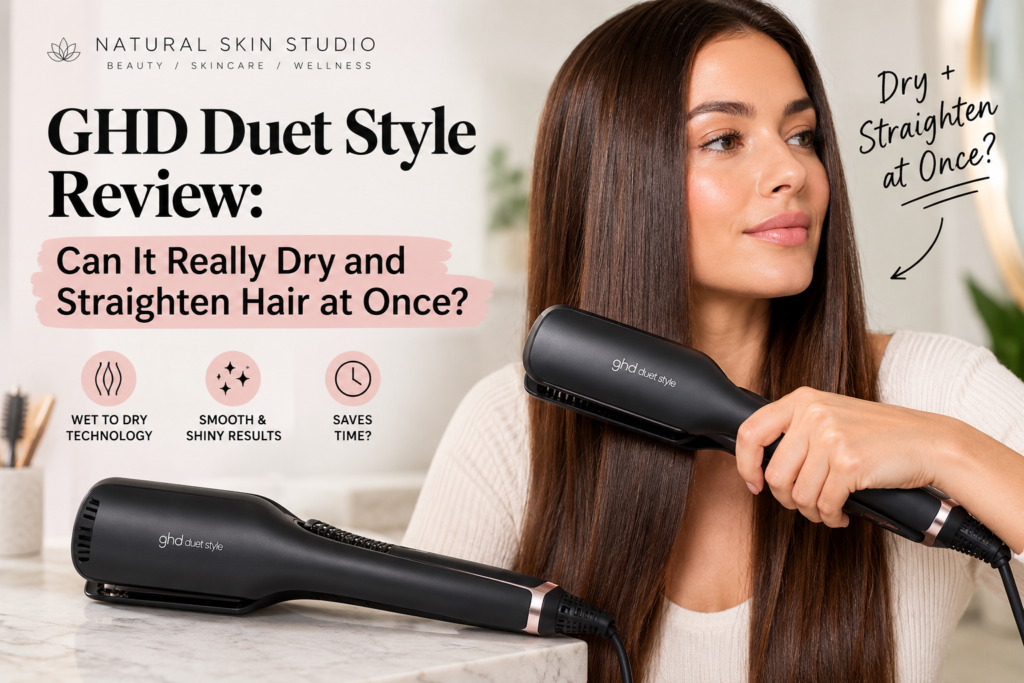
Most people go through the same hair-drying ritual: blast the hair dry with a dryer, section it off, run a flat iron over each piece, then reach for a serum or shine spray to fix whatever frizz is left. Three tools, three steps, and a chunk of your morning gone.
The GHD Duet Style says you can skip straight to step three. It’s marketed as the first 2-in-1 hot air styler that dries and straightens damp hair in a single pass, no separate blow-dry required. That’s a genuinely bold claim for a category that’s historically been full of gadgets that promise more than they deliver.
Affiliate disclosure: Natural Skin Studio may earn a commission if you purchase through links in this article. That doesn’t change what we tell you about a product’s strengths and weaknesses.
So does it actually work that way in practice, or is the “one-step” pitch more marketing than reality? This is a premium-priced tool, and before you spend several hundred dollars on it, you deserve a clear-eyed answer.

- DRY & STYLE WITH JUST ONE TOOL ― Revolutionary air-fusion technology dries and straightens hair at the same time, quickl…
- LUXURIOUS RESULTS EVERYDAY ― Unprecedented softness for up to 48 hours while protecting your hair’s natural moisture. Un…
- UNCOMPROMISING STYLE ― Advanced floating plates with ultra-glass coating ensure incredibly smooth and snag-free gliding …
Quick Verdict
Yes, the GHD Duet Style genuinely dries and straightens hair in the same pass — the airflow and heated plates are engineered to work simultaneously, not as two separate modes you toggle between. But “genuinely dries and styles at once” and “does it in a flash” are two different questions.
Independent testing has found the drying process itself can take considerably longer than a standalone hair dryer, because you’re working in small, controlled sections rather than rough-drying your whole head at once. TechRadar’s reviewer clocked the Duet Style at around 15 minutes compared to roughly four minutes with a regular hairdryer.
Who tends to love it: people with straight-to-wavy hair who want a sleek, frizz-free finish and are happy to trade some speed for fewer tools and a longer-lasting style. Who may be disappointed: anyone with very thick or very curly hair who wants a fast routine, or anyone expecting a traditional voluminous blowout.
Product Overview
The GHD Duet Style is a hot air hybrid styler that looks like a flat iron but functions more like a dryer and straightener merged into one device. Its Air-fusion technology channels a concentrated airflow through a purpose-built drying chamber that works together with four smart, low-temperature styling plates to dry and straighten hair at the same time.
That’s the key difference from both categories it’s compared to. A conventional flat iron only smooths hair that’s already dry. A conventional hair dryer only removes moisture; it doesn’t smooth or straighten. The Duet Style is built to do both jobs inside the same styling chamber, on hair that’s still wet or towel-dried.
Under the hood, a few features do the heavy lifting:
- Wet-to-style mode dries hair using warm, low-temperature air combined with the plates, rather than the high heat a traditional iron applies to dry strands.
- A brushless DC motor keeps the fan running at a consistent speed while staying compact and lightweight, which is meant to reduce arm fatigue during styling.
- Infinity sensors built into the plates are designed to read your hair’s needs and hold an optimal low styling temperature from root to tip.
- Root-drying vents at the top and bottom of the tool are aimed specifically at getting roots dry, at around 194°F.
- Shine Shot mode switches the tool over to dry-hair styling, at GHD’s standard 185°C styling temperature, for a finishing pass with no airflow.
- Automatic sleep mode shuts the tool off if left idle, a standard GHD safety feature.
- The Duet Style carries a two-year warranty and a 21-day return policy through GHD’s own site.
- It launched at £379 in the UK / €399 in Europe, and GHD’s US site currently lists it at $399, though pricing varies by retailer and bundle.
One important distinction: this is not the same product as the newer GHD Duet Blowdry. The Duet Blowdry comes from the same product family but uses a round brush with hot bristles rather than flat plates, designed to mimic a salon blow-dry rather than a straightened finish. If you want pin-straight results, the Duet Style — the subject of this review — is the one to look at.
- DRY & STYLE WITH JUST ONE TOOL ― Revolutionary air-fusion technology dries and straightens hair at the same time, quickl…
- LUXURIOUS RESULTS EVERYDAY ― Unprecedented softness for up to 48 hours while protecting your hair’s natural moisture. Un…
- UNCOMPROMISING STYLE ― Advanced floating plates with ultra-glass coating ensure incredibly smooth and snag-free gliding …
How Does the GHD Duet Style Work?
Air-fusion technology
Air-fusion technology combines internal aerodynamics with the four smart low-temperature plates inside a purpose-built styling chamber. In plain terms: air is pulled in, heated to a moderate temperature, and pushed through the chamber at the same time the plates are gently pressing and smoothing the hair section. Neither function is an afterthought — they’re built to happen together.
Wet-to-style mode
You use the dryer function, which activates as soon as you turn the tool on, to dry and style hair straight from towel-dried or damp. This is meant to replace the “dry first, then straighten” routine entirely for that first pass.
Smart plates and sensors
The four plates aren’t just heating elements. Infinity sensors inside the plates are designed to predict what your hair needs and maintain an optimal styling temperature from root to tip, adjusting rather than blasting every section with the same fixed heat.
Root drying
Roots hold more moisture and sit closer to the scalp, so the Duet Style includes root-drying vents built to focus airflow at the roots specifically, an area that’s historically hard to reach evenly with a flat iron alone.
Shine Shot
This is the part people most often misunderstand. Shine Shot is only meant for hair that’s already dry — it turns off the airflow entirely and runs the plates at GHD’s standard styling temperature of 185°C for a final smoothing and shine pass. Think of it as the traditional-flat-iron mode bolted onto the same device, not a wet-hair function.
Can It Really Dry and Straighten Hair at Once?
The honest answer is yes — but the quality of that experience depends heavily on your hair, not just the tool.
The Air-fusion chamber is genuinely built to dry and style in the same motion rather than as sequential modes. That part isn’t marketing spin. What varies is how fast and how straight the outcome feels, based on:
- Hair thickness and density
- Length
- Texture (straight, wavy, curly, coily)
- How wet the hair is when you start
- How small your sections are
- How many passes you make per section
- How pin-straight you actually want the finish to look
This is where it’s worth separating two different outcomes: “dry and smooth” versus “completely dry and pin-straight.” Most testers report the Duet Style reliably gets hair dry and noticeably smoother in one pass. Getting hair completely dry and razor-straight, especially with thicker or coarser sections, often takes more than one pass over the same piece of hair — which eats into the time savings the tool is supposed to deliver.
Realistic Styling Time
| Hair Situation | Expected Experience | What Affects Time |
|---|---|---|
| Fine, short hair | Faster | Small amount of hair to process |
| Fine, long hair | Moderate | Length adds more sections |
| Thick hair | Longer | Density slows each pass |
| Curly hair | Longer | Texture requires smaller sections |
| Towel-dried hair | Faster than soaking wet | Less moisture to remove |
| Second-day dry hair | Very quick refresh | Shine Shot alone, no drying needed |
One widely cited TechRadar test found the Duet Style took around 15 minutes on the reviewer’s hair, compared to about four minutes with a regular hairdryer, and the reviewer noted the need to section hair and make multiple passes over each strand to dry it thoroughly. That’s a meaningfully longer session than a conventional dry-then-straighten routine for some hair types.
At the same time, Woman & Home’s side-by-side comparison against the Dyson Airstrait found their hair took less time to style and felt softer using the competing tool, though results varied by technique and hair type. The takeaway isn’t that one number is “the truth” — it’s that styling time swings substantially based on hair type, section size, and how practiced you are with the tool.
Hair Type Performance
Fine Hair
Fine hair tends to dry faster simply because there’s less of it per section, which plays to the Duet Style’s strengths. The trade-off some testers flag is that a sleek, plate-pressed finish can read as flatter and less voluminous than a traditional round-brush blowout, since there’s no brushing-and-lifting motion involved.
Thick Hair
Thicker, denser hair generally requires more sections and more time to dry and style thoroughly than lighter hair types. Expect to spend real time here, and expect the tool’s weight to become more noticeable the longer a session runs.
Curly Hair
Testers with tighter curl patterns note the wide plates can smooth and add movement, but they don’t reproduce the spiral curl pattern that some curly-haired users want to preserve. If your priority is frizz control and a smoother texture rather than a fully pin-straight result, this can still work well; if you want to keep defined curls, this isn’t the tool for that.
Wavy Hair
Reviewers testing on fine, wavy hair report the tool does deliver on smoothing and straightening, with genuinely reduced frizz and longer-lasting results. Shine Shot can also be used selectively to reintroduce soft bends rather than a completely flat finish, if that’s the look you’re after.
Frizzy Hair
This is consistently one of the tool’s strongest categories across reviews. Testers across the board describe frizz control as a standout, noting it manages frizz better than other stylers they’ve used, with results that hold up over multiple days.
Color-Treated or Heat-Sensitive Hair
GHD markets the styling plates as running at a lower temperature than a standard flat iron, with sensors intended to hold an optimal low temperature throughout the pass. That’s a meaningful design choice for heat-conscious hair, but it’s not a guarantee against damage from repeated, heavy-handed use — any heat tool carries some risk depending on how often and how aggressively it’s used, regardless of manufacturer testing.
Does It Actually Save Time?
This is where expectations need adjusting. Compare the two routines:
Traditional: Hair dryer → sectioning → flat iron → separate frizz/shine step
Duet Style: Towel dry → Duet Style pass → optional Shine Shot
The Duet Style genuinely removes a device from your counter and a step from your routine — you’re not switching tools mid-session. What it doesn’t necessarily do is beat every conventional hair dryer on raw drying speed. In TechRadar’s testing, the Duet Style’s drying time was notably slower than the reviewer’s regular hairdryer. The time you save comes from consolidating tools and skipping the separate straightening step, not from the underlying drying process being faster than a dedicated dryer.
Finishing Results
Across independent reviews, the consistent themes are smoothness, reduced frizz, and shine, with styles that tend to hold up over more than one day. What’s less consistent is volume and movement. A GHD Duet Style finish tends to read as sleek and straight rather than voluminous, since the plates press hair flat as they dry it — closer to a polished straight look than a traditional round-brush salon blowout with lift and bounce at the roots.
If a bouncy, voluminous blowout is your goal rather than sleek and straight, you may want to compare notes with our Dyson Supersonic review, which covers a dryer built specifically around volume and shape.
Shine Shot Mode
Shine Shot deserves its own explanation because it’s easy to misunderstand as a wet-hair setting. It isn’t. It’s designed for use on dry hair only, and it turns off the airflow completely, running the plates at 185°C to deliver a frizz-free finish with additional shine.
Use it when your hair is already fully dry and you want a final polish, extra shine, or to touch up second-day hair without re-wetting it. You probably don’t need it if you’re already happy with the smoothness from your wet-to-style pass — it’s an optional finishing step, not a required second stage.
GHD Duet Style vs Dyson Airstrait
| Feature | GHD Duet Style | Dyson Airstrait |
|---|---|---|
| Wet-to-dry styling | Yes, via Air-fusion plates + airflow | Yes, via airflow-only technology |
| Dry styling | Shine Shot mode, plates only | Multiple heat settings, air-based |
| Straightening method | Heated plates | Directed airflow, no plates |
| Root access | Dedicated root-drying vents | Separate root-drying mode |
| Controls | Simple, minimal settings | More temperature/mode options |
| Weight/handling | Reported as heavy for extended use | Also reported as heavy; requires technique |
| Price positioning | Lower of the two premium options | Higher-priced premium option |
One comparison guide suggests choosing the GHD if you want a true 2-in-1 that replaces both your dryer and straightener on straight-to-wavy hair with a sleek finish, and choosing the Airstrait if you want more versatility with multiple modes and a softer, more natural-movement finish. Because the Airstrait relies entirely on angled airflow rather than heated plates, some reviewers find it eliminates a styling step the GHD still partly depends on, though TechRadar specifically noted the Airstrait was a genuine time-saver in their testing, unlike the Duet Style. Neither tool is a clear universal winner — the right pick depends on whether you prioritize plate-based smoothing or air-only styling, and how much you’re willing to spend.
For a broader look at where both fit among premium hair tech, see our guide to the best luxury hair styling tools in 2026.
- DRY & STYLE WITH JUST ONE TOOL ― Revolutionary air-fusion technology dries and straightens hair at the same time, quickl…
- LUXURIOUS RESULTS EVERYDAY ― Unprecedented softness for up to 48 hours while protecting your hair’s natural moisture. Un…
- UNCOMPROMISING STYLE ― Advanced floating plates with ultra-glass coating ensure incredibly smooth and snag-free gliding …
Design and Ergonomics
The Duet Style is built more like a flat iron than a dryer, with two arms that open and close around sections of hair. Multiple testers describe it as noticeably heavier than a standard straightener, with arm fatigue becoming apparent during a full head of styling, especially on longer or thicker hair where sessions run longer. TechRadar specifically flagged the bulky design as uncomfortable to use for extended periods, which also made it harder to create texture like curls or flicks — it’s built primarily for straight, sleek results rather than versatile styling.
Controls are kept deliberately simple: a power button, a Shine Shot toggle, and minimal settings beyond that, compared to the multi-setting control panel on the Dyson Airstrait.
Pros and Cons
Pros
- Genuinely dries and styles in the same pass, not sequential steps
- Can replace both a dryer and a straightener for some hair types
- Strong, consistently reported frizz control
- Long-lasting, sleek finish across multiple reviews
- Shine Shot adds a useful optional polish step
- Root-drying vents help with a traditionally hard-to-reach area
- Premium build quality and a two-year warranty
Cons
- Premium price point relative to buying a separate dryer and iron
- Reported as heavy and tiring to use for a full head of hair
- Drying time varies significantly and can run longer than a standalone dryer
- Requires careful sectioning and sometimes multiple passes
- Less suited to voluminous, bouncy blowout styles
- Not ideal for tightly curled or coily hair seeking curl definition
- Shine Shot is still a separate finishing step, not built into the wet pass
Who Should Buy It?
- Someone who currently dries and straightens their hair as two separate steps and wants to consolidate into one tool
- Someone with straight, wavy, or moderately frizzy hair who prioritizes a sleek, long-lasting finish
- Someone who values fewer devices on the counter and is comfortable trading some speed for that convenience
- Someone with color-treated or heat-conscious hair who wants a lower-temperature styling option for the drying phase
- DRY & STYLE WITH JUST ONE TOOL ― Revolutionary air-fusion technology dries and straightens hair at the same time, quickl…
- LUXURIOUS RESULTS EVERYDAY ― Unprecedented softness for up to 48 hours while protecting your hair’s natural moisture. Un…
- UNCOMPROMISING STYLE ― Advanced floating plates with ultra-glass coating ensure incredibly smooth and snag-free gliding …
Who Should Skip It?
- Anyone who wants the fastest possible drying time and is happy keeping a separate straightener
- Anyone with tight curls who wants to preserve curl pattern and definition
- Anyone who prioritizes big, voluminous, round-brush-style blowouts — worth comparing against our Dyson Airwrap review for that use case
- Anyone comparing strictly on drying speed against a dedicated high-power hair dryer — see our best luxury hair dryers guide for that comparison
- Budget-conscious buyers who’d rather invest in a strong separate dryer and iron combination for less total spend
Value for Money
At its price point, you’re paying for the engineering that lets one tool do two jobs, plus GHD’s plate technology, sensors, and warranty support. Whether that’s worth it depends heavily on how often you style your hair. If you dry and straighten most days, consolidating into one tool has real convenience value over time, even with a slower per-session drying time. If you only occasionally need a fully styled look, a lower-cost dryer paired with a separate iron may serve you just as well for meaningfully less money, and give you more flexibility for volume or curls along the way.
Maintenance and Buying Tips
- Keep the air filter/intake clear of hair and product buildup for consistent airflow performance
- Store on a heat-resistant mat or in the included bag, especially right after use
- Check the exact bundle, since some retailers include a heat-resistant pouch or mat and others sell the styler alone
- Confirm voltage compatibility if buying while traveling or importing from another region, as regional models can differ
- Compare current pricing across GHD’s own site and major retailers, since promotions and bundle pricing shift throughout the year
Frequently Asked Questions
Can the GHD Duet Style be used on wet hair?
Yes. It’s specifically designed for towel-dried or damp hair, using Air-fusion technology to dry and style at the same time. It isn’t meant for soaking-wet hair straight out of the shower without at least a towel-dry first.
Does the GHD Duet Style really straighten hair?
Yes, through its four heated plates working alongside the airflow. The straightening effect is strongest on straight-to-wavy hair, and less complete on thick or curly hair without extra passes.
How long does it take to dry hair?
It varies widely by hair type. One widely cited test reported around 15 minutes, compared to roughly four minutes with a standard hairdryer, so budget more time than you would for a typical blow-dry.
Is it good for thick hair?
It can work, but expect a longer session with more sections and passes than a standard dryer-and-iron routine, plus a heavier tool to maneuver throughout.
Is it good for curly hair?
It smooths and reduces frizz well, but it isn’t built to preserve tight curl definition. If keeping your natural curl pattern matters, this likely isn’t the right tool.
Can it replace a straightener?
For many straight-to-wavy hair types, yes — especially with Shine Shot for a final pass. For thicker or more textured hair wanting a completely pin-straight look, a dedicated flat iron may still get closer to salon-level flatness.
Can you use it on dry hair?
Yes, through Shine Shot mode, which switches off the airflow and runs the plates at GHD’s standard 185°C styling temperature for a finishing or refresh pass.
What is Shine Shot mode?
It’s a dry-hair-only setting that turns the Duet Style into a traditional flat iron, adding shine and smoothness without any airflow involved.
Is it better than the Dyson Airstrait?
Neither wins outright. The GHD is generally the lower-priced option with a simpler control set and plate-based styling, while the Airstrait relies purely on airflow and offers more styling modes at a higher price. The right choice depends on your priorities and budget.
Does the GHD Duet Style damage hair?
GHD states its testing found no thermal hair damage detected after 100 cycles of four passes in wet-to-style mode, compared to naturally dried hair. That’s a specific, limited testing claim, not a guarantee against damage under all use patterns — like any heat tool, outcomes depend on temperature settings, frequency of use, and hair condition going in.
The Bottom Line
The GHD Duet Style does exactly what its name promises: it dries and straightens hair in the same motion, using genuinely integrated Air-fusion technology rather than two modes bolted together. That much isn’t marketing spin.
What buyers need to go in understanding is that “one step” doesn’t automatically mean “fast.” Independent testing has repeatedly shown the drying phase can run longer than a standard hairdryer, and the tool’s weight becomes noticeable over a full styling session. The people most likely to feel the premium price is justified are those with straight-to-wavy hair who currently juggle two separate tools and want a sleek, long-lasting, frizz-free result without switching devices mid-routine. Anyone chasing raw speed, big volume, or defined curls will likely find better value elsewhere — including the Dyson Airstrait, a dedicated hair dryer, or a traditional flat iron.
If your priority is fewer tools and a consistently smooth finish over the fastest possible routine, the GHD Duet Style earns its price. If speed and versatility matter more than consolidation, it’s worth weighing the alternatives first.