
Natural Skin Studio may earn a commission if you purchase through links in this article. This does not affect our editorial assessment.
Fine hair can go from smooth to flat, dry, or damaged surprisingly quickly when the wrong straightener is used. Each strand has less mass to absorb heat, so a tool that feels fine on thick hair can feel punishing on yours. Slow passes and stray hot spots show up fast.
The goal when shopping for the best hair straighteners for fine hair is not maximum heat. It is controlled heat, evenly heated plates, a sensible plate width, as few passes as possible, and good technique. This guide explains why each of those matters, then matches specific tools to specific fine-hair situations instead of naming one winner for everyone.
How We Evaluated These Straighteners
Natural Skin Studio has not lab-tested the straighteners in the comparison sections. This guide relies on:
- manufacturer specifications from official product pages
- published editorial testing, including Allure’s 2026 hair straightener guide and Good Housekeeping’s hair straightener testing guide
- our own review coverage where it exists
- general hair-styling principles
Where a brand makes a claim, such as “less damage” or “intelligent” heat control, we report it as the brand’s claim. We have not independently verified those claims. Availability and pricing change, so check current prices at the retailer.
Quick Picks: Best Flat Irons for Fine Hair by Use Case
| Product | Best For | Plate Type | Heat Control | Why It Stands Out |
|---|---|---|---|---|
| T3 SinglePass StyleMax | Adjustable-temperature all-rounder | Ceramic, 1 inch | Nine heat settings plus automated heat customization | Wide range of settings and a Curl Mode for fine wavy hair |
| GHD Platinum+ | Smart-temperature, one-glide styling | 1 inch | Preset 365°F, predictive heat monitoring | Simple, hands-off approach to heat |
| Dyson Corrale | Cordless, premium, lower-heat option | Flexing manganese copper alloy | 330°F, 365°F, 410°F | Lowest of three presets is 330°F; up to 30 minutes cordless |
| Airflow or wet-to-dry tool | Styling without a hot plate | Varies | Varies | Different approach for reducing plate contact |
| Budget model (criteria below) | Occasional use on a tight budget | Ceramic | Adjustable dial | Value depends on verifying a real temperature control |
Each tool is described in detail below, including who should skip it.
What Makes a Hair Straightener Good for Fine Hair?
Five features matter most, and each affects how much heat your hair absorbs.
- Adjustable or well-regulated temperature. Fine strands do not need the top setting. A tool that lets you choose a conservative setting, or manages heat for you, gives you room to work gently.
- Even plate heating. Uneven plates create hot spots. On fine hair, a hot spot can be the difference between smooth and fried.
- Appropriate plate width. Narrower plates handle short or fine hair more precisely. Wider plates cover more hair but can be harder to control near the roots.
- Smooth glide. Plates that snag or drag encourage repeated passes.
- A comfortable, controlled clamp. Aggressive clamping flattens fine hair and can leave dents.
Good Housekeeping’s testing guide makes a related point in the same spirit: it advises using the lowest temperature that achieves your style, since heat styling can damage hair. That is our starting principle throughout.
Fine Hair vs Thin Hair: What’s the Difference?
People use the terms interchangeably, but they describe different things.
- Fine hair refers to the diameter of individual strands. You can have fine strands and plenty of them.
- Thin hair commonly refers to density, meaning how many strands cover the scalp. You can have thick-diameter strands and low density.
This matters because the two need different things from a straightener. Fine strands are more heat-sensitive, so temperature control is the priority. Low density means the roots and overall body show flatness more easily, so root technique and clamping pressure matter more. Many people have both. If you searched for a hair straightener for thin hair, the advice below applies, but read the root and volume section closely.
Can a Hair Straightener Damage Fine Hair?
Yes, any flat iron can contribute to heat damage if it is used at high temperatures or with repeated passes. There is no product that makes heat styling risk-free. Fine hair tends to show the effects sooner because each strand has less mass to buffer the heat.
Damage from heat styling can look like dryness, rough texture, frizz, split ends, breakage, or a loss of shine. Some tools advertise gentler heat, but we are not aware of independent evidence in this article’s sources that quantifies how much damage any specific model prevents, so treat those claims cautiously. What you can control is temperature, the number of passes, glide speed, and prep.
If your hair is breaking or you notice sudden changes in your scalp or hair, consult a professional stylist or a dermatologist. This guide is styling advice, not medical advice.
What Temperature Should You Use on Fine Hair?
There is no single safe number. The right setting depends on your hair’s condition, texture, chemical treatment history, and how straight you want the result.
As a starting framework, not a rule:
- Start low and work up. Try a conservative setting first and increase only if one controlled pass does not produce the result you want.
- Fine, healthy, naturally straight or slightly wavy hair often responds to moderate settings.
- Fine and damaged, bleached, or heavily processed hair generally calls for the low end of your tool’s range.
- Fine, wavy or frizzier hair may need more heat than very straight hair, but a slower, hotter approach is not the answer. Prep and sectioning help more.
For reference, the tools featured here take different approaches. Dyson’s official Corrale page lists three presets of 330°F, 365°F and 410°F. GHD’s official Platinum+ page lists a single preset styling temperature of 365°F. T3 lists nine heat settings. None of those numbers is a recommendation for your hair. They show how much control each tool gives you.
Are 1-Inch Plates Best for Fine Hair?
A 1-inch plate is a practical default for many fine-haired people, but not a requirement.
Why 1 inch often works:
- It is narrow enough to control small sections, which supports even heat and a single pass.
- It gets close to the roots without clamping large amounts of hair.
- It handles slight curls and bends, which helps fine wavy hair.
When narrower plates make more sense:
- Very short cuts, pixie styles, bangs, and edges are hard to reach with wider plates. A mini or narrow plate gives precision.
When wider plates make more sense:
- Longer hair with a lot of length to get through. Wider plates can cover more hair in fewer passes, but they need careful sectioning.
Are Wide Plates Bad for Fine Hair?
Not inherently. The problem is usually technique, not the plate size. Wide plates can be a reasonable choice for long, fine hair if you take small sections and avoid hovering. The risks are that they are harder to keep close to the scalp and can flatten roots more easily.
If you want to compare, our GHD Max review covers a wider-plate design and how it handles different hair types. For most fine-haired readers, though, we would begin with a 1-inch tool.
Ceramic vs Titanium: Which Is Better for Fine Hair?
Neither is universally better. What matters is how evenly the plate heats, how well it glides, and how much control you have over temperature.
- Ceramic plates are commonly associated with even, gentle-feeling heat and are common on tools for finer or more delicate hair. That is why “ceramic straightener for fine hair” is such a common search. T3’s official SinglePass StyleMax page lists ceramic plates.
- Titanium plates heat quickly and hold high temperatures, which many stylists like for coarse or thick hair. On fine hair, fast, very hot heat gives you less room for error, so titanium works best when the temperature is adjustable and set low.
- Tourmaline-infused plates are often marketed to reduce static and frizz. The benefit varies by product, and we have not found independent evidence in our sources that tourmaline changes heat damage.
- Flexing plates, like the manganese copper alloy plates on Dyson’s Corrale, are designed to flex and hold hair more evenly. That is a brand claim, and it is not a material category you can compare directly with ceramic or titanium.
The practical takeaway is to choose based on temperature control and even heat, not the material label.
Is Smart Temperature Control Worth It?
For many fine-haired people, yes, with caveats.
Smart or predictive temperature systems monitor plate heat and adjust it so it stays consistent as you work. GHD describes its Platinum+ as using ultra-zone predictive technology and heat monitoring, and Dyson describes intelligent temperature control on the Corrale. These are manufacturer descriptions. We have not seen independent evidence in the sources used here that they measurably reduce damage.
Consistent heat is useful in principle: it reduces temperature swings that can produce hot spots on fine hair. But a smart system does not replace good technique. A smart-temperature tool at the wrong setting, or used with repeated passes, can still damage fine hair. If you like control, an adjustable dial serves you as well or better. If you would rather not think about it, a well-regulated preset can be reassuring.
Why One-Pass Styling Matters for Fine Hair
Every extra pass adds heat exposure to the same strands. For fine hair, one controlled pass at an appropriate temperature is generally preferable to several fast passes at a low temperature, or one slow pass at a high one. Both extremes can create problems.
Some brands build a product around this idea. GHD’s official Platinum+ page describes the tool as designed for one-glide styling. T3’s SinglePass StyleMax is named for the same idea. Whether a tool truly achieves one pass depends on your hair and your prep, not just the tool.
Product Reviews
T3 SinglePass StyleMax
Best for: Fine hair where you want adjustable heat and a familiar 1-inch format.

Why it suits fine hair: According to T3’s official SinglePass StyleMax page, the tool has nine heat settings, which gives you room to choose a conservative temperature instead of being locked into one preset.
Key features: Nine heat settings, automated heat customization, ceramic plates, Curl Mode, and designs aimed at different hair textures.
Heat control: Adjustable across nine settings, with automated customization described by the brand.
Plate material: Ceramic.
Plate width: 1 inch.
Strengths:
- A wide range of temperature options
- A 1-inch width that suits most fine hair
- Curl Mode helps if you want to bend or wave the ends, which is useful for fine wavy hair
Limitations:
- T3’s “less damage” language is a brand claim. We have not confirmed it independently
- More settings mean more to learn, and a wrong setting is easy to choose
- It is corded
Best use case: Readers who want to fine-tune heat and occasionally curl.
Who should skip it: Anyone who wants a single preset with no decisions, or who needs cordless convenience.
Bottom line: A flexible, adjustable ceramic option. Its value for fine hair depends on choosing a low starting setting and resisting the urge to turn it up.
GHD Platinum+
Best for: Fine hair where you prefer managed heat and a simple, one-glide approach.
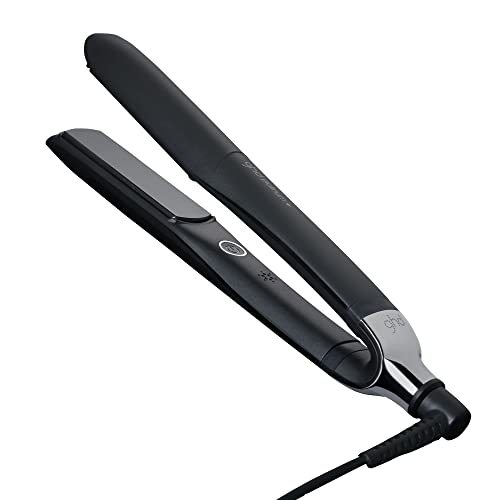
- SALON-TESTED RESULTS, NO GUESSWORK: Ultra-Zone tech reads your hair 250x/sec for 70% stronger hair and 75% more shine in…
- NO DIAL, NO DAMAGE: Locked at ghd’s stylist-tested 365°F “sweet spot” so you never guess a setting. Up to 2x color prote…
- PREMIUM CERAMIC FLOATING PLATES: Precision-milled ceramic plates with a whisbone hinge glide smoothly and maintain even …
Why it suits fine hair: GHD’s official Platinum+ specifications list a 1-inch plate width, a preset styling temperature of 365°F, ultra-zone predictive technology, and heat monitoring. GHD positions the tool for one-glide styling, which aligns with the one-pass goal.
Key features: 1-inch plates, a preset 365°F temperature, predictive technology, and heat monitoring.
Heat control: Preset. Predictive technology and heat monitoring are described by GHD.
Plate material: See the official page for the current material description before publishing.
Plate width: 1 inch.
Strengths:
- Simplicity: no dial to misjudge
- Consistent heat is the stated goal of the technology
- A 1-inch width suited to most fine hair
Limitations:
- One preset means you cannot go lower. If your fine hair is damaged, bleached, or very delicate, 365°F may be higher than you want
- GHD’s technology descriptions are marketing claims, not independent findings
- It is corded
Best use case: Fine, healthy hair where you want reliability and minimal fuss.
Who should skip it: Fine, damaged, or heavily color-treated hair that needs a genuinely low setting.
Bottom line: A sensible choice if you like preset, managed heat. If your hair needs lower temperatures, look elsewhere or choose an adjustable model.
Dyson Corrale
Best for: Fine hair where cordless use and a lower preset matter, and where budget allows.

- Use corded or cord-free for extra versatility. Up to 30 minutes cord-free styling: Delivers the same thermal performance…
- Less heat, half the damage: Flexing plates gather your hair for more control, so you can achieve the same style with les…
- Auto shut-off and Safety lock: Switches off after 10 minutes of inactivity for added peace of mind. Safety lock allows f…
Why it suits fine hair: Dyson’s official Corrale page lists three heat settings of 330°F, 365°F and 410°F. The lowest is 330°F, which gives more headroom for gentle styling than a single 365°F preset. Dyson also describes intelligent temperature control and flexing manganese copper alloy plates.
Key features: Flexing manganese copper alloy plates, three presets, intelligent temperature control, and up to 30 minutes of cordless styling.
Heat control: Three presets.
Plate material: Manganese copper alloy (flexing).
Plate width: See the official page for the current specification before publishing.
Strengths:
- A lowest setting of 330°F
- Cordless operation, which makes it easy to work through sections evenly and avoid cord drag
- Flexing plates are designed to hold hair more evenly, in Dyson’s description
Limitations:
- Dyson’s performance claims are brand claims. We do not cite independent evidence that they reduce damage
- Three presets are less granular than a nine-setting tool
- It sits at the premium end of the market. Check current pricing
- Battery life is limited to what Dyson lists, so long sessions may need a recharge
Best use case: Readers who want cordless flexibility and a relatively low preset.
Who should skip it: Anyone who wants fine-grained temperature control or a low-cost tool.
Bottom line: A premium option with genuine convenience benefits. Read our Dyson Corrale review for more detail on how it handles in daily use.
Budget Option: How to Shop for One
We are not naming a specific budget model because we have not verified one to the standard we hold the products above to. If you are buying on a budget, look for:
- an adjustable temperature control with a clearly displayed setting, not just “low/high”
- ceramic or ceramic-coated plates
- a 1-inch plate width
- plates that align evenly and glide without snagging
- auto shut-off
Skip tools that list only one very high temperature. An inexpensive tool can work well on fine hair if its temperature is controllable. A cheap one with no control can damage it quickly.
Best for Short Fine Hair
A narrow-plate model, often marketed as a mini or pencil flat iron, is generally easier to control on pixie cuts, bobs, and bangs. Apply the same principles: adjustable temperature, ceramic plates, one pass. We have not verified a specific narrow model here, so check specifications before buying.
Comparison Table
| Product | Best for | Plate material | Plate width | Heat settings | Fine-hair suitability | Key advantage | Main drawback |
|---|---|---|---|---|---|---|---|
| T3 SinglePass StyleMax | Adjustable control, fine wavy hair | Ceramic | 1 inch | Nine | Strong for most fine hair with a conservative setting | Wide temperature range and Curl Mode | More settings to manage; corded |
| GHD Platinum+ | Managed, one-glide styling | Verify on official page | 1 inch | Preset 365°F | Good for healthy fine hair; limited for damaged hair | Simplicity and monitored heat | No lower setting |
| Dyson Corrale | Cordless convenience | Flexing manganese copper alloy | Verify on official page | 330°F, 365°F, 410°F | Good, especially with the 330°F preset | Cordless up to 30 minutes | Premium price; only three presets |
We list only specifications drawn from official pages. Confirm any “verify” cells before publication.
Fine Wavy Hair: A Note on Curl Mode
If you are searching for the best flat iron for fine wavy hair, look for a 1-inch tool that lets you both smooth and bend. T3 lists a Curl Mode on the SinglePass StyleMax. Fine wavy hair often needs a bit more heat to relax the wave, so the temptation is to raise the temperature. Try smaller sections and better tension first.
Cordless Straighteners: Are They Worth It?
Cordless tools trade unlimited run time for freedom of movement. For fine hair, the benefits are practical rather than magical:
- No cord tugging, so you can glide smoothly without snagging
- Easier to work around the back of the head in even sections
- Travel-friendly
The trade-offs are limited battery life, which for the Corrale Dyson lists as up to 30 minutes, and usually a higher price. If you straighten quickly and in sections, 30 minutes may be enough. If you have a lot of length or take time, it may not be. Our Dyson Corrale review looks at this in more detail.
Traditional Flat Irons vs Airflow and Wet-to-Dry Tools
A conventional flat iron clamps hair between hot plates. Airflow and wet-to-dry tools use different mechanisms, and they are worth considering if your main concern is plate contact.
Traditional flat irons offer the sharpest, sleekest finish and the most control on dry hair. They should be used only on completely dry hair.
Wet-to-dry tools are designed to style damp hair. Never use a conventional flat iron on wet or damp hair, because water turning to steam under high heat can damage hair. Only use a tool if the manufacturer explicitly says it is designed for wet-to-dry styling. Our GHD Duet Style review looks at one such tool. GHD’s own awards page notes that Duet Style won Allure’s 2023 Best of Beauty Award in the wet hair styling category.
Airflow-based styling is another direction, and it also tends to help with volume, because the hair is not flattened between plates. Our Dyson Airwrap review covers that approach.
Neither category is proven gentler than a well-used flat iron in the sources we cite. Which is better depends on the finish you want: airflow tools tend toward smooth, bouncy styles, while flat irons deliver a sleeker, straighter result.
How to Straighten Fine Hair Without Losing Volume
Fine hair flattens easily, especially at the roots. To keep body:
- Do not clamp hard at the roots. Use light pressure and start a little away from the scalp.
- Lift as you glide. Slightly lifting the section away from the head as you move down keeps some bend at the root.
- Use smaller sections. Big chunks require more pressure and more passes.
- Avoid heavy products. Rich oils and creams weigh fine hair down. Choose a lightweight heat protectant.
- Consider a volumizing prep. A lightweight root lift product before blow-drying can help.
- Blow-dry with lift first. If you use a dryer before straightening, our guide to the best luxury hair dryers in 2026 may help you choose one.
How to Straighten Fine, Color-Treated Hair
Color-treated fine hair, especially bleached hair, is often more fragile. Chemical processing changes the hair’s structure, so heat sensitivity increases.
- Use the lowest setting that gives you the result.
- Prefer a tool with a genuinely low option. GHD’s Platinum+ is a single 365°F preset, so it gives you no lower choice, while T3 and Dyson offer lower ones.
- Use a heat protectant every time.
- Keep to one pass per section.
- Space out heat sessions to give your hair a break.
Fine and Damaged Hair
If your fine hair is already damaged, the priority is to reduce heat exposure altogether. That means conservative heat, minimal passes, and possibly less frequent straightening. A straightener will not repair damage. Some hair-care treatments may improve how hair feels, but we do not make repair claims here. If you notice significant breakage, consult a professional stylist.
Heat Protectant and Preparation
Heat protectant is a step, not a fix. It may reduce some of the effects of heat, but it does not make high temperatures safe.
- Use a lightweight formula. Heavy products weigh down fine hair and can sizzle on hot plates.
- Apply evenly on damp hair before blow-drying, or on dry hair before straightening, as the product directs.
- Comb it through so it is distributed.
- Make sure the hair is completely dry before using a conventional flat iron.
Step-by-Step Routine for Straightening Fine Hair
- Start with completely dry hair. Use a conventional flat iron only on dry hair, unless the tool is explicitly designed for wet-to-dry use.
- Apply a heat protectant. Choose a lightweight formula.
- Detangle. Knots cause snagging and extra passes.
- Section your hair. Clip up the top layers and work from the bottom.
- Start with a conservative temperature. Increase only if one careful pass isn’t enough.
- Use manageable sections. Thin sections, roughly an inch or less, make even heating easier.
- Glide smoothly. Keep the iron moving, and do not stop or pause.
- Avoid repeated passes. If a section is not straight, adjust your technique or the temperature slightly instead of going over it again and again.
- Do not clamp aggressively. Firm, not tight, pressure protects both hair and volume.
- Finish lightly. If needed, add a lightweight smoothing or shine product.
How Many Passes Should You Make?
Aim for one. If one pass does not work, check that your sections are small enough, your hair is fully dry, and your temperature is suitable, before making a second. Habitual multiple passes are a common cause of heat damage on fine hair.
Common Mistakes People with Fine Hair Make
- Using the highest setting by default
- Making several quick passes over the same section
- Straightening damp hair with a conventional iron
- Skipping heat protectant or using a heavy one
- Clamping too hard at the roots
- Taking sections that are too wide
- Pausing or hovering with hot plates on the hair
- Straightening every day without breaks
Frequently Asked Questions
What is the best hair straightener for fine hair in 2026?
There is no single best for everyone. Look for adjustable or well-regulated temperature, even plates, and a 1-inch width. Depending on your priorities, that might mean an adjustable ceramic model like the T3 SinglePass StyleMax, a managed-heat model like the GHD Platinum+, or a cordless option like the Dyson Corrale.
What temperature should I use on fine hair?
Start low and increase only if needed. There is no universal safe temperature, because the right setting depends on your hair’s condition, texture, and treatment history. Fine, damaged, or bleached hair generally needs the low end of a tool’s range.
Is ceramic or titanium better for fine hair?
Neither is universally better. Ceramic is commonly associated with gentle, even heat, while titanium heats quickly, which leaves less margin on fine hair. Temperature control and even plates matter more than the material.
Are 1-inch flat irons good for fine hair?
Yes, for most people. A 1-inch plate offers precise control and reaches close to the roots. Very short hair may suit narrower plates, and long hair can tolerate wider ones with careful sectioning.
Can straightening damage fine hair?
Yes. Any flat iron can contribute to heat damage, and fine hair often shows it sooner. Lower temperatures, one pass, and heat protectant can reduce the risk but not remove it.
How often can I straighten fine hair?
As rarely as you comfortably can. There is no set number, and it depends on your hair’s condition. Fine, damaged, or color-treated hair benefits from more breaks between sessions.
Is GHD Platinum+ good for fine hair?
It can be for healthy fine hair. GHD lists a 1-inch plate and a preset 365°F temperature. The single preset means it may be too high for fragile fine hair.
Is T3 SinglePass StyleMax good for fine hair?
It can be, especially if you use a low setting. T3 lists ceramic plates, a 1-inch width, and nine heat settings, which give you room to be conservative.
Is Dyson Corrale good for fine hair?
It can be. Dyson lists a lowest setting of 330°F and up to 30 minutes of cordless styling. It is a premium tool, and the claims about its plates and temperature control are Dyson’s own.
Should I use a heat protectant on fine hair?
Yes, and choose a lightweight one. It may reduce some effects of heat, though it does not make high heat safe. Heavy formulas can weigh fine hair down.
Can I straighten fine hair without losing volume?
Yes, with technique. Use light pressure at the roots, smaller sections, and lightweight products. Some people prefer airflow tools for volume.
Is a wide-plate straightener good for fine hair?
It can be for long hair, if you take small sections. Wide plates are harder to control near the roots and can flatten fine hair more easily, so most readers do best starting with 1 inch.
Final Recommendations: Which Type Should You Choose?
- If you want precise heat control: choose an adjustable-temperature ceramic model, such as the T3 SinglePass StyleMax.
- If you want smart heat management: consider a managed-heat model like the GHD Platinum+, remembering it has one preset.
- If you prioritize cordless convenience: consider the Dyson Corrale, and confirm its battery life suits your routine.
- If you want wet-to-dry styling: consider an airflow-based or wet-to-dry tool, and use it only as the manufacturer directs.
- If your hair is fine and damaged: prioritize conservative heat and minimal passes over maximum power.
The best hair straighteners for fine hair are the ones that let you use less heat, fewer passes, and gentler technique. Pick the tool that supports that, verify current specifications and pricing, and let your hair’s condition guide the rest.