
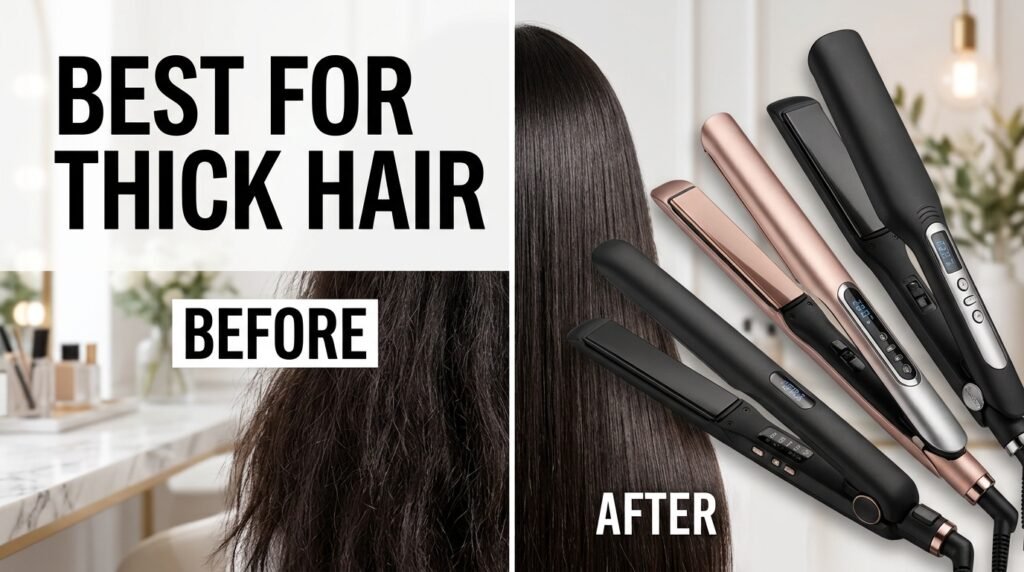
If you have thick hair, you already know the routine. You clip up half your head, pull down a section the width of a pencil, and make pass after pass. Forty-five minutes in, your arm aches, the top layer looks glassy, and the hair underneath is still puffy. By the time you finish, the first section you did has started to frizz again.
The fix isn’t simply buying the hottest flat iron. A tool that runs too hot can leave you with more heat exposure on every strand, and a very wide plate can be awkward on short layers. A tool with great specs on paper can also be tiring to use for an hour.
The best flat iron for thick hair is the one whose plate width, plate material, heat control, and heat recovery fit your particular kind of “thick.” This guide breaks that down, then maps it to the tools people actually shop for in 2026.
Quick Picks
| Situation | Best fit | Why | Main trade-off |
|---|---|---|---|
| Long, dense hair where speed matters | ghd Chronos Max | Wide plates cover more hair per pass. ghd’s own testing claims faster frizz reduction than the older ghd Max. | Fixed temperature, premium price |
| Wide-plate value from ghd | ghd Max | The older wide-plate model, still relevant when discounted | Newer Chronos Max is ghd’s current pick |
| Coarse, resistant strands | BaBylissPRO Nano Titanium | Titanium plates, up to 450°F, 50 settings, 4-year warranty (manufacturer specs) | Easy to overheat if you go to maximum |
| Adjustable heat with preset guidance | T3 SinglePass StyleMax | Nine settings with texture-based presets | Verify current plate width before buying |
| Precision, roots, bangs, shorter layers | ghd Platinum+ | 1-inch format | More sections on very dense hair |
| Cordless | Dyson Corrale | No cord, flexing plates | Premium price, limited runtime, standard-width plates |
| Wet-to-dry convenience | Dyson Airstrait / ghd Duet Style | Dry and straighten in one step | Not ideal for very thick, dense, or tightly curled hair |
I didn’t force categories where the evidence was thin. There is no single winner here, and the sections below explain why.
First, “Thick Hair” Is Not One Hair Type
Shoppers use “thick hair” to describe several different things, and each one changes what you should buy.
Thick (wide) strands means each individual hair has a large diameter. This is a texture trait, and it’s often what people mean by coarse.
Dense hair means you have lots of strands per square inch. Your ponytail feels heavy even if each hair is fine. Dense hair is mostly a section-size and speed problem. You need to move through a lot of hair, so plate width and glide matter more than raw temperature.
Coarse hair is about strand structure and how resistant the hair is to changing shape. Coarse hair can be less dense, and dense hair can be fine.
Long and thick hair compounds all of the above. Plate length, arm fatigue, and how well the tool holds temperature over an hour all start to matter.
Thick wavy hair usually needs a smoothing blowout first, then moderate heat.
Thick curly hair has more shape to undo, so it benefits from a good blow-dry beforehand and a tool that keeps steady tension.
Thick coily or textured hair varies widely. Some people want a silk press with careful, low-pass technique, while others simply want to elongate curl pattern. Heat control, protection, and section discipline matter most here.
Thick but damaged or color-treated hair changes the whole calculation. Hair that’s been bleached or chemically treated may not tolerate high heat, regardless of how thick it looks.
Thick, frizz-prone hair is often less about heat and more about prep, humidity, and finishing.
Someone with dense but fine hair and someone with sparse but very coarse hair are both “thick,” and they may need different tools. That’s why one generic roundup can’t serve everyone.
What Makes a Straightener Good for Thick Hair?
Plate width. Wider plates cover more hair per pass, which cuts the number of sections. That matters most for dense, long hair.
Plate material. Titanium heats quickly and holds higher temperatures. Ceramic distributes heat more evenly. We compare them below.
Heat consistency and recovery. Recovery is how quickly plates return to temperature after they’ve been dragged through cold, thick hair. A tool that dips mid-section forces extra passes. This is one of the biggest real differences between a $50 iron and a premium one, though it’s rarely printed on the box.
Clamping and tension. Thick hair needs firm, even pressure so it doesn’t slip out or bunch at the plates’ edge.
Glide. Smooth plate surfaces and rounded edges reduce snagging.
Temperature control. Adjustability matters if your hair is mixed (coarse at the nape, finer at the hairline), if it’s color-treated, or if you like to dial in gradually. Fixed-temperature tools trade flexibility for simplicity.
Root access. Chunky housings can keep you from getting close to the scalp, which leaves that “flat at the crown, puffy underneath” look.
Ergonomics. Weight, balance, and cord behavior matter more than spec sheets suggest, because thick hair means long sessions.
Titanium vs. Ceramic for Thick Hair
Neither material is universally better.
| Titanium | Ceramic | |
|---|---|---|
| Heat transfer | Fast | Even, smoother profile |
| High-temp performance | Strong | Adequate, depends on the tool’s heater |
| Best for | Resistant, coarse strands | Wide range of textures, including damaged hair |
| Risk | Easy to overheat fragile hair if used carelessly | Can feel slower on very resistant hair unless the tool recovers heat well |
Titanium earns its reputation with resistant, coarse strands because it gets hot and stays hot. But that same speed means mistakes happen faster. Ceramic’s gentler, more uniform heat is generally described by editors as a good option for fine, damaged, or color-treated hair, and plenty of ceramic tools handle thick hair well when their heater recovers quickly. A titanium straightener for thick hair is a reasonable choice for coarse strands. It isn’t a requirement for dense ones. Yahoo!
What Plate Width Is Best for Thick Hair?
| Width | Speed | Section size | Root access | Best for | Watch out for |
|---|---|---|---|---|---|
| 1 inch | Slower on dense hair | Small | Excellent | Bangs, short layers, precision, versatile styling | Many sections on long, dense hair |
| 1.25 inch | Moderate | Medium | Good | A middle ground for many thick-hair shoppers | May still feel slow on very dense hair |
| 1.5 inch | Faster | Larger | Good | Long or dense hair with moderate versatility | Slightly bulkier |
| 2 inch / wide | Fastest | Largest | Harder near scalp and hairline | Long, dense, or curly hair | Awkward on short hair, bangs, and tight roots |
Wider plates aren’t automatically better. They’re a speed advantage when you have a lot of hair to cover. They’re a handicap on short layers, around the face, and in tight root areas. Wide plates can also make curling and waving harder, though rounded designs help.
How Hot Should a Straightener Be for Thick Hair?
There’s no universal safe number. The right setting depends on strand diameter, hair condition, texture, chemical history, density, and how sleek you want the finish.
Manufacturers approach this differently. ghd states that all its flat irons heat to 365°F, which it says research supports as optimal for styling without unnecessary damage. That is a manufacturer position, not independent testing. BaBylissPRO’s official page lists 50 heat settings up to 450°F. T3’s SinglePass StyleMax, per Forbes, offers nine manual settings from 260 to 410°F, including three presets tied to hair texture. ghd Professional Hair Straighteners, Stylers & Flat Irons for Hair | ghd® +2
Reviewers disagree on this too. One retail-review site argues that for very thick, coarse, or natural hair, 365°F may simply not be enough heat to straighten effectively. Others favor controlled heat. Both can be true for different heads of hair. acfc
A sensible approach is to start low, work up only as far as you need, and never treat maximum temperature as a target. If a tool needs to be at its maximum to work, that may point to poor prep, oversized sections, or poor heat recovery rather than too little heat.
How We Evaluated the Best Straighteners
I evaluated plate material and width, temperature options, heat consistency and recovery, styling speed and number of passes, frizz control, ease of use, root access, ergonomics, safety features, warranty, price/value, and suitability for different thick-hair textures.
I kept three kinds of evidence separate:
- Manufacturer claims. Specs and marketing statements from ghd, BaBylissPRO, and others. Useful for specifications, but “styles in half the time” or “up to 3x faster” are brand-reported, often from brand-run lab tests or consumer surveys.
- Editorial testing. Hands-on reviews from publications such as Good Housekeeping, Glamour, and Allure offer independent context on performance, plate materials, and hair-type fit.
- Customer feedback. Verified buyer reviews are useful for spotting patterns, but they’re anecdotal and skew toward people with strong opinions.
Prices below are approximate and change often. Check current pricing before buying.
Product-by-Product Guide
ghd Max

- Wider plates for faster styling: 2” ceramic plates are 70% larger* to straighten long, thick, or curly hair in half the …
- Shine and smoothness in one pass: Delivers up to 80% more shine and 2x less frizz with high-gloss plates and dual-zone h…
- Optimum temperature, no guessing: Pre-set to the scientifically proven 365ºF for styling without extreme heat damage
What it is. ghd’s original wide-plate styler, marketed as a 2-inch model. Interestingly, ghd’s own page metadata describes 1.65-inch wide plates, so the “2-inch” name likely refers to overall plate assembly. Check the listing you’re buying. ghdhair
Why it works for thick hair. ghd says the plates are 70% larger than its standard size and pitches it for long, thick, and curly hair. Its dual-zone sensors monitor a fixed 365°F throughout use (manufacturer claim). The official page also lists a 2-year warranty and shows a list price around $299, often discounted (approximate). ghdhair
Best hair type. Long, dense, wavy or moderately curly hair that isn’t extremely resistant.
Performs well: Speed on large heads of hair. A verified buyer on ghd’s site with thick, wavy, color-treated hair reported about 30 minutes and two passes on most sections, versus over an hour previously. That’s one customer’s experience, not a test.
Limitations. Fixed temperature, so no adjustment for fragile or very resistant hair. Wide plates reduce root and bangs precision. A verified curly-haired reviewer on ghd’s site called it basic for the price and said straightening still took a long time, a reminder that texture matters.
Styling speed / root access. Fast; moderate root access.
Who should consider it. Long, dense hair where speed is the main pain point. See our GHD Max hair straightener review.
Who should skip it. Anyone with short layers, or hair that needs higher or adjustable heat.
Value. Strongest when discounted, since ghd now points shoppers to its newer Chronos Max.
ghd Chronos Max
What it is. ghd’s current wide-plate flagship, with two-inch plates and HD motion-responsive technology. ghd describes it as its best wide flat iron, perfect for thick, curly hair. ghd
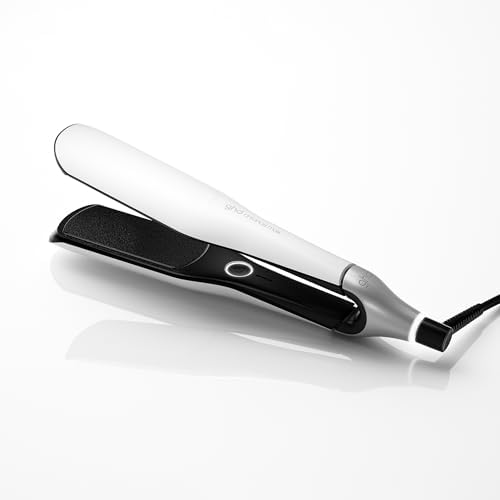
- 3x faster styling results: Our patented, smart HD motion-responsive technology adapts to your movements for ultra-fast o…
- Long-lasting shine: Achieve up to 85% more shine, 2x less frizz, and high-definition styles that last for 24 hours¹
- No extreme heat damage: Maintains the optimal 365ºF temperature with 2x more heat monitoring responsiveness for safe, co…
Why it works. Editorial coverage notes that the two-inch plates allow larger sections than a traditional one-inch iron. ghd claims lab testing shows it is 3x faster than the ghd Max at achieving the same frizz reduction on frizzy hair, and cites a 2023 consumer survey where 82% of 112 consumers agreed it gave a 24-hour style. Both are manufacturer-run, so treat them as directional. Curly Nikkighd
Limitations. Like all ghd tools, it holds a fixed 365°F. Very wide plates are a poor fit for tight areas. It’s also the more expensive of the two wide models.
Who should consider it. Long, dense, frizz-prone hair, and anyone who wants ghd’s newest wide-plate design.
Who should skip it. Anyone who needs adjustable heat, or has shorter hair.
BaBylissPRO Nano Titanium

- STRAIGHTEN, WAVE, OR CURL WITH ONE TOOL — Designed for ultimate styling versatility, the heated outer housing allows you…
- SMOOTH, SHINY RESULTS WITH LESS FRIZZ — Nano Titanium plates deliver highly efficient heat transfer to instantly smooth …
- CUSTOMIZED HEAT FOR EVERY HAIR TYPE — Five LED temperature settings up to 465°F provide adjustable heat control for all …
What it is. BaBylissPRO’s titanium-plate line. The official 1-inch Ultra-Thin page lists extended 5-inch plates, 50 heat settings up to 450°F, a dual-voltage ceramic heater with fast heat-up and recovery, a 9-foot swivel cord, and a limited 4-year warranty (manufacturer specs). It listed at $179.99, though it showed out of stock when I checked. Editorial coverage points to a 1.5-inch Ultra-Thin version as more attractive for thick hair. babylissproCurly Nikki
Why it works. Titanium heat transfer and a wide range of settings suit coarse, resistant strands. Adjustability lets you dial in a lower temperature for finer or treated sections.
Limitations. The 1-inch version means more sections on very dense hair. Titanium at high settings can be rough on hair that’s already stressed.
Best hair type. Coarse, resistant, or moderately curly hair, and shoppers who value adjustability and warranty length.
Who should skip it. Anyone who prefers a fixed, worry-free temperature.
Value. Generally the more affordable premium route, with a longer warranty than the ghd Max. See our BaBylissPRO Nano Titanium review.
T3 SinglePass StyleMax

What it is. A digital iron with adjustable heat and texture-based presets. Forbes named it best overall in its 2026 roundup, citing even heat distribution and smooth results. CNN Underscored’s reviewer said it glided effortlessly through her coarse hair, and noted a curl mode and curved ends. ForbesCNN
Why it matters for thick hair. It combines adjustability with guidance, which helps if you’re unsure where to start. I couldn’t verify a plate width for the current model, so confirm this before buying if wide coverage is your priority.
Limitations. Its 410°F maximum is below BaBylissPRO’s 450°F, which may matter for very resistant hair.
Who should consider it. Thick-haired shoppers with mixed texture or some damage who want control. See our T3 SinglePass StyleMax review.
ghd Platinum+
What it is. ghd’s 1-inch premium styler. CNN Underscored lists it at $319, and Forbes named it its pick for thick hair, so it earns a place despite the narrower plates. CNN
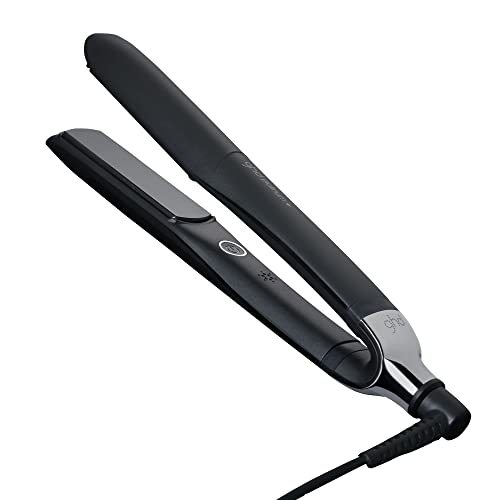
- SALON-TESTED RESULTS, NO GUESSWORK: Ultra-Zone tech reads your hair 250x/sec for 70% stronger hair and 75% more shine in…
- NO DIAL, NO DAMAGE: Locked at ghd’s stylist-tested 365°F “sweet spot” so you never guess a setting. Up to 2x color prote…
- PREMIUM CERAMIC FLOATING PLATES: Precision-milled ceramic plates with a whisbone hinge glide smoothly and maintain even …
Why it works. Precision. Slim plates reach roots, bangs, and shorter layers, and the tool works for curling and waving too.
Limitations. Narrow plates mean more sections on dense hair. Fixed 365°F.
Who should consider it. Thick hair with shorter layers, bangs, or anyone who uses one tool for multiple styles. See our GHD Platinum+ review.
Who should skip it. Very long, very dense hair where speed is the priority.
Dyson Corrale
What it is. A cordless straightener with flexing plates that gather hair as they clamp. It’s a premium-priced tool, and Forbes’ 2026 roundup lists it as its best cordless pick.

- Use corded or cord-free for extra versatility. Up to 30 minutes cord-free styling: Delivers the same thermal performance…
- Less heat, half the damage: Flexing plates gather your hair for more control, so you can achieve the same style with les…
- Auto shut-off and Safety lock: Switches off after 10 minutes of inactivity for added peace of mind. Safety lock allows f…
When it makes sense. If you travel, or you’re tired of fighting a cord, and you want a premium tool with a different plate design. Cordless also helps with reaching the back of the head.
Limitations. Battery runtime limits how long you can work, which matters on dense, long hair. The plates are standard width, so you’ll do more sections than with a wide-plate tool. Confirm current settings and runtime on Dyson’s site. See our Dyson Corrale review.
Who should skip it. Anyone who mainly wants speed on very dense hair, or who’s budget-conscious.
Dyson Airstrait and ghd Duet Style
These are a different category, covered in the comparison below. Our Dyson Airstrait review and GHD Duet Style review go deeper on each.
Key Comparisons
ghd Max vs. ghd Chronos Max
| ghd Max | ghd Chronos Max | |
|---|---|---|
| Plates | Wide (marketed 2-inch) | Two-inch, HD motion-responsive |
| Temperature | Fixed 365°F | Fixed 365°F |
| Speed claim | “Half the time” vs ghd Original (brand claim) | Brand claims 3x faster frizz reduction vs Max in lab |
| Position | Older model, often discounted | Newer flagship |
Both have the same fixed temperature, and both have the same trade-offs on precision and root access. The real difference is technology and price. If a Max is significantly cheaper, it’s a reasonable value. If you want ghd’s latest wide-plate design and can afford it, the Chronos Max is what ghd recommends for thick hair. Neither is a fit if you need adjustable heat.
ghd Max vs. ghd Platinum+
The Max is about coverage and speed, while the Platinum+ is about control. On long, dense hair, the Max cuts sections. On shorter layers, bangs, and root work, the Platinum+ wins. The Platinum+ is also the more versatile styling tool. Both use ghd’s fixed-temperature approach.
BaBylissPRO Nano Titanium vs. ghd Max
Titanium vs. ceramic-based ghd technology; adjustable up to 450°F vs. fixed 365°F; usually a lower price and longer warranty (4 years on the listed Babyliss vs. 2 on the Max). The Max is easier to use without thinking, and the BaBylissPRO gives coarse-hair shoppers more headroom and more responsibility. The Babyliss 1-inch is more precise, and wider Babyliss versions exist for thick hair.
Traditional Flat Irons vs. Dyson Airstrait / ghd Duet Style
Wet-to-dry stylers use airflow to dry and straighten damp hair in one step rather than pressing hair between hot plates. The appeal is convenience and skipping a separate blow-dry.
On very thick, dense, or tightly curled hair, the limits show up. Drying takes time, airflow has to move through a lot of hair, and you can’t apply the same tension a hot plate gives. Editors testing these tools generally describe them as strong for fine to medium hair and less convincing on very thick or tightly curled hair. For dense hair, a conventional flat iron after a proper blow-dry usually remains the more practical route. That’s a category limitation rather than a knock on the products.
Best Straightener by Hair Situation
| Hair situation | Prioritize | Suitable type | Why |
|---|---|---|---|
| Long + thick | Speed, wide plates, recovery | 1.5–2 inch, e.g., ghd Chronos Max or Max | Fewer sections, less arm time |
| Thick + coarse | Heat headroom, adjustability | Titanium or high-recovery adjustable tool, e.g., BaBylissPRO | Resistant strands need reliable heat |
| Thick + wavy | Smoothness, moderate heat | Ceramic or titanium, 1.25–1.5 inch | Prep matters more than max heat |
| Thick + curly | Blow-dry first, steady tension | Wide plates with strong recovery | Reduces passes |
| Thick + coily/textured | Heat control, protection | Adjustable tool, small sections | Avoid overheating; keep passes low |
| Thick + frizzy | Prep, glide, sealing | Smooth-plate ceramic, anti-frizz finish | Humidity is a finishing problem too |
| Thick + color-treated | Lower temperature | Adjustable ceramic, e.g., T3 | Chemical treatment lowers tolerance |
| Thick + damaged | Lowest workable heat | Adjustable, gentle | Fewer passes, less heat |
| Thick + short layers | Precision | 1-inch, e.g., ghd Platinum+ | Root access |
| Thick + very long | Speed, ergonomics | Wide plates, swivel cord | Fatigue is the real enemy |
How to Straighten Thick Hair Properly
- Start with clean, fully dry hair. A thorough blow-dry does a lot of the work. Straightening damp hair with a tool that isn’t designed for wet use is a common mistake.
- Apply heat protectant. It reduces, but doesn’t eliminate, heat stress.
- Detangle so the iron doesn’t snag.
- Divide into sections. Clip the top away and start at the nape.
- Use manageable sections, roughly as wide as the plate and thin enough that you can see the plates close.
- Choose an appropriate temperature. Start lower and increase only if needed.
- Glide steadily with even pressure, close to the root.
- Avoid repeated passes. Two clean passes beat six rushed ones.
- Let hair cool before touching or brushing it, so it sets.
- Finish lightly. A small amount of anti-frizz product goes a long way.
Fewer passes usually come from better prep, right-sized sections, and a tool that holds temperature, not from cranking the heat. No routine gives zero damage. The goal is to minimize it.
Common Mistakes
- Using maximum heat automatically. More heat isn’t more effective if the section is too big.
- Sections that are too large. Hair in the middle never heats.
- Sections that are too small. You’ll pass over strands repeatedly and take forever.
- Passing over the same strand again and again.
- Using a dry-hair straightener on damp hair.
- Skipping heat protectant.
- Buying very wide plates for short hair.
- Ignoring hair condition. Color-treated or damaged hair needs a lower ceiling.
- Judging a tool only by maximum temperature. Recovery, glide, and plate quality matter as much.
- Confusing dense hair with coarse hair. Dense hair needs speed and coverage. Coarse hair needs reliable heat.
Are Expensive Straighteners Worth It?
Sometimes. Premium tools typically justify their price through better heat consistency and recovery, smoother plates, longer warranties, and more comfortable ergonomics. On thick hair those advantages show up because you use the tool for a long time and push it hard. But a pricey tool won’t fix bad prep, oversized sections, or a mismatched plate width. If you straighten rarely or have manageable hair, a mid-priced tool may serve you fine.
Buying Checklist
Before you buy, ask:
- How long is my hair?
- How dense is it?
- Are my individual strands coarse?
- Is it curly, wavy, or coily?
- Is it damaged or color-treated?
- Do I prioritize speed or precision?
- Do I need adjustable heat?
- Do I want wide plates?
- Do I travel?
- What’s my realistic budget?
For a broader overview, see our guide to hair straightening tools and products.
FAQs
What is the best type of straightener for thick hair?
It depends on what kind of thick. Long, dense hair generally benefits from wide plates, and coarse hair from tools with strong heat recovery and reliable heat. Adjustable temperature helps if your hair is mixed or treated.
Are titanium straighteners better for thick hair?
Not universally. Titanium heats fast and suits resistant, coarse strands, but it can be harsh on fragile hair if you use too much heat. Ceramic can work well when the tool recovers heat quickly.
Are wide plates better for thick hair?
They’re faster on long, dense hair, but they’re clumsy for bangs, short layers, and roots.
What temperature should I use on thick hair?
There’s no single right answer. Start lower, increase gradually, and factor in coarseness, color treatment, and damage. Manufacturers differ, with ghd fixing 365°F and BaBylissPRO listing settings up to 450°F.
Is 1-inch or 2-inch better for thick hair?
Two-inch saves time on long, dense hair. One-inch offers precision and root access. Some shoppers choose 1.5 inches as a compromise.
What is the best straightener for thick curly hair?
Blow-dry first, then use a tool with steady tension, strong heat recovery, and enough plate width to reduce passes. Adjustability helps if your curls vary by section.
Can thick hair use a ceramic flat iron?
Yes. Many ceramic tools handle thick hair well, especially with good heat recovery.
How can I straighten thick hair without multiple passes?
Blow-dry thoroughly, use heat protectant, take right-sized sections, and use a tool that holds temperature.
Is the GHD Max good for thick hair?
It’s a strong option for long, dense hair if you value speed and don’t need adjustable heat. Very coarse or tightly curled hair may want more temperature range.
Is a wet-to-dry straightener better for thick hair?
Usually not. Wet-to-dry tools offer convenience, but very thick, dense, or curly hair generally does better with a blow-dry and a conventional flat iron.
Conclusion: A Decision Framework
- Prioritize wide plates if your hair is long, dense, or curly and speed is your main frustration.
- Choose titanium if your strands are coarse and resistant, and you’re comfortable managing heat.
- Choose ceramic for a more even, forgiving heat profile, especially with color-treated or damaged hair.
- Prioritize adjustable heat if your hair is mixed, treated, or you want control.
- Choose fixed-temperature premium tools such as ghd if you’d rather not think about settings.
- Consider cordless only if convenience is worth a premium and shorter session length.
- Consider wet-to-dry if your hair is thinner or medium, not very thick or tightly curled.
If you’re still torn, compare a few options in our guide to luxury hair styling tools.