
Disclosure: Natural Skin Studio participates in the Amazon Associates program and other affiliate partnerships. If you purchase through links in this article, we may earn a small commission at no extra cost to you. Our editorial recommendations are always independent.
The Real Question Isn’t “Which Is Best?” — It’s “Which Is Worth It for You?”
A $500 hair tool sounds borderline absurd until you actually think about what’s sitting in your bathroom cabinet right now. A dryer. A straightener. A curling wand. Maybe a hot-air brush you bought on a whim. Add those up, and you might already be close to $400—spread across multiple tools that each do one thing, with cords that tangle, and results that vary depending on which YouTube tutorial you found at 7 a.m.
That’s the actual case for luxury hair styling tools in 2026: not that they’re inherently superior to everything cheaper, but that the best ones can consolidate your routine, deliver more consistent results, and over several years of daily use, cost less per styling session than you’d expect.
The problem is that the premium hair tool market is genuinely complicated right now. Several brands are competing at the $300–$600 price point with very different approaches, very different strengths, and marketing that does an excellent job of making everything sound equally impressive. Some tools really do justify that price. Others are charging for packaging, prestige, or features that most buyers will never actually use.
This guide cuts through that. We looked at the current 2026 market across multi-stylers, hair dryers, wet-to-dry tools, straighteners, and hot-air brushes—and the goal isn’t to hand you a list. It’s to help you figure out which luxury tool, if any, makes sense for how you actually style your hair.
At a Glance: Top Picks by Category
| Category | Top Pick | Best Alternative |
|---|---|---|
| Luxury Multi-Styler | Dyson Airwrap i.d. | Shark FlexStyle |
| Premium Hair Dryer | Dyson Supersonic | T3 Featherweight StyleMax |
| Wet-to-Dry Styler | GHD Duet Style | Dyson Airstrait |
| Premium Straightener | GHD Platinum+ | GHD Max (for thick/long hair) |
| Hot-Air Brush | T3 AireBrush Duo | Shark FlexFusion |
| Best Value at This Tier | Shark FlexStyle | T3 Aire 360 |
Full justifications for each recommendation appear throughout this guide. No pick is listed without explanation.
What Makes a Luxury Hair Tool Actually Worth the Money?
Before we get into specific products, here’s how to evaluate any expensive styling tool—because the answer to “is it worth it?” genuinely depends on your situation.
1. Performance
This sounds obvious, but ask specifically: does it produce noticeably better results than what you’re currently using? “Better” might mean smoother, shinier, less frizz, longer-lasting curl definition, or a blowout that doesn’t require a second pass. If you can get the same result from a $60 tool, the premium isn’t justified on performance alone.
2. Heat Management
This is where genuine technology differences appear. Traditional styling tools apply maximum heat and hope you control the damage. Better tools regulate temperature consistently—either through sensors that adjust heat in real time, lower operating temperatures that still achieve results, or airflow-based styling that reduces direct plate or barrel contact with hair.
GHD uses what it calls Tri-Zone Technology in the Platinum+ to measure temperature 250 times per second and maintain 365°F, which it says is the optimal styling temperature according to its research. Dyson’s Airwrap relies primarily on high-velocity airflow rather than high heat, which means hair never actually touches an extremely hot surface in the same way. These are meaningfully different approaches—not just marketing language—but neither is universally “better.” They’re better for different hair types and styling goals.
3. Versatility
One of the strongest arguments for spending $400–$600 on a multi-styler is replacing three or four separate tools. But only if you’ll actually use the attachments. A Dyson Airwrap with six attachments is excellent value if you use five of them. If you only ever use the smoothing brush because you just want a blowout, a dedicated hot-air brush at a lower price point makes more financial sense.
4. Styling Time
Some premium tools genuinely save time—a higher-powered dryer reduces drying time, a multi-styler eliminates tool switching, a wet-to-dry straightener cuts out the blow-dry step entirely. But time savings are also sometimes overstated in marketing. A tool advertised as cutting drying time by 50% typically refers to laboratory conditions or very specific hair types.
5. Hair-Type Compatibility
This matters more than almost any other factor. The best luxury multi-styler in the world won’t be your best tool if it doesn’t work with your hair texture. We break this down in detail below.
6. Ergonomics
Weight, balance, cord flexibility, and button placement all affect daily usability. A 1.5-pound dryer that causes arm fatigue isn’t enjoyable to use, regardless of its technology. Tools designed with professional stylists in mind tend to score better here—though not always.
7. Durability and Build Quality
A tool you use several times a week for four or five years has a very different cost-per-use calculation than one that dies after 18 months. Premium brands generally use better internal components, but build quality varies by product even within the same brand. Motor quality, materials, and heat element construction all influence longevity.
8. Warranty
Dyson offers a two-year warranty. GHD offers two years. Shark typically offers one year though this can vary. T3 offers a two-year warranty on most products. A longer warranty doesn’t automatically mean better build quality, but it does affect risk when you’re spending $400+.
9. Maintenance
Filters need cleaning, attachments can wear out, and some tools require more maintenance than others. The Dyson Supersonic has a removable filter that needs regular cleaning—skipping this visibly affects performance over time. Factor this into your assessment of long-term ownership.
10. Total Cost of Ownership
Here’s a simple calculation worth doing:
Purchase price ÷ expected years of use = approximate annual cost
A $500 multi-styler used four times a week for five years costs roughly $100 per year, or about $0.50 per styling session. That’s before you account for the $180 straightener, $120 curling wand, and $80 hot-air brush it might replace—none of which you’d need to buy. Conversely, a $400 tool used twice a month costs significantly more per session and almost certainly doesn’t justify its price.
Frequency of use is one of the most important variables in this decision.
Comparison Table
| Product | Type | Approx. Price | Best For | Key Technology | Main Advantage | Main Drawback | Worth It? |
|---|---|---|---|---|---|---|---|
| Dyson Airwrap i.d. | Multi-styler | ~$599 | Wavy/fine-medium hair | Coanda airflow effect | Replaces multiple tools, low-heat styling | Doesn’t work well on very thick or coily hair | Yes, if you use 3+ attachments |
| Shark FlexStyle | Multi-styler | ~$300 | Most hair types | Interchangeable attachments, ionic | Strong value, good range of attachments | Less refined airflow than Dyson | Yes—best value at this tier |
| T3 Aire 360 | Multi-styler | ~$350 | Wavy to curly | 360° airflow barrel | Works on a wider curl range, salon feel | Fewer attachments than competitors | Worth it for curly-hair users |
| Dyson Supersonic | Hair dryer | ~$430 | All types, especially fine/color-treated | High-pressure motor, heat control | Fast drying, intelligent heat, lightweight | Very expensive for a dryer; alternatives close the gap | Depends heavily on budget |
| T3 Featherweight StyleMax | Hair dryer | ~$280 | Thick/long hair | High-wattage, multiple heat/speed settings | Powerful, professional-grade | Less intelligent heat management than Dyson | Yes, strong alternative to Dyson |
| Shark SpeedStyle | Hair dryer | ~$150–$180 | All hair types | IQ COOL™ technology, concentrator/diffuser | Excellent value, fast drying | Fewer specialty attachments | Yes—best mid-luxury pick |
| GHD Duet Style | Wet-to-dry | ~$400 | Straight/wavy, color-treated | Dual-zone steam + plates | Styles wet hair, reduces heat exposure time | Limited to straightening/smoothing | Worth it if you skip blow-drying |
| Dyson Airstrait | Wet-to-dry | ~$500 | Fine-medium, frizz-prone | High-velocity airflow, no plates | No direct plate contact on wet hair | Not ideal for thick or curly hair | Conditional—read the section below |
| GHD Platinum+ | Straightener | ~$279 | All types, especially color-treated | Tri-Zone Technology, 365°F | Consistent heat, excellent finish | One temperature, no adjustment | Yes, for daily straightener users |
| GHD Max | Straightener | ~$329 | Long/thick hair | Wider plates, Tri-Zone Technology | Covers more hair per pass | Too wide for short/fine hair | Yes, if hair length/thickness fits |
| T3 AireBrush Duo | Hot-air brush | ~$200 | Fine-medium, volume-seekers | Dual-diameter barrels, ionic | Two barrel sizes, natural finish | Not ideal for very thick hair | Yes, if a hot-air brush is your primary tool |
| BaBylissPRO Nano Titanium | Straightener | ~$100–$130 | Professional use, thick hair | Nano titanium plates, high heat | Very high heat, durable, professional | No intelligent heat management | Yes, for those who need maximum heat |
Prices are approximate as of early 2026 and subject to change. Always verify current pricing before purchasing.
Luxury Multi-Stylers
Dyson Airwrap i.d.
What It Does
The Airwrap uses Dyson’s Coanda effect technology—high-velocity airflow that causes hair to wrap around the barrel rather than requiring clips or clamps—to curl, wave, volumize, and smooth hair. The i.d. version, released in late 2025, adds a small display that remembers your preferred settings and allows more precise control.

- Program your perfect curls. App enabled for one-touch, personalized styling.
- Engineered for straight and wavy hair.
- 6-in-1 style versatility. Dry, curl, wave, shape, and smooth with no heat damage.
According to Dyson’s product page, the Airwrap uses controlled airflow rather than extreme heat as the primary styling mechanism. The company states that hair is never exposed to temperatures above 302°F during airflow styling—significantly lower than many traditional curling tools.
What Makes It Premium
The Coanda effect is real physics, not just a marketing hook. The airflow creates enough attraction to pull hair toward the barrel, which means styling works faster and with less clamping force than traditional curling irons. This genuinely reduces direct heat exposure time. The i.d. update adds personalization features and a refined motor, though the core technology remains similar to earlier Airwrap versions.
What It Does Better
Volume and wave creation on fine-to-medium hair. It excels at producing lived-in waves, bouncy blowout volume, and smooth styles without the flat, plasticky look that some straighteners create. When used well, the finish looks more like a professional blowout than like a tool was involved.
Where It Falls Short
Very thick, coily, or tightly curled hair. The Airwrap’s Coanda effect requires hair to respond to airflow—and very dense, resistant hair textures don’t always cooperate. Reviewers with 4A–4C hair textures have consistently noted that the curling attachments produce less defined results on their hair type. TechRadar’s ongoing coverage of multi-stylers has noted this limitation in multiple test rounds.
The $599 price is also genuinely steep, and the i.d.’s personalization features, while nice, aren’t fundamental to styling performance.
Best For
Fine to medium hair, wavy to loose curl patterns, anyone replacing multiple tools (dryer, curler, smoothing brush), and people who prioritize lower heat styling.
Who Should Skip It
People with very thick or coily hair, anyone who only needs one styling function, and budget-conscious buyers who are mainly drawn to the brand prestige rather than the multi-function value.
Value for Money
Strong—but only if you actively use multiple attachments. If you’re buying it primarily as a dryer or primarily as a curler, better single-function tools exist at lower prices.
Shark FlexStyle
What It Does
The FlexStyle is Shark’s direct Airwrap competitor: a multi-styler with interchangeable attachments that can curl, smooth, volumize, and dry. Its defining design feature is a flexible neck that lets you flip the tool direction mid-styling.

- MULTI-STYLING HAIR DRYER TOOL: Rotate the powerful hair dryer to transform into a versatile multi styler for drying, sty…
- CURL, VOLUMIZE, SMOOTH & DRY: Attach stylers to the wand to curl, volumize, smooth, and dry. Create multiple styles with…
- NO HEAT DAMAGE: Fast drying with low heat, measuring and regulating temperatures 1000x per second to ensure consistent a…
According to Shark’s product information, the FlexStyle includes multiple curl barrels, a smoothing brush, a paddle brush, and a concentrator nozzle, depending on the configuration purchased.
What Makes It Premium
Shark brought legitimate competition to a market Dyson essentially owned. The FlexStyle is ionic, produces good airflow, and has more attachment variety in some bundles than the base Airwrap. The flexible neck is genuinely useful—not a gimmick—for reaching sections of hair without awkward arm positioning.
What It Does Better
Value. At roughly half the price of the Dyson Airwrap i.d., the FlexStyle delivers comparable results for most hair types, particularly for straight-to-wavy hair where the smoothing and volume attachments perform very well. It’s also better-suited to thicker hair than the Airwrap in some configurations.
Where It Falls Short
The airflow-based curling technology isn’t quite as refined as the Airwrap—the Coanda effect on the Airwrap is more consistent when wrapping fine hair around barrels. On very fine hair, some users report the curl attachment requires more practice. The overall build finish is also a step below Dyson’s.
Best For
People who want multi-styler capability without the Dyson price, those with straight to wavy or thick hair, and value-conscious buyers who want to consolidate tools.
Who Should Skip It
Those with very fine hair who specifically want the Airwrap’s curl-wrapping precision, or buyers who only need one styling function.
Value for Money
Excellent. The Shark FlexStyle is the most compelling value argument in the multi-styler category in 2026.
Dyson Airwrap vs. Shark FlexStyle: Which Should You Buy?
Choose the Dyson Airwrap i.d. if: You have fine-to-medium hair, you specifically want the most refined airflow-curling experience, you’re comfortable spending $599, and you want the personalization features of the i.d. model.
Choose the Shark FlexStyle if: You want multi-styler capability at a meaningfully lower price, you have thicker or straighter hair that benefits from strong airflow drying, or you want to put the savings toward something else.
For most people, the FlexStyle is the smarter financial decision. The Airwrap’s advantage is real but narrower in practice than its price premium suggests.
T3 Aire 360
The T3 Aire 360 takes a different angle: its 360° airflow barrel wraps hair more evenly around the barrel using omnidirectional airflow, which T3 says produces more consistent curl formation. It’s positioned at approximately $350 and sits between the Dyson and Shark in price.

- Aire 360 technology automatically gathers hair to form soft, bouncy blowout curls with zero heat damage*
- Ceramic curling attachments harness high-performance heat and air to style lasting blowout curls
- SoftAire drying concentrator softens airflow for rapid drying that helps protect hair’s natural moisture
It’s genuinely worth considering for wavy-to-curly hair types (roughly 2B–3B) where the 360° airflow creates better curl definition than single-direction airflow tools. If you’ve found the Airwrap’s directional wrapping difficult to work with, the Aire 360’s approach can feel more intuitive.
It’s not a clear winner over either competitor—the Dyson is more refined on fine hair, the FlexStyle offers better value—but for its specific curl-focused use case, it’s a legitimate choice worth testing if retailers offer demos.
Premium Hair Dryers
Dyson Supersonic
The Supersonic remains the reference point for premium hair dryers, but in 2026 it faces more serious competition than it did at launch. At approximately $430, it’s hard to justify on price alone. What it delivers is fast drying through a powerful small motor, intelligent heat control via glass bead thermistors that measure temperature and adjust heat 40 times per second (per Dyson’s own specifications), and a relatively lightweight, well-balanced design.

- Fast drying. The small, powerful Dyson digital motor V9 combined with Air Multiplier technology produces a high-pressure…
- Intelligent heat control. The Dyson Supersonic hair dryer measures air temperature over 40 times a second and regulates …
- Magnetic attachments adjust quickly and easily. Heat Shield technology keeps the surfaces of attachments cool, even duri…
The question isn’t whether it’s good—it is—but whether its performance advantage over a $280 T3 StyleMax or even a $150 Shark SpeedStyle is worth $150–$280. For most hair types, that gap is narrower than Dyson’s marketing suggests.
Best for: Fine hair, color-treated hair, those with heat sensitivity concerns, and people who want best-in-class intelligent heat management.
Skip if: You have thick or very long hair that benefits more from higher wattage than heat precision, or you’re working within a tighter budget.
T3 Featherweight StyleMax
The StyleMax is a professional-grade dryer that competes seriously with the Supersonic at a lower price. It delivers strong wattage, multiple heat and speed settings, and a build quality that holds up well over time. It doesn’t have the Supersonic’s real-time heat sensors, but it has more manual control options.
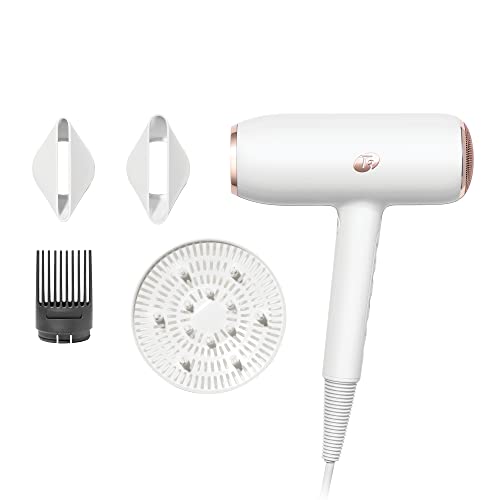
For thick or long hair, the StyleMax often outperforms the Supersonic in practice because raw airflow power matters more than precise temperature calibration when you’re working through dense hair. You can read our full breakdown in our T3 Featherweight StyleMax review.
Best for: Thick, long, or coarse hair; professional-style results at a more reasonable price point.
Shark SpeedStyle
At roughly $150–$180, the SpeedStyle isn’t technically a luxury dryer, but it belongs in this conversation because it delivers performance that punches well above its price. It includes useful attachments—a smoothing concentrator, a curl-diffuser, and a finishing nozzle—and dries hair quickly with good ionic output.

- High-Speed Styling, No Compromise: This powerful hair dryer delivers ultra-fast wet-to-dry results with three smart styl…
- Shiny, Frizz-Free Finish: The RapidGloss Finisher uses dual high-speed airflow to smooth flyaways and boost shine, givin…
- No Heat Damage: Advanced technology regulates temperature 1,000x per second, staying below 230°F to protect hair from he…
For budget-conscious readers who want the multi-attachment experience without a $400+ investment, the SpeedStyle is worth serious consideration. You can see how it performs in our Shark SpeedStyle review.
Dyson Supersonic vs. T3 Featherweight StyleMax
Choose the Dyson Supersonic if: You have fine, color-treated, or heat-sensitive hair and want the most intelligent heat management available in a consumer dryer.
Choose the T3 StyleMax if: You have thick or long hair that needs power over precision, or if you’d rather spend $150 less and invest it elsewhere.
Wet-to-Dry Stylers
GHD Duet Style
The GHD Duet Style is one of the more genuinely interesting luxury tools in 2026. It’s a straightener that uses dual-zone technology—steam on the lower plate, heat on the upper—to style hair from wet to dry in a single pass. GHD claims this reduces the time hair is exposed to heat because you’re eliminating a separate blow-dry step.

- DRY & STYLE WITH JUST ONE TOOL ― Revolutionary air-fusion technology dries and straightens hair at the same time, quickl…
- LUXURIOUS RESULTS EVERYDAY ― Unprecedented softness for up to 48 hours while protecting your hair’s natural moisture. Un…
- UNCOMPROMISING STYLE ― Advanced floating plates with ultra-glass coating ensure incredibly smooth and snag-free gliding …
We’ve tested this tool at Natural Skin Studio. Our GHD Duet Style review covers the specifics in detail, but the headline finding is this: it genuinely works on damp (not soaking wet) hair, and the results on straight to wavy hair are smooth and frizz-free. The caveats are real, though—very thick hair still needs work in sections, and “wet-to-dry” styling requires hair that’s been towel-dried, not freshly washed.
At approximately $400, it’s a meaningful premium over standard straighteners, but for someone who currently blow-dries and then straightens every time, it does eliminate a step and reduce total heat exposure time.
Best for: Straight to wavy hair, those who straighten frequently and want to cut time from their routine, color-treated hair where minimizing heat exposure time matters.
Who should skip it: Very thick or curly hair (results are inconsistent), anyone who only occasionally straightens, buyers on a tighter budget who can get excellent results from the GHD Platinum+ at a lower price.
Dyson Airstrait
The Airstrait is Dyson’s answer to the wet-to-dry category, but with a completely different approach: it uses high-velocity airflow through two angled airways to smooth and straighten hair without traditional hot plates. The Airstrait’s airways direct air across the hair as it passes through, stretching and smoothing it as it dries.
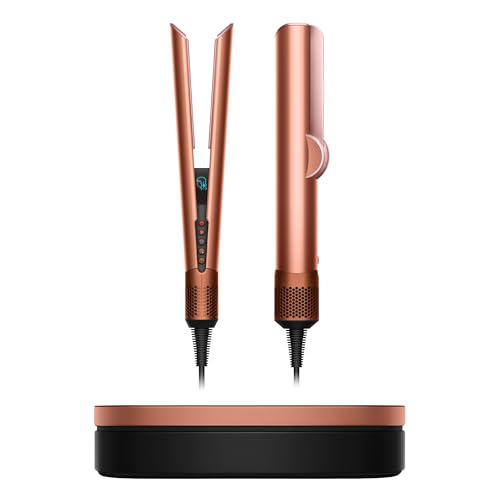
- Wet to dry straightening with air. No hot plates. No heat damage.¹
- Reduces time spent drying and styling by an average of 25%.⁴
- Airflow is projected downwards at a 45° angle to create the tension needed to align hair for a smooth end style – with l…
Dyson positions the Airstrait as a tool for frizz-prone hair that wants smoothness without direct plate heat. For fine to medium, frizz-prone straight-to-wavy hair, reviewers—including coverage from Allure—have noted that results are genuinely good: smooth, shiny, with no direct plate pressing on wet hair.
But the Airstrait is limited in what it can achieve on curly or thick hair, and at approximately $500 it’s an expensive tool for a relatively specific use case. It’s not a replacement for a curling tool, a volumizing brush, or a diffuser. It does one thing well.
Best for: Fine to medium, frizz-prone, straight-to-wavy hair types. Ideal for those who want smooth, polished styles without touching very hot plates to wet strands.
Who should skip it: Anyone with thick, coily, or curly hair; anyone who needs more versatility from a $500 tool; anyone who already has a good dryer and straightener combination.
GHD Duet Style vs. Dyson Airstrait
Choose the GHD Duet Style if: You want polished, straightened results from wet hair with the familiar control of a flat iron and your hair is straight to wavy.
Choose the Dyson Airstrait if: You want to avoid direct plate contact entirely, prefer an airflow-only approach, and your hair is fine to medium and frizz-prone.
Both tools are niche—useful for a specific type of user but not broadly applicable. See our detailed GHD Duet Style review for a closer look at real-world performance.
Premium Straighteners
GHD Platinum+
The Platinum+ uses GHD’s proprietary Tri-Zone Technology, which the company says maintains a consistent 365°F across the entire plate surface—a temperature GHD’s research identifies as optimal for styling without unnecessary damage. Independent coverage from The Guardian and Allure has consistently rated the Platinum+ among the best consumer straighteners for its consistent, reliable results.
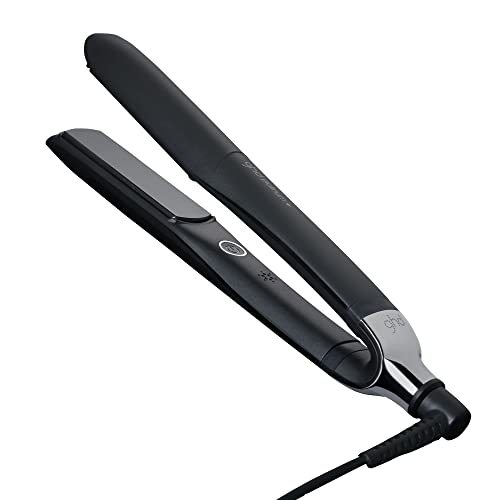
- SALON-TESTED RESULTS, NO GUESSWORK: Ultra-Zone tech reads your hair 250x/sec for 70% stronger hair and 75% more shine in…
- NO DIAL, NO DAMAGE: Locked at ghd’s stylist-tested 365°F “sweet spot” so you never guess a setting. Up to 2x color prote…
- PREMIUM CERAMIC FLOATING PLATES: Precision-milled ceramic plates with a whisbone hinge glide smoothly and maintain even …
What distinguishes the Platinum+ from cheaper straighteners isn’t the maximum temperature it reaches—many budget tools go hotter—but the consistency of heat distribution and the smoothness of the plate material. Uneven heat distribution is a primary cause of lines and ridges in finished styles; the Platinum+ largely eliminates this.
At approximately $279, it’s not cheap, but for a daily straightener it’s a legitimate long-term investment. GHD’s build quality is excellent, and most users report years of reliable performance.
Best for: Daily straightener users across most hair types, especially color-treated hair where consistent heat (rather than spikes of very high heat) matters most.
Who should skip it: The GHD Platinum+ has one temperature setting. If your hair needs very low heat or you prefer to adjust settings manually, this may frustrate you. For thick or very long hair needing faster coverage, the Max is a better fit.
You can find a full breakdown of the Platinum+ and its competitors in our guide to hair straightening tools.
GHD Max vs. GHD Platinum+
The Max has wider plates and the same Tri-Zone technology. If you have long, thick, or very dense hair, the wider plates cover more surface area per pass, which meaningfully reduces styling time.
Choose the Platinum+ if: You have short to medium-length, fine to medium, or normal-density hair.
Choose the Max if: Your hair is long (shoulder length or below), thick, or high-density.
BaBylissPRO Nano Titanium
At roughly $100–$130, the BaBylissPRO nano titanium straightener is the professional benchmark for high-heat styling at a non-luxury price. Titanium plates heat faster and distribute heat more evenly than most ceramic alternatives. Professional stylists have used BaBylissPRO tools for years precisely because they’re durable and effective.
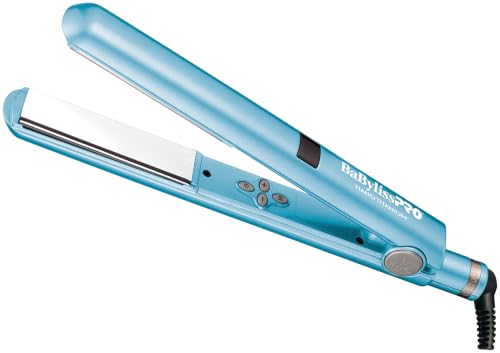
- SLEEK STRAIGHT & WAVES — Create sleek, polished straight styles with 1-inch plates designed for short, medium, and long …
- FRIZZ-FREE SHINE — Nano Titanium plates transfer ultra-high heat evenly to help reduce frizz, minimize hot spots, and re…
- FASTER STYLING RESULTS — All-directional floating plates guarantee 100% hair contact for fewer passes and efficient styl…
It doesn’t have intelligent heat management like the GHD Platinum+, and it runs hot—which is the point for thick, resistant hair types that genuinely need high heat to achieve a smooth result. For fine or color-treated hair where heat damage is a concern, it’s overkill. But for thick, coarse, or difficult-to-straighten hair, it outperforms many tools at twice the price.
Premium Hot-Air Brushes
T3 AireBrush Duo
The T3 AireBrush Duo includes two interchangeable barrel sizes, giving you the flexibility to create tighter waves or looser, voluminous blow-dry styles from the same tool. At approximately $200, it’s in a mid-range price bracket that’s worth considering if a hot-air brush is your primary styling tool.
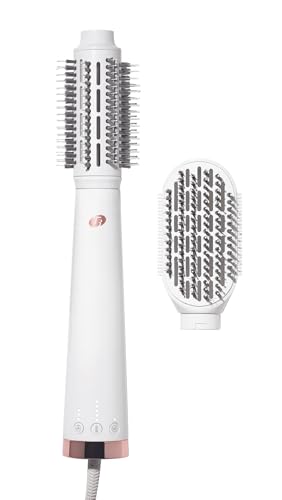
- What it is: If you’re in search of consistently bouncy waves, this T3 hot-air brush duo is the answer. This carefully en…
- What it does: An award-winner for good reason, this brush features two interchangeable heads, proprietary IonFlow techno…
- Rotating cord
The ionic output reduces static and frizz, and the results on fine to medium hair are genuinely good—you can achieve a polished, professional-looking volume blow-dry that would otherwise require a dryer and a round brush used simultaneously.
For detailed performance notes, our T3 AireBrush Duo review covers specific hair types.
Best for: Fine to medium hair, volume-seekers, those who want a smooth blow-dry without learning round-brush technique.
Who should skip it: People with very thick or coarse hair (it often struggles to smooth dense textures), and anyone who already has a multi-styler with a volumizing brush attachment—you’re duplicating functionality.
Hair-Type Guide: Which Luxury Tool Makes Sense for You?
Fine Hair
Fine hair benefits enormously from airflow-based styling and careful heat control. The Dyson Airwrap i.d. and Shark FlexStyle both work well. For drying, the Dyson Supersonic’s heat management prevents fine strands from getting overworked. Avoid the GHD Max’s wide plates—they’re too large for fine hair’s density.
Thick Hair
Thick hair needs power. The T3 StyleMax dryer outperforms the Supersonic for drying thick hair efficiently. The GHD Max is excellent for straightening. The FlexStyle’s airflow is strong enough to smooth thick hair where the Airwrap sometimes struggles.
Wavy Hair
Wavy hair has the widest tool compatibility. The Airwrap, FlexStyle, and T3 Aire 360 all produce excellent results. You’re enhancing a natural pattern rather than fighting it, which makes most multi-styler technology work in your favor.
Curly Hair (2C–3C)
The T3 Aire 360’s 360° airflow diffuses heat more evenly around curl formations. Diffuser attachments on any of the premium dryers improve results significantly. Avoid any tool that requires very high heat or direct plate contact on your natural curl pattern.
Coily Hair (4A–4C)
This is where most luxury multi-styler marketing falls short. The Dyson Airwrap’s Coanda technology works less reliably on very dense coil patterns. BaBylissPRO tools with higher heat and titanium plates are often more effective for stretching and smoothing coily hair than any airflow-based styler. A premium ionic dryer with a quality diffuser attachment matters more than the tool category.
Color-Treated or Damaged Hair
Prioritize consistent heat management over raw heat. The GHD Platinum+’s fixed optimal temperature is actually an advantage here—it won’t spike unpredictably. The Dyson Airstrait eliminates plate-on-wet-hair contact, which is relevant for brittle or chemically treated strands. Avoid tools that go above 400°F unless your hair genuinely needs it.
Long Hair
Wide plates (GHD Max), powerful dryers (T3 StyleMax), and multi-stylers with large-barrel attachments all save significant time on long hair. This is one situation where paying more for power and speed has clear practical value.
Short Hair
Many luxury multi-stylers are slightly awkward on hair shorter than chin length. A premium straightener like the GHD Platinum+ and a good blow-dryer are often a better combination for short styles than a multi-styler designed around longer sections.
When Luxury Isn’t Worth It
This is the section most buying guides skip—but it’s arguably the most useful.
You rarely style your hair. A $500 tool used once a month is almost never a smart purchase. A basic $40 straightener or a $70 dryer will serve you adequately for occasional use.
You only need one function. If you exclusively blow-dry and never curl or wave your hair, you don’t need a multi-styler. A strong mid-range dryer does the job without the premium.
You have very thick or coily hair and are looking at airflow-based tools. Dyson Airwrap marketing reaches a broad audience, but the technology’s real advantages are concentrated among fine-to-medium, straight-to-wavy hair types. If your hair regularly resists airflow styling, you’re paying for technology that doesn’t match your needs.
The premium features will go unused. If you’re considering the Dyson Airwrap i.d. for its personalization display but plan to use the same settings every session, you’re paying for a feature with zero practical benefit to you.
A mid-range tool can get you there. The Shark SpeedStyle at $150 delivers fast drying with good ionic output. The BaBylissPRO nano titanium at $110 straightens most hair types excellently. If either of these tools would meet your needs, there’s no editorial reason to tell you to spend four times more.
You’re mainly buying for aesthetics. Premium tools are beautifully designed. But if you’re buying the Dyson Supersonic primarily because it looks good on your bathroom shelf, the honest answer is that the $280 you’d save by choosing a T3 StyleMax could go toward something you’d use more deliberately.
2026 Market Trends Worth Knowing
A few developments have meaningfully shaped the premium hair tool landscape heading into 2026:
Multi-function tools have become the default premium purchase. Single-function luxury tools are harder to justify at $400+ when competitors offer multi-stylers at similar prices. The entire category has shifted toward consolidation.
Wet-to-dry technology is maturing. Both the GHD Duet Style and Dyson Airstrait represent a more developed wet-to-dry category than existed a few years ago. Results are more reliable and the hair-safety arguments are better substantiated than early claims suggested.
Brands are beginning to address more hair textures. Dyson has expanded attachment options with coily-hair-specific barrels, and Shark’s FlexStyle lineup has grown. Neither has fully solved the multi-styler gap for 4A–4C textures, but the effort is more genuine than it was.
Intelligent heat control has become a real differentiator. Real-time temperature adjustment—not just preset heat levels—is increasingly distinguishing premium tools from mid-range ones in meaningful ways, particularly for damaged or fine hair.
FAQs
Are luxury hair styling tools worth the money?
Sometimes, yes. The honest answer is that it depends on how frequently you style your hair, what functions you need, and whether the tool’s technology genuinely matches your hair type. A multi-styler that replaces three separate tools you use daily can be excellent value. A premium single-function tool you use twice a month almost certainly isn’t.
What is the best luxury hair styling tool in 2026?
For most people, the Shark FlexStyle offers the strongest combination of versatility and value. For fine-to-medium hair specifically, the Dyson Airwrap i.d. is the most refined option. Neither is objectively “best” without knowing your hair type and styling goals.
Is the Dyson Airwrap still worth it in 2026?
Yes, for the right person—fine to medium hair, multiple styling needs, preference for lower-heat styling. The i.d. update adds useful personalization, and the core technology remains genuinely differentiated. If your hair is thick or coily, other tools offer better results.
Is the Shark FlexStyle worth buying instead of the Dyson Airwrap?
For most buyers, yes. The FlexStyle delivers comparable multi-styler performance at roughly half the price. Unless you specifically benefit from the Dyson’s refined Coanda curling technology on fine hair, the FlexStyle is the smarter financial decision.
Which luxury hair tool is best for thick hair?
The T3 Featherweight StyleMax for drying, GHD Max for straightening, and Shark FlexStyle for multi-styling. Thick hair generally benefits more from power and plate size than from the airflow precision that justifies the Dyson’s premium.
Which premium styling tool is best for fine hair?
The Dyson Airwrap i.d. for multi-styling, the Dyson Supersonic for drying, and the GHD Platinum+ for straightening. Fine hair responds best to controlled heat and gentler airflow styling.
Are expensive hair dryers actually better?
Better in specific ways—the Dyson Supersonic’s intelligent heat control is genuinely superior to most alternatives. But “better” in practice depends on your hair type. For thick hair, a powerful T3 dryer may outperform a Dyson in actual drying time. For fine hair, the Dyson’s heat control has real advantages.
What is the best luxury hair straightener?
The GHD Platinum+ for most hair types; the GHD Max for long or thick hair. Both use consistent, well-controlled heat technology that produces smooth, reliable results. The BaBylissPRO nano titanium is a significantly cheaper alternative worth considering for those who need high heat.
Can one luxury styling tool replace multiple tools?
A good multi-styler can—but only if you’ll actually use its attachments. The Dyson Airwrap and Shark FlexStyle can realistically replace a dryer, curler, and smoothing brush. If your styling routine only requires one of those functions, a multi-styler’s value proposition doesn’t apply to you.
How long should a premium hair styling tool last?
Most well-built premium tools, used with proper maintenance, should last three to five years with regular use. Dyson, GHD, and T3 all have established track records for durability, though individual experiences vary. A two-year warranty period is typical across premium brands—factor repair or replacement costs into your total ownership calculation.
The Bottom Line: Spend Carefully, Buy Deliberately
The best luxury hair styling tool is the one whose premium features solve a problem you actually have—not the most expensive one, not the most-marketed one, and not the one your favorite influencer happens to be holding.
Before you spend $300–$600 on any of these tools, answer four questions:
How often will you use it? Daily use justifies premium tools. Weekly use warrants mid-range. Occasional use means even a basic tool is probably sufficient.
What functions do you actually need? If you need versatility, a multi-styler earns its premium. If you need one thing done well, buy the best single-function tool at a reasonable price.
Does the technology match your hair type? Airflow-based curling doesn’t work equally across all textures. Intelligent heat control matters more for fine and damaged hair than for thick and resistant hair. Match the technology to your actual hair.
What are you replacing? A multi-styler that replaces $400 worth of separate tools at a combined cost of $300 is genuinely economical. The same multi-styler purchased alongside three other tools you’ll keep using is just an expensive addition to a cluttered cabinet.
If you answer those questions honestly, the right choice—whether that’s a $600 Airwrap, a $300 FlexStyle, a $280 GHD Platinum+, or a $150 Shark SpeedStyle—becomes a lot clearer than any list of “best” products could make it.
Natural Skin Studio may earn a commission on qualifying purchases made through links in this article. All editorial recommendations are independent of affiliate arrangements.