
By the Natural Skin Studio editorial team | Updated October 26, 2026
Affiliate disclosure: Natural Skin Studio may earn a commission if you buy through links on this page, at no extra cost to you. This does not change our conclusions.
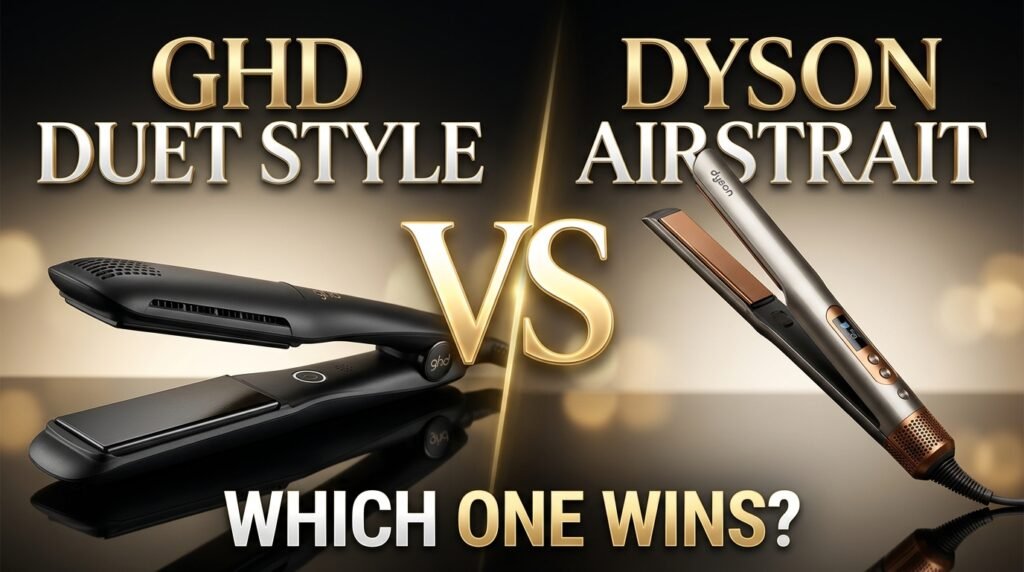
Quick answer: Choose the Dyson Airstrait if your priority is a sleek, poker-straight finish and a faster wet-to-straight routine, and you can justify the higher price. Choose the GHD Duet Style if you want a tool that also works as a true flat iron on dry hair, you prefer a lower price, and you can live with a heavier, bulkier tool. Neither is a guaranteed replacement for a hair dryer and straightener for every hair type.
How we researched this: This is a research-based comparison. We did not run our own hands-on tests, and we have not invented timings or lab results. We drew on the manufacturers’ own pages, current US pricing and the published findings of independent reviewers, and we flag where a claim comes from the brand rather than from independent testing.
The Core Difference: Air Only vs Air Plus Plates
Both tools dry and straighten hair at the same time, but they get there differently.
The Dyson Airstrait has no hot plates. It uses a stream of heated, high-pressure air to dry and straighten as you glide it through sections. Dyson says it regulates air temperature many times per second and that straightening from wet resets hair’s bonds without the extreme heat of a traditional hot-plate straightener. That is Dyson’s own claim, not an independent finding.
The GHD Duet Style combines airflow with four heated, lower-temperature plates, which GHD calls Air-fusion technology. Flip into Shine Shot mode and the fan switches off and the plates heat to 365°F, so it behaves like a regular flat iron. GHD states Shine Shot is for dry hair only. GHD’s “no heat damage” claim comes from its own testing in wet-to-style mode, so treat it as a manufacturer result.
In practice this matters most for finish. Airflow alone smooths and dries; plates add pressure and contact, which is why the GHD can also do dry-hair styling the Dyson struggles with.
At a Glance
| GHD Duet Style | Dyson Airstrait | |
|---|---|---|
| Technology | Airflow plus 4 heated plates | Heated airflow only, no plates |
| Wet mode | Single wet-to-style setting | Three temperatures: 175°F, 230°F, 285°F |
| Dry-hair mode | Shine Shot: fan off, plates at 365°F | Dry mode: 250°F or 285°F, plus Boost, and a cool setting |
| Weight | About 1.5 lb per TechRadar | About 2.2 lb total, about 1.3 lb in hand per TechRadar |
| Cord | About 8.8 ft per TechRadar | About 6.6 ft per TechRadar |
| List price (US) | $429 MSRP | $499.99 in recent reviews |
| Warranty | 2 years (GHD US) | Verify at purchase; one major retailer listing shows 2 years |
Specs and temperatures are drawn from the brand pages and from TechRadar’s GHD Duet Style review and its Dyson Airstrait review. Reviewers measured and reported some figures differently, so confirm details on the product page before buying.
Price and Value in the US
Prices move constantly, so here is how to read them rather than a number to rely on.
- GHD Duet Style: GHD’s US list price is $429. When we checked on October 26, 2026, the GHD product page showed a promotional price of $254, while GHD’s wet-to-dry comparison page showed $210. That mismatch is a good reminder that promotions are temporary and can differ between pages. Third-party retailers have listed it at full price or at their own discounts.
- Dyson Airstrait: Reviewers have reported a US list price of $499.99, and some newer limited colorways have been listed higher at certain retailers. Temporary discounts have appeared, including deals around the high $300s to low $400s at retailers like Amazon and Best Buy. Check Dyson’s US site for the current figure.
Value verdict: The GHD is the cheaper tool even at MSRP, and you effectively get a dryer and a flat iron in one body. Woman & Home’s reviewer also noted GHD sales appear more often than Dyson ones. Neither is cheap, though. TechRadar pointed out that you could still buy a separate dryer and flat iron for less than the Duet Style’s list price. If you only buy at full price, the Dyson’s premium is significant. If a Dyson promotion lands close to a GHD promotion, the decision shifts from price to finish and handling.
Wet-to-Dry vs Dry-Hair Touch-Ups
Wet-to-dry: Both tools are designed to take towel-dried hair to styled in one step, working in sections. GHD’s instructions call for sections no wider than the plates, roughly 2 inches, with a pause at the roots. Dyson’s guidance is to towel dry, pre-dry the roots, then section and style, finishing with a cold shot.
Dry-hair touch-ups: This is where the tools diverge most. The Duet Style’s Shine Shot turns it into a conventional flat iron, which independent reviewers found useful for adding shine, smoothing frizz and even creating a soft wave. Dyson confirms the Airstrait can refresh dry hair in Dry mode, but Woman & Home’s reviewer found it less effective as a dry straightener and could not curl with it. If you plan to use one tool for second-day hair and quick flat-iron-style fixes, the GHD has the advantage.
GHD Shine Shot vs Dyson Dry Mode
They are not equivalents. GHD’s Shine Shot stops the airflow and heats the plates for direct, flat-iron-style contact on dry hair. Dyson’s Dry mode keeps the airflow going at set temperatures for refreshing or finishing. Choose Shine Shot if you want plate-style sleekness or gentle bends on dry hair. Choose Dry mode if you only want light smoothing and prefer to avoid plate contact.
Which Suits Your Hair Type?
The following is guidance inferred from manufacturer information and independent reviews. Individual results vary with hair density, texture, porosity and technique.
- Fine or thin hair: The Dyson offers a gentler 175°F wet setting that Dyson positions for fine and color-treated hair. The GHD has only one wet setting. Fine-haired buyers who prefer GHD’s finish still reported good results in GHD’s customer reviews, but the single setting gives you less control. One verified GHD reviewer with curly, fine hair reported a straw-like feel and multiple passes, so test the return policy if your hair is fine and easily dried out.
- Thick hair: Woman & Home’s reviewer, who has long, thick, curly hair, preferred the Dyson for a smoother, less frizzy and faster result. TechRadar warned that the GHD could take far longer on thick or long hair. The Dyson’s 285°F setting is aimed at thick, coarse or curly hair.
- Wavy hair: Either can work, but the Dyson tends to push toward a straighter, flatter result, while the GHD offers a little extra flexibility with Shine Shot waves.
- Curly or coily hair: Expect the most variability. The GHD’s TechRadar reviewer, who has naturally curly hair, found it noticeably reduced frizz and extended the style, but at a time cost. Neither brand should be assumed to work for every curl pattern, and a stylist’s advice is worth seeking.
- Long hair: Both require sectioning and more time with more hair. The GHD’s weight can add to arm fatigue over a long session.
- Frizz-prone hair: Both brands market frizz control, and both reviewers saw benefits. The Dyson delivered a less frizzy finish in Woman & Home’s comparison, while TechRadar credited the GHD with long-lasting frizz control and style longevity.
Natural Finish or Flat and Straight?
If you want movement and a softer, more natural finish, the Airstrait is a good starting point when used on a moderate setting, though it is not a volumizing tool. If you want maximum sleekness, Woman & Home’s reviewer found the Dyson produced the straighter result, while the GHD was better at roots and at adding a wave. TechRadar noted the GHD gave up some of the body and bounce of a traditional blow-dry, so neither is a substitute for a round-brush bouncy blowout.
Drying Speed: What to Realistically Expect
We did not time either tool, and published times are highly dependent on the person. What independent reviewers reported:
- TechRadar’s reviewer, with long, thin hair, found the GHD far slower than a regular hair dryer on soaking wet hair and faster on damp hair, and she expected longer times for thicker hair.
- Woman & Home’s reviewer, with long, thick, wavy hair, found the Dyson faster than the GHD when she compared them directly, and the GHD needed an extra Shine Shot pass.
Treat these as one person’s experience, not a promise. Time depends on section size, hair density and length, how well you towel dry, and how many passes you make. Realistically, plan for a longer session than a quick blow-dry, especially at first.
Handling, Roots, Weight and Ergonomics
- Root access: Woman & Home’s reviewer found the GHD better at reaching roots, because of plates and vents on both sides, while the Dyson’s airflow is directional and she struggled to get close to the roots. Her workaround was to rough-dry the roots first. Dyson’s own routine includes a pre-dry roots step.
- Weight and balance: The Dyson has a bulky plug that houses some of the internal hardware, which helps reduce weight in the hand. The GHD is lighter on paper but TechRadar found it bulky and tiring, and some US buyers on GHD’s page describe it as large and hard to maneuver at the roots.
- Cord and storage: The GHD has a longer cord, per TechRadar. The Dyson’s plug is hefty and some buyers find it awkward for travel. Both are large tools, so plan for storage space. The Dyson comes with a heat-resistant mat in some markets.
- Controls: The Dyson has a display, a lock, and temperature and airflow settings. The GHD is deliberately simple. GHD shuts down after 30 minutes of non-use, while Dyson enters standby after a few minutes of inactivity.
Maintenance and Voltage
Both tools use filters that need regular care. Dyson recommends cleaning its filter monthly with a soft dry cloth. TechRadar notes GHD suggests a soft toothbrush for its filter. Dyson also states the Airstrait should only be used in the region where it was bought because it is engineered for that country’s voltage, so do not assume a US unit will work abroad. Verify GHD’s voltage guidance for your region before traveling with the Duet Style. Dyson also notes altitude can affect airflow-based tools, so check with them if you live at very high elevation.
Heat Exposure and Hair Care
Both brands claim minimal heat damage in wet mode, and both claims come from the manufacturers’ own testing rather than independent studies. No styling tool guarantees damage-free results. Excess heat, repeated passes and styling hair that is too wet can all stress hair, regardless of the technology. For healthier hair, towel dry first, use the lowest effective setting, avoid lingering in one place, use a heat protectant, and consider less frequent heat styling if your hair is already damaged. If your hair is bleached or very fragile, ask a stylist before adopting any new heat routine.
Pros and Cons
GHD Duet Style
Pros:
- Works as both a wet-to-dry styler and a flat iron (Shine Shot)
- Lower MSRP and frequent promotions
- Reviewers reported good frizz control and long-lasting styles
- Better reported root access
Cons:
- Heavy, bulky and tiring to hold, per reviewers
- Single wet-mode temperature
- Can be slow, especially on long or thick hair
- Less volume and bounce than a classic blow-dry
Dyson Airstrait
Pros:
- Multiple temperature and airflow settings for different hair needs
- Reviewers reported a sleek, straight, shiny result and a faster wet-to-straight routine
- Premium build, display and lock
- Built-in cool setting to finish
Cons:
- Higher price
- Less effective as a dry-hair straightener and cannot curl
- Harder to reach roots without pre-drying
- Heavy plug, regional voltage limitation
Who Should Buy Which?
Buy the GHD Duet Style if you want one tool for wet styling and dry flat-ironing, you want a lower price, you have fine to medium hair, or you like adding gentle waves.
Buy the Dyson Airstrait if you want the straightest, sleekest finish, you have thick, coarse or frizz-prone hair and want more heat control, and the higher price fits your budget.
Consider neither if you want volume and bounce from a round brush, you need a fast routine and have a quick dryer you like, you want to curl, you have very damaged hair and a stylist advises against heat, or you are shopping on a tight budget. A reliable dryer and flat iron combination can cost less. If a premium dryer is on your wish list, see our Dyson Supersonic review for how it compares as a drying tool.
Can Either Replace a Dryer and Straightener?
Not for everyone. If you enjoy the wet-to-sleek routine and your hair responds well, either tool can streamline things. But reviewers reported limits: slower times on some hair types, less volume, restricted curling and lingering handling issues. Keep an existing dryer and straightener until you are sure the new tool works for your hair and routine, and check each retailer’s return window.
Final Verdict
If you want the straightest, shiniest result and the most control over heat, the Dyson Airstrait is the stronger wet-to-straight tool based on the independent reviews we examined, at a higher price. If you want better value and a tool that doubles as a dry flat iron, the GHD Duet Style is the more versatile and affordable choice, with the trade-off of weight and speed. Your hair type and your tolerance for handling a heavy tool matter more than any spec sheet.
FAQ
Is the GHD Duet Style or Dyson Airstrait better for thick hair? One independent reviewer with thick, curly hair preferred the Dyson for speed and a less frizzy finish. Another reviewer warned the GHD could be slow on thick hair. Results vary.
Is the GHD Duet Style or Dyson Airstrait better for fine hair? The Dyson’s lower 175°F setting gives more control, but GHD users with fine hair also reported good results. Start with the lowest effective setting either way.
Can I use these on dry hair? Yes. GHD’s Shine Shot is for dry hair only, and the Dyson has a Dry mode for touch-ups.
Do they damage hair? Both brands claim minimal heat damage in wet mode, based on their own testing. No heat tool is risk-free.
Are they worth it? That depends on how much time and money you spend on your current routine and how well your hair responds. Check current prices and return policies before buying.